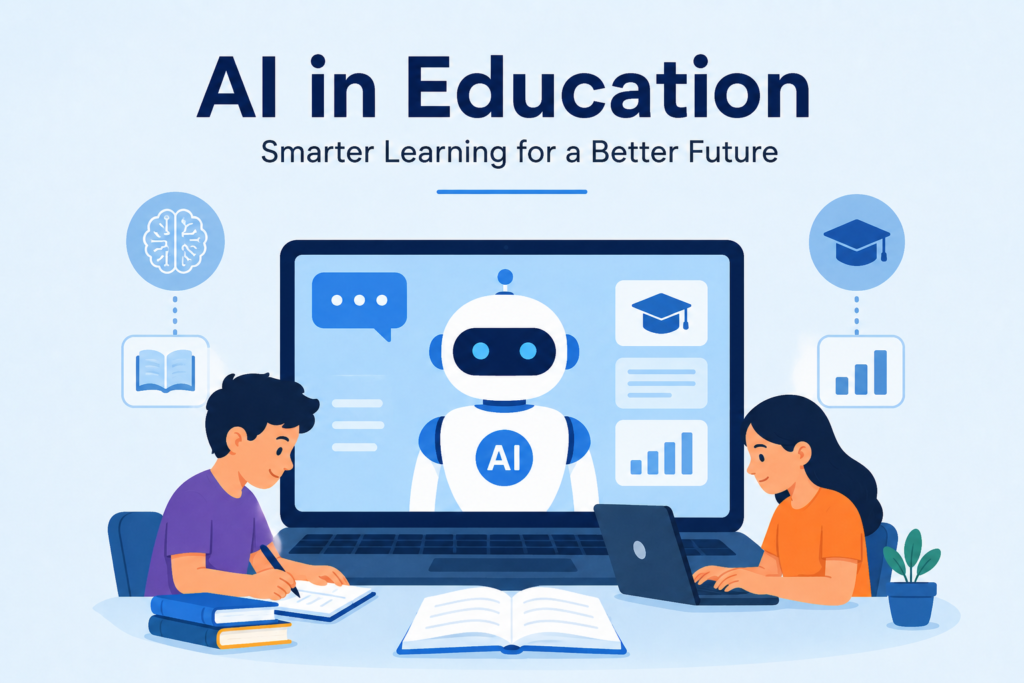
How Artificial Intelligence Is Transforming Education: Benefits, Challenges and the Future of Learning
Artificial Intelligence (AI) is rapidly changing the education sector. What once seemed like a technology limited to science fiction is now being used in classrooms, online learning platforms, universities, and educational administration.
From personalized learning and automated feedback to teacher support and student services, AI is creating new ways for students to learn and educators to work more efficiently.
However, the growing role of AI in education also raises important questions about privacy, accessibility, teacher training, and the importance of human interaction. The real challenge is not whether AI should be used in education, but how it can be implemented responsibly and effectively.
AI Is Making Learning More Personalized
One of the biggest advantages of artificial intelligence in education is its ability to support personalized learning.
Traditional classrooms often use the same lesson, pace, and assignments for an entire group of students. However, every learner is different. Some students understand a concept quickly, while others need additional explanations and practice.
AI-powered educational platforms can analyze student performance and identify areas where additional support may be needed.
For example, a student struggling with mathematics could receive additional practice questions focused on a specific topic, while a student who has already mastered the material could move toward more advanced exercises.
This approach allows adaptive learning technology to respond to individual needs instead of treating every student exactly the same.
AI Can Give Students Immediate Feedback
Feedback is an important part of learning.
Students often need to know what they did correctly, where they made mistakes, and how they can improve. Traditionally, providing detailed feedback to every student can take teachers considerable time.
AI can assist by providing immediate feedback on certain types of assignments and exercises.
This doesn’t mean that automated feedback should replace teachers. Instead, it can give students an additional opportunity to identify mistakes and practice independently.
Teachers can then spend more time working directly with students who require deeper explanation or personal guidance.
AI Can Reduce Teachers’ Administrative Work
Teachers do much more than stand in front of a classroom.
They prepare lessons, evaluate assignments, communicate with parents, organize materials, track student progress, and complete administrative tasks.
Some of these responsibilities can be supported by AI.
Educational AI tools can help teachers:
- Generate lesson ideas
- Create quizzes and practice exercises
- Organize teaching materials
- Summarize information
- Provide draft feedback
- Create differentiated learning activities
- Analyze classroom performance data
By reducing repetitive work, AI tools for teachers can give educators more time to focus on students.
The teacher remains essential because education involves much more than delivering information. Teachers provide encouragement, mentorship, emotional support, creativity, and judgment—qualities technology cannot simply reproduce.
AI Can Help Identify Students Who Need Support
Artificial intelligence can also help schools analyze large amounts of educational data.
For example, institutions may examine attendance, academic performance, assignment completion, and other indicators to identify students who could be experiencing academic difficulties.
This type of predictive analytics in education may allow schools to intervene earlier rather than waiting until a student has already fallen significantly behind.
However, predictive systems should be used carefully.
An algorithm’s prediction should not automatically become a final judgment about a student. Teachers and administrators need to consider the circumstances behind the data and make decisions with appropriate human oversight.
AI Is Changing University Administration
AI isn’t limited to classroom learning.
Universities and schools can also use artificial intelligence to improve administrative services.
AI-powered virtual assistants can answer routine questions about:
- Admissions
- Enrollment
- Courses
- Deadlines
- Financial aid
- Campus services
- Student support
This can make it easier for students to find information without waiting for staff members to respond to every basic question.
At the same time, administrative staff can focus their attention on more complicated cases that require human interaction.
AI Can Expand Access to Education
One of the most exciting possibilities is the potential for AI to make education more accessible.
Students can increasingly access educational content from anywhere with an internet connection.
AI-powered learning platforms can help learners practice skills outside traditional classroom hours, while translation and language technologies can make educational material easier to access for people who speak different languages.
Technology can also support students with disabilities through tools such as speech recognition, text-to-speech, automated captions, and other accessibility features.
This creates opportunities for inclusive education with AI, although access to the necessary technology remains a major challenge.
AI Can Support Language Learning
Language education is another area where AI can be particularly useful.
AI-powered language applications can provide exercises, vocabulary practice, pronunciation assistance, and conversational practice.
Students can practice repeatedly without feeling embarrassed about making mistakes in front of other people.
For language learners, this creates an additional opportunity to build confidence while receiving instant feedback.
AI can therefore complement traditional language instruction and give students more opportunities to practice outside the classroom.
AI Can Make Learning More Interactive
Education doesn’t have to be limited to textbooks and traditional lectures.
AI can help create interactive learning experiences based on simulations, virtual environments, educational games, and personalized activities.
Imagine a student learning history through an interactive virtual environment or studying science through a simulated experiment.
These technologies can make abstract concepts easier to understand by allowing students to explore them in more engaging ways.
When used appropriately, AI-powered educational technology can turn passive learning into a more active experience.
The Digital Divide Remains a Major Challenge
Despite its potential, AI cannot benefit every student equally if students don’t have equal access to technology.
Some schools have modern computers, fast internet connections, and trained staff. Others may lack basic digital infrastructure.
This creates a significant concern about the digital divide in education.
If advanced AI tools become a normal part of learning but only wealthy schools can provide access to them, technological progress could actually increase educational inequality.
Governments, educational institutions, and technology companies therefore need to consider affordability and infrastructure alongside innovation.
Student Privacy Is Another Major Concern
AI systems often require data to provide personalized experiences.
That can include information about student performance, learning behavior, preferences, and interactions.
This creates important questions about student data privacy and AI.
Schools and technology providers need strong policies explaining:
- What information is collected
- Why it is collected
- How long it is stored
- Who can access it
- How it is protected
- Whether it is shared with third parties
Students and parents should have appropriate information about how educational technology handles personal data.
Can AI Replace Teachers?
This is one of the biggest questions surrounding AI in education.
The short answer is that technology should not be viewed as a replacement for teachers.
AI can explain a concept, generate exercises, organize information, and provide certain types of feedback.
But education is fundamentally human.
Teachers understand classroom dynamics, recognize when a student is frustrated, encourage learners who have lost confidence, adapt explanations to individual students, and build relationships that influence motivation.
A chatbot can provide an answer.
A teacher can understand why a student needs that answer.
That difference matters.
Over-Reliance on AI Can Create Problems
Another concern is that students may begin using AI to complete their work instead of learning from it.
For example, if a student asks an AI tool to write every essay, solve every problem, and answer every homework question, the technology may save time—but the student may miss the opportunity to develop important skills.
This is why responsible AI use in education is so important.
Students should be encouraged to use AI as a learning assistant rather than a shortcut.
Instead of asking AI to simply provide an answer, students can ask it to:
- Explain a difficult concept
- Give practice questions
- Identify weaknesses in a draft
- Provide alternative examples
- Quiz them on a topic
- Help them understand a mistake
This approach keeps the student actively involved in the learning process.
Teachers Need AI Training
Introducing AI into schools isn’t simply a matter of purchasing software.
Teachers need training to understand how these technologies work, where they can be useful, and where they can create risks.
AI literacy for teachers should include understanding issues such as accuracy, bias, privacy, academic integrity, and appropriate classroom use.
Teachers also need practical guidance on incorporating AI without allowing technology to dominate the learning experience.
AI Can Help Build the Classroom of the Future
The future classroom may look very different from the traditional classroom.
Students may have access to personalized digital tutors, adaptive learning platforms, AI-assisted educational resources, interactive simulations, and instant feedback.
Teachers may use AI to reduce administrative workloads and better understand student progress.
Schools may use technology to improve communication and student services.
But the most successful model is unlikely to be one where AI takes control of education.
Instead, the future may involve teachers and AI working together.
AI can handle certain repetitive and data-intensive tasks.
Teachers can focus on the human side of education.
Students can benefit from both.
How Schools Can Use AI Responsibly
To make the most of artificial intelligence, schools should establish clear guidelines.
A responsible approach could include:
1. Protect Student Data
Use appropriate privacy and security measures when collecting and processing student information.
2. Train Educators
Give teachers practical training in AI tools and responsible implementation.
3. Maintain Human Oversight
Important decisions about students should not be based solely on automated predictions.
4. Promote AI Literacy
Students should learn how AI works, what its limitations are, and how to verify information.
5. Address Accessibility
Ensure that AI-powered education doesn’t become available only to students with greater financial resources.
6. Encourage Critical Thinking
Students should question AI-generated information instead of automatically accepting it.
The Future of AI in Education
Artificial intelligence is still developing, and its role in education will likely continue to expand.
The technology could eventually make learning more adaptive, accessible, interactive, and efficient.
But technological advancement alone doesn’t guarantee better education.
The real measure of success will be whether AI helps students understand more, think more deeply, become more independent, and develop skills that prepare them for the future.
Education should not become a competition between humans and machines.
Instead, AI should provide tools that allow teachers to teach more effectively and students to learn in ways that better suit their individual needs.
Conclusion
Artificial Intelligence is transforming education, from personalized learning and automated feedback to teacher assistance, student support, accessibility, and institutional management.
Its potential is enormous, but so are the responsibilities that come with it.
Schools must address concerns surrounding privacy, inequality, accuracy, academic integrity, and over-reliance on technology.
Most importantly, AI should complement—not replace—the human relationships at the heart of education.
The classroom of the future may be powered by artificial intelligence, but it should remain centered on human curiosity, creativity, critical thinking, and connection.
If educators, policymakers, technology developers, parents, and students work together, AI can become more than another technological trend. It can become a powerful tool for creating a more flexible, accessible, and effective education system.