AI and the Discipline of Human Flourishing
Introduction: Redefining Progress in the Age of Artificial Intelligence
As artificial intelligence continues to reshape industries, economies, and daily life, a critical question has emerged at the center of technological discourse: does AI genuinely serve human flourishing, or does it merely optimize for efficiency, engagement, and profit? In 2026, the conversation around responsible AI development has evolved beyond simple automation and productivity gains. It now demands a deeper, more disciplined inquiry into how intelligent systems can support human dignity, wellbeing, and purpose.
This emerging field — often referred to as human-centered AI — treats flourishing not as a byproduct of innovation, but as its central design principle. Understanding this shift is essential for technologists, policymakers, businesses, and everyday users navigating an increasingly AI-integrated world.
What Is Human Flourishing, and Why Does It Matter for AI?
Human flourishing, rooted in the Aristotelian concept of eudaimonia, refers to a state of holistic wellbeing that encompasses psychological health, meaningful relationships, purposeful work, autonomy, and personal growth. Unlike fleeting happiness or short-term satisfaction, flourishing is a long-term, multidimensional measure of what it means to live well.
When applied to AI ethics and wellbeing, this framework challenges developers to ask deeper questions:
- Does this AI system enhance human autonomy or diminish it?
- Does it foster genuine connection or encourage isolation?
- Does it cultivate skill and understanding or promote dependency?
- Does it respect user attention and time, or exploit it?
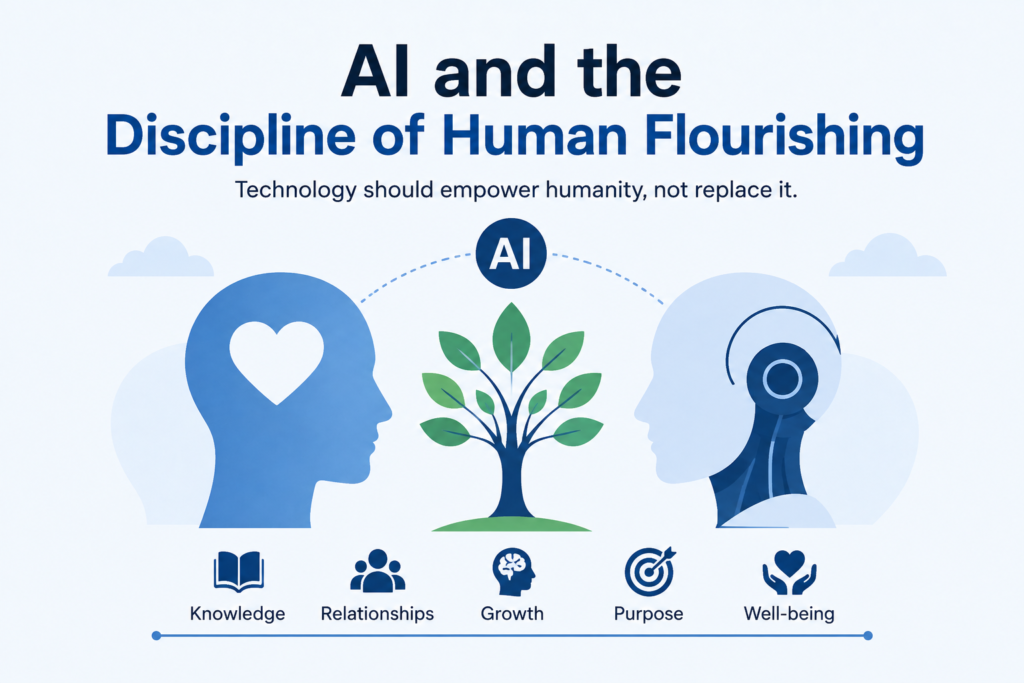
These questions form the foundation of what many researchers now call the discipline of human flourishing in AI design — a structured, values-driven approach to building technology that prioritizes long-term human wellbeing over short-term engagement metrics.
The Shift from Engagement-Driven to Wellbeing-Driven AI
For over a decade, digital products were largely built around engagement optimization — capturing attention, maximizing screen time, and driving usage metrics. This approach, while commercially successful, has been linked to rising concerns about digital burnout, social fragmentation, and diminished mental health.
Artificial intelligence for good represents a paradigm shift away from this model. Leading AI labs and ethicists are increasingly advocating for systems designed around:
- Intentional friction — encouraging thoughtful engagement rather than compulsive use
- Transparency — helping users understand how and why AI reaches its conclusions
- Augmentation over replacement — enhancing human capability rather than substituting it
- Long-term value — measuring success by user outcomes, not just usage duration
This transition reflects a broader recognition that ethical AI design must account for psychological and social externalities, not just technical performance.
Core Pillars of AI-Driven Human Flourishing
1. Psychological Wellbeing and Mental Health Support
AI-powered mental health tools, mood tracking applications, and conversational support systems are increasingly designed with safeguards that prioritize user safety over interaction volume. This includes crisis-detection protocols, healthy usage boundaries, and referrals to human professionals when appropriate — hallmarks of AI wellbeing technology done responsibly.
2. Meaningful Work and Economic Dignity
As automation reshapes the labor market, the discipline of flourishing demands that AI and the future of work be approached with intentionality. Rather than displacing workers without recourse, responsible implementation focuses on reskilling, augmenting human judgment, and preserving the dignity and purpose that meaningful work provides.
3. Authentic Human Connection
Social AI tools must be evaluated not just on their ability to simulate companionship, but on whether they strengthen or substitute for real human relationships. A flourishing-oriented approach encourages AI to function as a bridge to human connection — not a permanent replacement for it.
4. Autonomy and Informed Decision-Making
Flourishing requires agency. AI systems built on this discipline avoid manipulative design patterns (dark patterns) and instead empower users with clear information, honest recommendations, and respect for independent choice.
5. Equitable Access and Inclusion
True human flourishing cannot be selective. Ensuring AI ethics and wellbeing principles extend across socioeconomic, geographic, and demographic lines is essential to prevent a two-tiered society where only some benefit from AI-driven progress.
Why This Discipline Is Gaining Momentum in 2026
Several converging factors have accelerated interest in human flourishing as a formal AI design discipline:
- Regulatory pressure: Governments worldwide are introducing AI governance frameworks that emphasize user protection and psychological safety.
- Public trust concerns: Surveys consistently show that users want transparency and accountability from AI systems, not just capability.
- Enterprise accountability: Organizations are recognizing that sustainable AI adoption requires trust, and trust is built on demonstrable commitment to user wellbeing.
- Academic and research investment: Universities and think tanks are formalizing flourishing metrics, creating measurable frameworks that move beyond anecdotal claims of “ethical AI.”
This momentum signals that human-centered AI is no longer a niche philosophical stance — it is becoming a competitive and reputational necessity.
Practical Steps Toward Flourishing-Centered AI
For organizations and developers seeking to align with this discipline, several actionable principles stand out:
- Embed wellbeing metrics into product KPIs alongside traditional performance indicators
- Conduct psychological impact assessments before major AI feature launches
- Design for transparency, ensuring users understand AI-driven decisions that affect them
- Build in reflection points that discourage compulsive or unhealthy usage patterns
- Involve multidisciplinary teams, including psychologists, ethicists, and sociologists, in the design process
These steps mark a departure from purely technical development cycles toward a more holistic, human-first methodology.
The Future: AI as a Partner in Human Flourishing
Looking ahead, the most successful and trusted AI systems will likely be those that treat flourishing as a measurable, non-negotiable design outcome — not a marketing afterthought. As artificial intelligence becomes further embedded in healthcare, education, workplaces, and personal life, the organizations that lead with this discipline will shape not only better products, but a healthier digital society.
The path forward requires ongoing collaboration between technologists, ethicists, policymakers, and everyday users. Ultimately, the question is not simply what AI can do, but what it should do to help people live fuller, more meaningful lives.
Conclusion
The discipline of human flourishing offers a compelling framework for the next era of responsible AI development. By centering wellbeing, autonomy, connection, and dignity, this approach challenges the industry to move beyond metrics of engagement and toward metrics of genuine human benefit. As AI continues its rapid evolution, embedding flourishing as a core design principle may prove to be one of the most important shifts in how technology serves humanity.