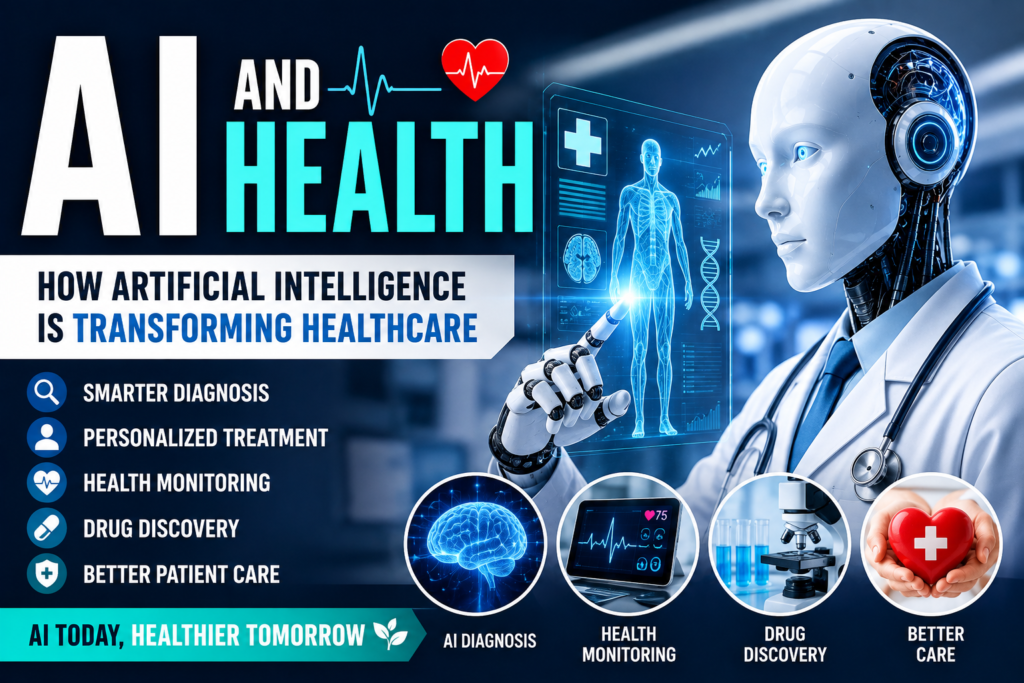
AI and Health: How Artificial Intelligence Is Transforming Healthcare
Artificial Intelligence (AI) is rapidly changing the healthcare industry. From medical research and health monitoring to disease detection and personalized treatment, AI in healthcare is helping doctors, researchers, hospitals, and patients access smarter digital solutions.
As AI technology continues to improve, the combination of artificial intelligence and healthcare could become one of the most important technological developments of the coming years.
What Is AI in Healthcare?
AI in healthcare refers to the use of artificial intelligence technologies to analyze medical information, identify patterns, support healthcare professionals, and improve healthcare processes.
AI systems can process large amounts of information much faster than traditional computer systems. This can help healthcare organizations analyze medical images, patient information, research data, and other complex datasets.
AI is designed to assist healthcare professionals rather than simply replace them. Human expertise, professional judgment, and appropriate medical supervision remain essential.
How Artificial Intelligence Is Changing Healthcare
AI is being explored and adopted across many areas of healthcare. Some of the most important applications include medical imaging, health monitoring, drug discovery, administrative automation, and personalized healthcare.
AI for Disease Detection
One of the most promising applications of AI is helping identify potential signs of disease.
Machine learning systems can analyze medical images and other health-related data to identify patterns that may require further examination by healthcare professionals.
This technology has the potential to support earlier detection and improve the efficiency of medical workflows.
AI-Powered Health Monitoring
Wearable devices and smart health technologies are generating increasing amounts of health-related data.
AI can analyze information such as activity patterns, heart-related measurements, sleep data, and other signals collected by compatible devices.
This can help users understand trends in their health and provide useful information that can be discussed with healthcare professionals.
AI and Personalized Healthcare
Every person is different, and healthcare is increasingly moving toward personalized approaches.
AI can analyze large datasets to identify patterns and potentially help healthcare professionals understand which factors may be relevant to an individual patient.
This area, often called personalized medicine, is becoming an important part of modern healthcare research.
AI in Medical Research
Artificial intelligence is also helping researchers process enormous amounts of scientific and medical information.
AI can assist with analyzing research data, identifying relationships between biological factors, and exploring potential treatments.
Another important area is AI drug discovery. Researchers are exploring AI models to help identify promising compounds and speed up parts of the drug development process.
AI Healthcare Chatbots and Virtual Assistants
AI-powered chatbots and virtual assistants are becoming increasingly common in digital healthcare services.
They can help users find general health information, navigate healthcare services, answer frequently asked questions, and provide administrative assistance.
However, AI-generated health information should not automatically be treated as a medical diagnosis. Professional medical advice is important when someone has symptoms or concerns about their health.
Benefits of AI in Healthcare
The growing use of healthcare AI could provide several benefits:
- Faster analysis of large datasets
- More efficient healthcare workflows
- Support for medical research
- Improved patient engagement
- Personalized healthcare solutions
- Automation of repetitive administrative tasks
- Better organization of healthcare information
- Support for medical professionals
The exact benefits depend on how the technology is designed, tested, and implemented.
Challenges of Artificial Intelligence in Healthcare
Despite its potential, AI in healthcare also comes with significant challenges.
Patient privacy and data security are extremely important because healthcare systems handle sensitive information. AI systems must also be carefully tested to reduce errors and unintended bias.
Another major concern is transparency. Healthcare professionals and patients need to understand the limitations of AI systems and when human expertise should take priority.
Responsible development, strong security, testing, and appropriate human oversight are therefore essential.
The Future of AI and Health
The future of AI health technology is expected to continue developing rapidly.
AI could become increasingly integrated into medical research, digital health platforms, hospitals, wearable technology, and healthcare management.
As computing power and AI models improve, healthcare professionals may gain access to increasingly sophisticated tools for analyzing information and supporting decision-making.
The most successful future for AI in healthcare will likely be one where artificial intelligence works alongside healthcare professionals rather than operating without human oversight.
Conclusion
Artificial Intelligence and healthcare are becoming closely connected as technology continues to evolve. From medical research and disease detection to health monitoring and healthcare automation, AI has the potential to transform many parts of the healthcare industry.
However, technology alone cannot replace professional medical judgment. The responsible use of AI in healthcare requires privacy protection, careful testing, transparency, and human oversight.
As AI technology continues to advance, its role in healthcare is likely to become even more important, creating new possibilities for smarter, faster, and more personalized healthcare solutions.