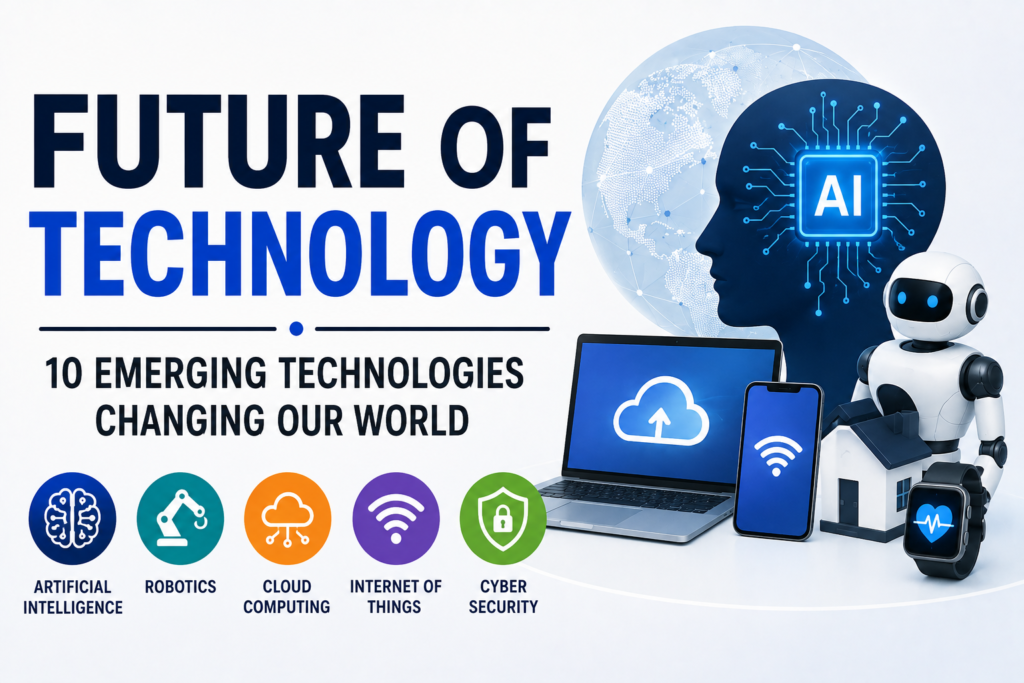
Future of Technology: 10 Emerging Technologies Changing Our World
Technology has become an essential part of modern life. From smartphones and online banking to artificial intelligence and smart devices, technology continues to change how people work, communicate, learn and solve everyday problems.
The Future of Technology is expected to bring even greater changes as artificial intelligence, robotics, connected devices, cloud computing and other technologies continue to develop.
These innovations are not only changing businesses. They are also influencing education, healthcare, transportation, entertainment and everyday life.
1. Artificial Intelligence
Artificial intelligence is one of the most important areas of modern technology.
AI systems can analyze information, recognize patterns, generate content, automate tasks and assist people with complex problems.
Businesses are increasingly exploring AI for customer service, data analysis, marketing, software development and other activities.
As AI continues to improve, it is likely to become even more integrated into everyday digital services.
2. Robotics
Robotics combines software, sensors, machines and artificial intelligence to create systems capable of performing physical tasks.
Robots are already used in manufacturing, warehouses, healthcare and research.
Future robots could become more capable of working alongside humans and performing tasks that are dangerous, repetitive or highly precise.
3. Internet of Things
The Internet of Things, commonly known as IoT, connects physical devices to the internet so they can collect and exchange information.
Smart watches, home security systems, connected appliances and industrial sensors are examples of IoT technology.
The growth of connected devices could make homes, factories and cities increasingly intelligent.
4. Cloud Computing
Cloud computing allows people and organizations to access computing resources and data through internet-based services.
Instead of maintaining all infrastructure locally, businesses can use cloud platforms for storage, software, databases and computing power.
Cloud technology has already transformed the way companies build and operate digital services and will remain an important part of the Future of Technology.
5. Cybersecurity
As more information moves online, protecting digital systems becomes increasingly important.
Cybersecurity technologies are designed to protect computers, networks, applications and data from unauthorized access and other threats.
Artificial intelligence is also being explored for identifying unusual activity and improving security monitoring.
As digital services expand, cybersecurity will become an even more important technology field.
6. Biotechnology
Technology is also transforming biology and medicine.
Modern biotechnology combines biological science with advanced computing, laboratory techniques and data analysis.
Researchers are exploring technologies that could improve medical research, diagnostics, drug development and personalized healthcare.
The combination of computing and biology could become one of the most important areas of technological innovation.
7. Virtual and Augmented Reality
Virtual reality creates immersive digital environments, while augmented reality adds digital information to the real world.
These technologies can be used in gaming, education, training, design and entertainment.
As hardware becomes more advanced, VR and AR experiences could become more realistic and accessible.
8. Electric and Autonomous Vehicles
Transportation is also experiencing major technological changes.
Electric vehicles are becoming increasingly important as manufacturers develop new battery technologies and charging systems.
At the same time, researchers and companies are working on autonomous driving technologies that can assist vehicles with navigation and decision-making.
The combination of electric transportation, automation and connected infrastructure could significantly influence future mobility.
9. Quantum Computing
Quantum computing is a developing field that uses principles of quantum mechanics to process information in fundamentally different ways from conventional computers.
Although practical quantum computing is still developing, researchers are investigating potential applications in areas such as optimization, materials science, chemistry and cryptography.
It could eventually solve certain types of problems that are extremely difficult for traditional computers.
10. Advanced Connectivity
Faster and more reliable communication networks are another important part of the Future of Technology.
Advanced wireless networks can support connected devices, remote services, smart infrastructure and real-time applications.
Better connectivity could make it easier for people and machines to exchange information from almost anywhere.
Technology and the Workplace
Technology is changing the workplace rapidly.
AI tools can automate repetitive tasks, cloud platforms enable remote collaboration and digital systems allow businesses to analyze enormous amounts of information.
Some jobs will change as automation increases, while new roles may emerge around AI, cybersecurity, robotics, data and other technologies.
Learning new digital skills could therefore become increasingly valuable.
Technology in Healthcare
Healthcare is another area where technology can have a major impact.
Digital health platforms, wearable devices, medical imaging, robotics and AI-assisted systems are being developed to support healthcare professionals and patients.
Technology can help collect and analyze information, but medical decisions still require appropriate professional judgment.
Technology and Education
Education is also becoming increasingly digital.
Students can access online courses, digital libraries, interactive learning platforms and AI-powered educational tools.
Technology can make educational resources more accessible, although teachers and human interaction remain important parts of effective education.
Challenges of New Technology
Technological progress also creates challenges.
Privacy, cybersecurity, misinformation, job displacement, digital inequality and responsible use of AI are important issues that society must address.
Developing new technology is only one part of the process. Governments, businesses and communities also need appropriate policies and safeguards.
What Will the Future Look Like?
The Future of Technology will probably not be defined by one single invention.
Instead, different technologies will increasingly work together.
AI could interact with robotics. IoT devices could connect to cloud platforms. Advanced networks could allow these systems to communicate in real time.
This combination could create new products, services and ways of working that are difficult to imagine today.
Final Thoughts
The Future of Technology is likely to bring major changes across almost every part of society.
Artificial intelligence, robotics, IoT, cloud computing, cybersecurity, biotechnology, quantum computing and advanced connectivity are just some of the technologies shaping the next generation of digital innovation.
The biggest opportunity will not simply be having access to new technology. It will be learning how to use these technologies responsibly and effectively.
As technology continues to evolve, people and businesses that adapt, learn new skills and understand emerging trends may be better prepared for the digital future.