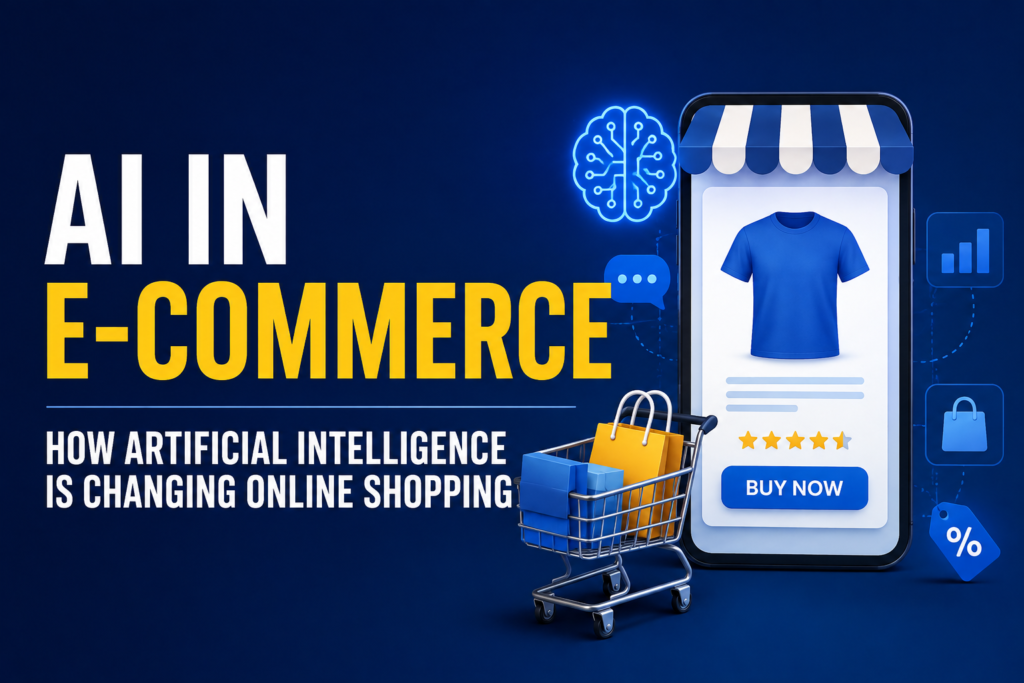
AI in E-commerce: How Artificial Intelligence Is Changing Online Shopping
Online shopping has changed dramatically over the last decade. Customers can now discover products, compare prices, read reviews and complete purchases without visiting a physical store.
Artificial intelligence is taking this transformation even further.
AI in E-commerce is helping online businesses understand customers, automate repetitive tasks and create more personalized shopping experiences.
From product recommendations to customer support and fraud detection, AI is becoming an important technology for modern online stores.
What Is AI in E-commerce?
AI in E-commerce refers to the use of artificial intelligence technologies in online retail and shopping platforms.
AI systems can analyze large amounts of information and identify patterns that may be difficult to detect manually.
E-commerce companies can use AI for:
- Product recommendations
- Customer support
- Marketing
- Fraud detection
- Inventory management
- Search optimization
- Content creation
- Sales analysis
These applications can help businesses operate more efficiently while improving the customer experience.
1. Personalized Product Recommendations
One of the most visible uses of AI is product recommendations.
For example, if a customer frequently views running shoes, an AI-powered system may recommend related sports products.
Personalization can make product discovery easier for shoppers.
2. AI Customer Support
Customers often have similar questions about products, delivery, returns and payments.
AI-powered chatbots can answer many common questions automatically.
This allows customers to receive assistance without waiting for a human representative.
More complicated issues can still be transferred to a human support agent.
3. AI-Powered Search
Finding the right product quickly is extremely important for online stores.
Traditional search systems may depend heavily on exact keywords.
AI-powered search can understand the meaning behind a customer’s query and potentially provide more relevant results.
For example, a shopper could search for “comfortable shoes for walking” rather than entering a specific product name.
4. AI for Marketing
Marketing is another important application of AI in E-commerce.
AI tools can help businesses analyze customers and create marketing campaigns.
They can assist with:
- Email campaigns
- Social media content
- Advertising copy
- Customer segmentation
- Product promotions
- Marketing analysis
This can help online stores produce marketing content more efficiently.
5. AI Product Descriptions
Large online stores may have hundreds or thousands of products.
Writing descriptions for every product manually can take a considerable amount of time.
AI can help generate product descriptions based on information such as product features, specifications and target customers.
6. Fraud Detection
Online businesses need to protect themselves and their customers from fraudulent transactions.
AI systems can analyze transaction patterns and identify activity that appears unusual.
For example, a transaction that differs significantly from a customer’s normal purchasing behavior could be flagged for additional review.
AI does not eliminate fraud, but it can help businesses identify potentially suspicious activity more efficiently.
7. Inventory Management
Managing inventory is one of the biggest challenges for online retailers.
Too much inventory can increase storage costs, while too little inventory can lead to lost sales.
AI can analyze historical sales, customer demand and other information to help businesses make better inventory decisions.
More advanced systems can also help predict potential changes in demand.
8. AI and Pricing
Some e-commerce businesses use technology to analyze market conditions, competitor prices and customer demand.
AI can help businesses understand pricing patterns and identify opportunities for adjustments.
However, pricing decisions should also consider costs, profit margins, brand positioning and customer expectations.
9. AI for Small Online Stores
AI is not only useful for large e-commerce companies.
Small online businesses can also use AI tools for everyday activities such as:
- Writing product descriptions
- Creating social media posts
- Answering customer questions
- Analyzing sales
- Generating marketing ideas
- Organizing product information
This can allow small teams to accomplish more without hiring additional employees for every task.
10. AI Can Improve the Shopping Experience
The ultimate goal of AI in E-commerce is not simply automation.
A good AI system can make online shopping more convenient.
Customers may receive better search results, relevant recommendations, faster support and more personalized experiences.
When implemented correctly, AI can benefit both shoppers and businesses.
Challenges of AI in E-commerce
Despite its advantages, AI also creates challenges.
Privacy
AI systems may process customer information, making privacy and data protection important considerations.
Accuracy
AI-generated product information can sometimes contain errors.
Cost
Advanced AI solutions can require investment in software and infrastructure.
Human Support
Some customers still prefer speaking directly with a human, especially when dealing with complicated problems.
Over-Personalization
Too much personalization can sometimes make customers uncomfortable if they feel that a business is tracking too much of their behavior.
The Future of AI in E-commerce
The future of AI in E-commerce is likely to involve increasingly intelligent shopping experiences.
AI systems may become better at understanding natural-language searches, predicting customer needs and assisting shoppers throughout the buying process.
AI agents could also perform more complex shopping tasks, such as comparing products, organizing options and assisting customers before they make a purchase.
At the same time, businesses will need to focus on transparency, privacy and responsible use of customer data.
Final Thoughts
AI in E-commerce is changing how online stores operate and how customers shop.
For businesses, the biggest opportunity is not simply using AI because it is popular. The real value comes from identifying specific problems and using AI to solve them efficiently.
As the technology continues to develop, AI in E-commerce is likely to become an increasingly important part of the future of online shopping.