Robotics Technology: How Robots Are Changing the Future
Robots were once mostly associated with science-fiction movies and futuristic stories. Today, robotics has become a real and rapidly developing technology used in factories, hospitals, warehouses, laboratories and even homes.
Robotics Technology combines mechanical engineering, electronics, sensors, software and artificial intelligence to create machines capable of performing physical tasks.
As AI becomes more advanced, robots are also becoming better at understanding their surroundings, making decisions and interacting with humans.
What Is Robotics Technology?
Robotics Technology is the field of designing, building and programming robots to perform specific tasks.
A modern robot may contain:
- Cameras
- Sensors
- Motors
- Processors
- Artificial intelligence
- Computer vision
- Navigation systems
- Robotic arms
- Communication systems
These components work together to allow robots to interact with the physical world.
How Do Robots Work?
A robot generally follows a cycle:
Sense → Process → Decide → Act
For example, a warehouse robot can detect an object, determine its location and move toward it.
Robotics and Artificial Intelligence
Artificial intelligence is becoming increasingly important in robotics.
Traditional robots usually follow predefined instructions.
AI-powered robots can potentially handle more complex environments because they can use machine learning, computer vision and other AI techniques to interpret information.
This combination of AI and robotics is helping create more adaptable machines.
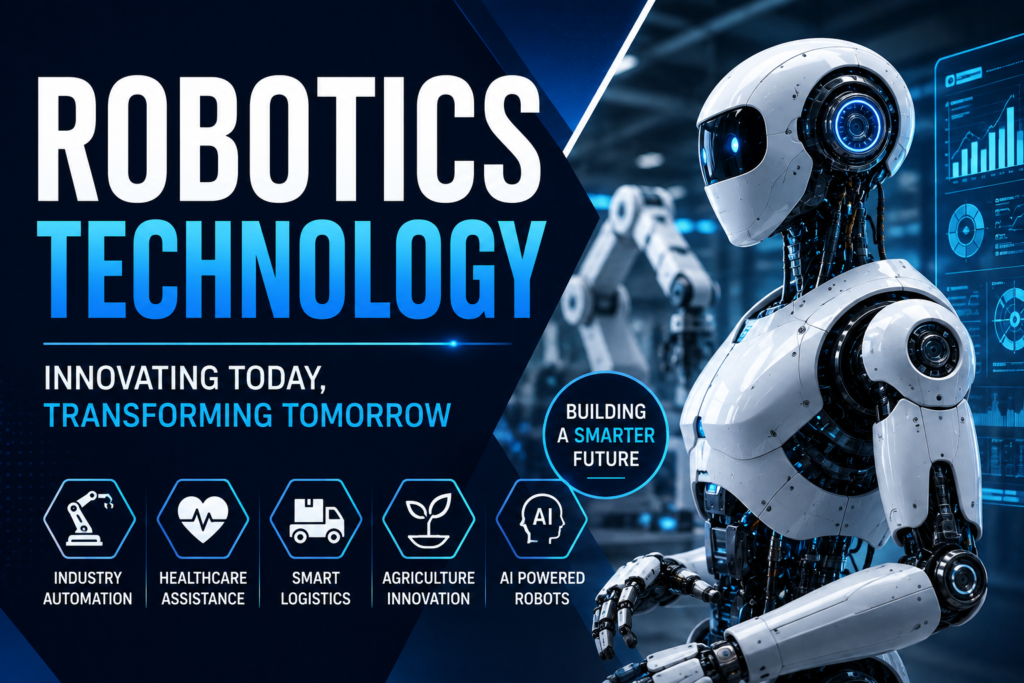
Robots in Manufacturing
Manufacturing is one of the largest applications of robotics.
Factories use robots for tasks such as:
- Welding
- Painting
- Assembly
- Packaging
- Quality inspection
- Material handling
Robots can perform repetitive tasks consistently and can operate in environments that may be dangerous for humans.
Robots in Healthcare
Healthcare is another important area of robotics research.
Robotic systems can assist with:
- Surgical procedures
- Rehabilitation
- Patient assistance
- Medical training
- Laboratory automation
- Hospital logistics
Medical robots are generally designed to assist healthcare professionals rather than completely replace them.
Robots in Agriculture
Agriculture is also becoming more automated.
Robots can potentially help farmers with:
- Crop monitoring
- Weed detection
- Harvesting
- Planting
- Soil analysis
- Fruit picking
Combining robotics with sensors and AI could help farmers monitor crops more precisely.
Robots in Warehouses
Large warehouses increasingly use automated machines to move products.
Warehouse robots can transport items, organize inventory and assist workers in fulfilling orders.
This can make logistics operations faster and reduce the amount of repetitive physical work required from employees.
Humanoid Robots
One of the most interesting areas of modern robotics is the development of humanoid robots.
Humanoid robots are designed with human-like characteristics such as:
- Two arms
- Two legs
- A head
- Cameras or other sensors
- Human-like movement
Researchers are exploring whether these robots could eventually work in environments designed for humans.
Robots in Homes
Robots are already entering everyday households.
Examples include:
- Robot vacuum cleaners
- Robotic lawn mowers
- Smart home devices
- Educational robots
- Security robots
Future household robots may become capable of performing more complex tasks.
Autonomous Robots
Autonomous robots can perform tasks with limited direct human control.
They use sensors, software and navigation systems to understand their environment and determine how to move.
Autonomy is particularly important for robots operating in warehouses, factories, farms and outdoor environments.
Benefits of Robotics Technology
Robotics can provide several potential benefits.
Increased Productivity
Robots can perform repetitive tasks continuously and consistently.
Improved Safety
Robots can be used in environments that are dangerous for humans.
Greater Precision
Machines can perform certain repetitive operations with high consistency.
Reduced Repetitive Work
24/7 Operation
Some automated systems can operate continuously with appropriate maintenance and supervision.
Challenges Facing Robotics
Robotics also has significant challenges.
High Development Costs
Advanced robotic systems can require expensive hardware, software and maintenance.
Complex Environments
Robots can struggle with unpredictable environments that humans can handle naturally.
Safety
Robots working around people must be designed with appropriate safety systems.
Employment Concerns
Automation can change the types of jobs available and may require workers to develop new skills.
The Future of Robotics
The future of Robotics Technology is closely connected with developments in artificial intelligence.
As AI models become better at understanding images, language and environments, robots could become more capable of handling complex physical tasks.
Future robots may work alongside humans in factories, hospitals, warehouses, offices and homes.
The goal isn’t necessarily to create machines that replace every human activity. Instead, robotics may increasingly be used to combine human creativity and decision-making with machine precision and physical capabilities.
Robotics and the Workplace
The workplace of the future could involve humans and robots working together.
Humans may focus on:
- Creativity
- Leadership
- Communication
- Complex decisions
- Strategy
Robots could handle:
- Repetitive operations
- Heavy lifting
- Transportation
- Inspection
- Dangerous tasks
This type of collaboration could become increasingly common as robotics improves.
Final Thoughts
Robotics Technology is changing from simple programmable machines into increasingly intelligent and adaptable systems.
The combination of robotics, artificial intelligence, computer vision and advanced sensors could create machines capable of performing tasks that were previously difficult to automate.
From factories and hospitals to farms and homes, robots are becoming an increasingly important part of modern technology.