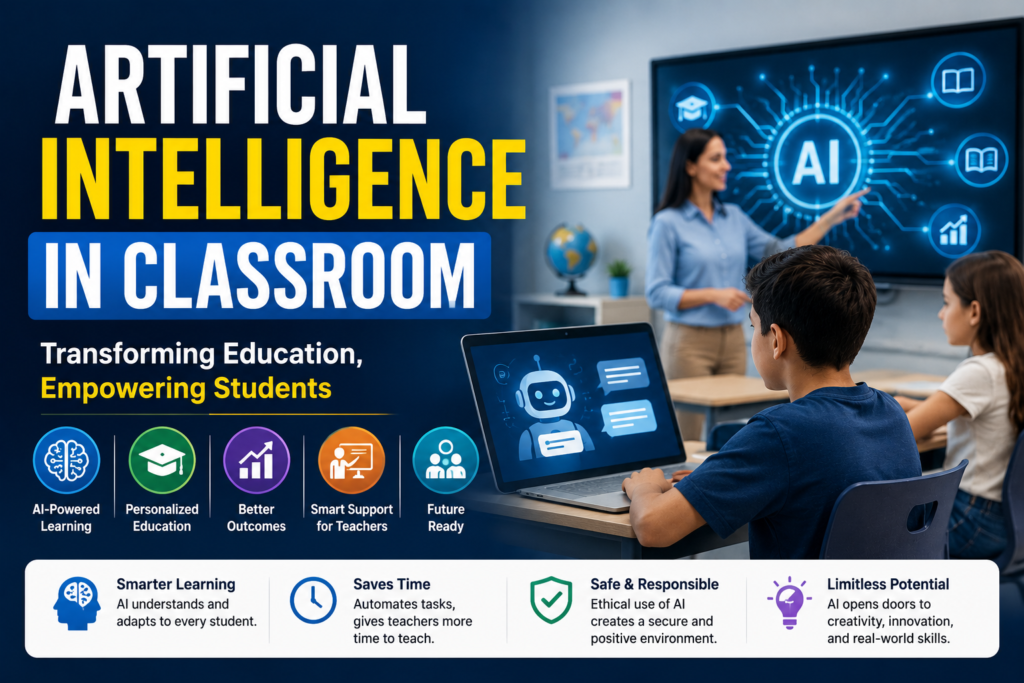
Artificial Intelligence in Classroom: The Future of Learning Has Already Arrived
Imagine a classroom where every student can receive personalized explanations, teachers can create lesson plans in minutes, and difficult concepts can be explained in multiple ways instantly.
This is no longer science fiction.
Artificial intelligence is rapidly becoming part of modern education, changing how students study, how teachers prepare lessons, and how schools think about learning.
But the real question is not whether AI belongs in education.
The real question is:
How can we use AI without losing the human side of education?
This article explores how artificial intelligence in classroom environments can transform learning, the benefits it offers, the risks schools must consider, and what the classroom of tomorrow could look like.
What Is Artificial Intelligence in Classroom?
Artificial intelligence in classroom refers to the use of AI-powered software and systems to support teachers and students during the educational process.
Instead of replacing teachers, AI can work as an additional educational assistant.
Students can use AI to:
- Understand difficult subjects
- Practice questions
- Improve writing
- Learn languages
- Generate study questions
- Receive explanations
- Summarize educational material
- Practice conversations
Teachers can use it to:
- Prepare lesson plans
- Create quizzes
- Generate exercises
- Develop classroom activities
- Create different difficulty levels
- Organize educational material
- Provide initial feedback
The important point is that AI should support education rather than replace education.
Why AI Could Change Education Forever
For hundreds of years, education has largely followed the same model:
Teacher → Classroom → Textbook → Homework → Examination
AI introduces another possibility:
Teacher + AI + Student → Personalized Learning
Every student doesn’t learn at the same speed.
One student might understand a mathematical concept immediately.
Another might need five different explanations.
A third student might understand it through a real-world example.
AI can potentially provide these different explanations instantly.
That’s one of the most powerful opportunities created by artificial intelligence in classroom environments.
Personalized Learning for Every Student
Imagine a teacher has 30 students.
It’s extremely difficult to provide completely personalized instruction to all 30 students at the exact same time.
AI can help provide additional support.
For example, a student could say:
“I don’t understand this. Explain it like I’m a beginner.”
The AI could provide a simpler explanation.
The student could then ask:
“Give me an example.”
Then:
“Give me five practice questions.”
This creates a learning conversation rather than simply providing a textbook definition.
The teacher remains responsible for the student’s education, but AI can provide additional practice between teacher interactions.
AI Could Become a 24/7 Study Assistant
One major limitation of traditional education is time.
A teacher can’t realistically be available to answer every question at midnight.
AI systems can potentially provide learning assistance whenever students need it.
A student studying at home could ask:
“Explain photosynthesis.”
Then:
“Give me a simple example.”
Then:
“Quiz me.”
Then:
“Explain the questions I got wrong.”
This type of interactive learning could make studying much more engaging.
However, students should still verify important information and use trusted educational resources.
AI can make mistakes.
Artificial Intelligence in Classroom Can Help Teachers Save Time
Teachers don’t only teach.
They also spend significant time preparing educational materials.
AI can help accelerate some repetitive tasks.
For example, a teacher could ask AI to create:
A Mathematics Quiz
“Create 10 Grade 8 algebra questions with answers.”
A Science Activity
“Create a classroom experiment about renewable energy.”
An English Exercise
“Create a grammar exercise focused on past tense.”
A Discussion
“Create five classroom discussion questions about climate change.”
The teacher can then review and modify the material.
AI doesn’t have to make the final decision.
It simply helps the teacher get started faster.
AI Can Create Different Difficulty Levels
One of the most interesting possibilities is adapting educational content.
Suppose a class is learning the same science topic.
A teacher could create:
Basic version: Simple explanations and vocabulary.
Intermediate version: Standard classroom exercises.
Advanced version: Complex questions requiring analysis.
This allows students to practice at a level appropriate to their current understanding.
That doesn’t mean students should be permanently placed into fixed categories.
Instead, AI can help teachers provide flexible learning material.
AI Can Transform Language Learning
Language education is another area where AI can be extremely useful.
Students can practice conversations without needing another person available.
For example:
Student: “I want to practice English for a job interview.”
AI can become the interviewer.
It can ask questions such as:
“Tell me about yourself.”
The student responds.
The AI can then provide feedback on grammar, vocabulary, and communication.
This can give students additional opportunities to practice outside school.
AI Can Make Learning More Interactive
A textbook gives you information.
AI can potentially have a conversation about that information.
That’s a significant difference.
Imagine studying history.
Instead of simply reading about a historical event, students could ask questions about different perspectives, causes, consequences, and possible interpretations.
A science student could ask AI to explain the same concept at beginner, intermediate, and advanced levels.
A mathematics student could ask for hints instead of the final answer.
This creates a more interactive learning environment.
The Biggest Danger: AI Can Make Students Lazy
This is where educators need to be careful.
AI can solve problems.
It can write essays.
It can summarize books.
It can generate answers.
And that’s exactly why it can become dangerous when used incorrectly.
If a student asks AI to complete every assignment, the student may receive a good grade while learning very little.
Education isn’t about collecting answers.
It’s about developing:
- Critical thinking
- Problem-solving
- Communication
- Creativity
- Research skills
- Independent thinking
The best use of AI is therefore:
“Help me understand.”
Not:
“Do my homework for me.”
AI and Academic Integrity
Schools also face a difficult challenge: AI-generated assignments.
A student could potentially submit AI-written work as their own.
Instead of relying entirely on AI detection, schools can rethink assignments.
Teachers can ask students to:
- Explain their answers
- Present projects
- Show their working
- Discuss sources
- Complete classroom activities
- Critically evaluate AI responses
- Write personal reflections
This makes genuine understanding much more important than simply submitting a document.
AI Can Also Be Wrong
This is a lesson every student needs to learn.
AI sounds confident—even when its information is incorrect.
A student should never assume:
“AI said it, therefore it must be true.”
Instead:
AI answer → Verify → Compare sources → Think critically
Teachers can actually use AI mistakes as educational exercises.
For example, a teacher could provide students with an AI-generated explanation and ask:
“Find three mistakes in this answer.”
Now AI becomes part of the lesson.
Students aren’t simply consuming information.
They’re learning how to evaluate it.
Privacy Must Be Taken Seriously
Schools also need to think about student privacy.
Before introducing an AI platform, schools should understand what happens to information entered into the system.
Important questions include:
- What student information is collected?
- Where is it stored?
- Who can access it?
- Is the information used to train systems?
- How long is it retained?
- What security protections exist?
Technology should never be introduced into classrooms without considering student safety and privacy.
AI Should Not Replace Teachers
This is perhaps the most important point.
A teacher is much more than a source of information.
A good teacher can recognize when:
- A student is confused
- Someone has lost motivation
- A student needs encouragement
- A classroom needs a different approach
- Students are struggling emotionally
- A lesson isn’t working
AI can generate information.
It doesn’t replace the human relationship between teacher and student.
The future shouldn’t be:
AI vs Teachers
It should be:
Teachers using AI to become more effective.
Artificial Intelligence in Classroom and Accessibility
AI could also make education more accessible.
Students with different learning requirements may benefit from technologies such as:
- Text-to-speech
- Speech-to-text
- Translation
- Simplified explanations
- Personalized practice
- Voice-based interaction
A student who struggles to read a long passage might use text-to-speech.
A student learning a new language might use translation assistance.
A student who struggles with writing might use AI to identify areas for improvement.
Used responsibly, these technologies can create additional opportunities for students.
What Will the Classroom of the Future Look Like?
The classroom of the future may look surprisingly familiar.
There will still be:
Teachers
Students
Books
Discussions
Experiments
Projects
Examinations
But technology may become a much larger part of the learning process.
Students could have AI learning assistants.
Teachers could have AI planning assistants.
Schools could use adaptive learning systems.
Educational content could become more personalized.
And students may learn not only traditional subjects, but also how to work with AI responsibly.
Students Need AI Literacy
Knowing how to use AI will likely become an important skill.
But AI literacy doesn’t simply mean knowing how to write prompts.
Students should understand:
- What AI can do
- What AI cannot do
- Why AI makes mistakes
- How to verify AI information
- How to protect privacy
- When AI use is appropriate
- How to use AI ethically
The future workforce will increasingly involve AI tools.
Teaching students how to use them responsibly can therefore become an important part of modern education.
How Schools Can Use AI Responsibly
Schools should not simply give students AI tools and say:
“Figure it out.”
A better approach includes clear policies.
1. Create AI Guidelines
Students should know when AI is permitted.
2. Train Teachers
Teachers need practical training on using AI effectively.
3. Teach Verification
Students should learn to check AI-generated information.
4. Protect Privacy
Schools should carefully evaluate AI platforms before using them.
5. Encourage Independent Thinking
Assignments should still require students to demonstrate their own understanding.
6. Keep Teachers in Control
AI should assist educational decisions rather than blindly making them.
The Business Opportunity Behind AI Education
The growth of educational AI is also creating opportunities for developers, teachers, entrepreneurs, and technology companies.
There is increasing demand for:
- AI tutoring platforms
- Educational chatbots
- AI lesson planners
- Personalized learning systems
- AI assessment tools
- Language-learning assistants
- AI educational content
- Teacher productivity tools
The education industry is enormous.
AI is opening the door to a new generation of educational products and services.
Is AI Good or Bad for Education?
The answer depends entirely on how it’s used.
AI can be harmful when:
- Students use it to cheat
- Teachers rely on it without checking information
- Schools ignore privacy
- Students stop thinking independently
- AI replaces meaningful human interaction
AI can be beneficial when:
- Teachers use it as an assistant
- Students use it for understanding
- Information is verified
- Schools establish clear policies
- Human judgment remains central
- AI improves accessibility
That’s why the debate shouldn’t simply be:
“Should schools ban AI?”
A better question is:
“How can schools teach students to use AI intelligently?”
The Real Future of Education
The most successful schools may not be the ones that use the most technology.
They may be the ones that combine technology with excellent teaching.
Imagine a teacher who uses AI to prepare tomorrow’s lesson in minutes.
Then spends the saved time talking with students.
Imagine a student who uses AI to understand a difficult topic.
Then closes the AI tool and solves the next problem independently.
Imagine a classroom where technology handles repetitive tasks while humans focus on creativity, communication, curiosity, and critical thinking.
That’s the future worth building.
Final Verdict
Artificial intelligence in classroom environments has enormous potential.
It can personalize learning, support teachers, improve accessibility, make lessons more interactive, and give students additional opportunities to practice.
But it also creates serious risks.
Students can become dependent on AI.
Assignments can lose their educational value.
Incorrect information can spread.
Privacy can be compromised.
And schools can accidentally prioritize technology over human connection.
The solution isn’t to ignore AI.
The solution is to teach students how to use it responsibly.
Conclusion
Education has always evolved with technology.
The blackboard changed classrooms.
The textbook changed how knowledge was distributed.
The internet changed research.
Now AI is changing how people interact with information itself.
Artificial intelligence in classroom environments could become one of the biggest transformations in education in decades—but its success will depend on the people using it.
Teachers should remain teachers.
Students should remain thinkers.
AI should remain a powerful assistant.
When those three work together, education can become more personalized, accessible, interactive, and efficient without losing the human connection that makes learning meaningful.
The future isn’t about replacing the classroom with AI.
It’s about building a smarter classroom with AI.