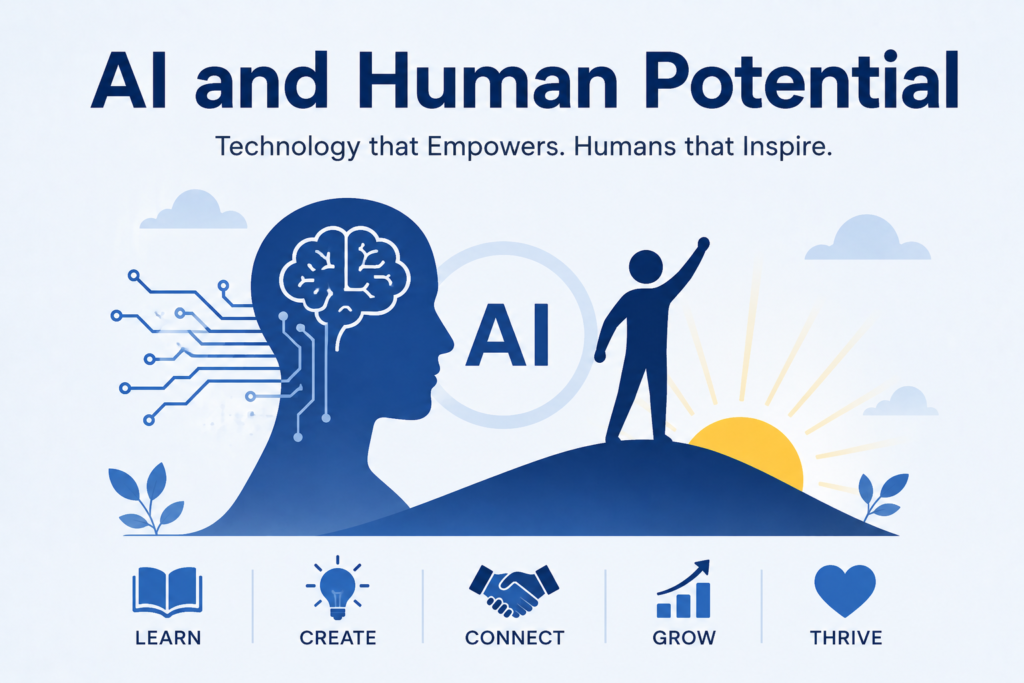
Artificial Intelligence and Human Potential: Can AI Help Us Live Better Lives?
Artificial intelligence is no longer a distant idea reserved for science fiction. AI technology has become part of everyday life, influencing education, healthcare, business, communication, creativity, and the way people access information.
Generative AI tools can write, summarize, translate, analyze, brainstorm, and answer questions within seconds. These capabilities offer enormous opportunities for individuals and organizations.
But technological progress raises a deeper question:
What should AI ultimately be designed to achieve?
If the only goal is greater speed and productivity, we may overlook something far more important: human flourishing.
A truly successful AI future should not simply create smarter machines. It should help people become more capable, creative, connected, knowledgeable, and fulfilled.
What Is Human Flourishing?
Human flourishing is the idea that a good life involves more than material success.
People flourish when they have opportunities to:
- Develop knowledge and skills
- Build meaningful relationships
- Exercise creativity
- Make responsible choices
- Develop character
- Contribute to society
- Pursue meaningful goals
- Maintain personal wellbeing
This perspective changes how we think about AI and humanity.
Instead of asking only what AI can accomplish, we should also ask whether a particular use of AI contributes positively to human development.
AI Can Expand Human Potential
One of the strongest arguments for AI for human good is its ability to expand what individuals can accomplish.
A student can use AI to understand a difficult subject. A small business owner can use it to analyze information and develop marketing ideas. A researcher can use AI to explore large datasets. A writer can use it to brainstorm ideas and improve a draft.
In each case, AI can act as an amplifier of human ability.
The important distinction is between assistance and replacement.
When AI helps someone understand something, it can increase their capability.
When AI simply performs every task for them, it may reduce the opportunity to develop that capability themselves.
The Importance of Human Agency
Human agency and AI are closely connected.
Human agency means having the ability to make decisions, exercise judgment, and take responsibility for one’s actions.
As AI becomes more capable, people may increasingly rely on automated recommendations.
An AI system might recommend what to buy, what to read, how to study, which candidate to consider, or how to approach a particular problem.
Recommendations can be useful, but people should still have the ability to question them.
A healthy relationship with technology should therefore look like this:
AI provides possibilities. Humans provide judgment.
AI Should Strengthen Critical Thinking
One of the most valuable human skills in the age of artificial intelligence is critical thinking.
AI can produce answers quickly, but speed doesn’t guarantee accuracy.
People need to evaluate information rather than automatically accepting whatever an AI system generates.
Users should ask:
- Is this information accurate?
- What evidence supports it?
- Could there be another explanation?
- What information might be missing?
- Is the source reliable?
- Does this recommendation actually fit my situation?
These habits are becoming essential forms of AI literacy.
Knowing how to use AI isn’t enough. People also need to understand when they should question it.
The Danger of Outsourcing Too Much Thinking
AI can make difficult tasks easier.
That is one of its greatest strengths.
But there is a difference between removing unnecessary effort and removing valuable effort.
For example, struggling to understand a complicated mathematical concept can be frustrating. An AI tutor can provide an explanation and additional examples.
That’s helpful.
But if students always ask AI to provide the answer without attempting the problem themselves, they may miss the opportunity to develop problem-solving skills.
The same principle applies outside education.
If people ask AI to write every message, generate every idea, solve every problem, and make every decision, convenience can gradually become dependence.
The goal of responsible AI use is not to eliminate human thinking. It is to make human thinking more effective.
AI and Creativity
Generative AI has dramatically changed the creative process.
People can now generate images, stories, presentations, music concepts, video ideas, and designs with relatively little effort.
This creates exciting possibilities for AI and creativity.
Someone who previously struggled with graphic design can experiment with visual concepts. A writer can explore different story directions. A filmmaker can develop early concepts faster.
But creativity is more than producing an output.
The process of creating something can help people develop imagination, confidence, identity, and self-expression.
AI should therefore function as a creative partner rather than making human creativity irrelevant.
AI Can Make Education More Personalized
Education is another area where AI and human development can intersect.
Students learn at different speeds and have different strengths and weaknesses.
AI-powered educational systems can provide personalized explanations, practice exercises, quizzes, and feedback.
A student struggling with algebra can receive additional examples.
A student who has mastered the basics can explore more advanced material.
Teachers can also use AI to reduce repetitive administrative work and spend more time interacting with students.
The strongest educational model is therefore unlikely to be humans versus AI.
It is more likely to be teachers and students working with AI while maintaining human judgment and interaction.
Human Relationships Still Matter
Technology can make communication easier, but convenience should not replace relationships.
Human beings need genuine connections with family, friends, teachers, colleagues, and communities.
AI can simulate conversation and provide information, but human relationships involve shared experiences, emotional responsibility, trust, and mutual care.
This becomes particularly important as AI companions and conversational systems become increasingly sophisticated.
The question isn’t simply whether AI can imitate companionship.
The more important question is whether its use helps people build healthier lives or encourages them to withdraw from meaningful human relationships.
AI and Personal Wellbeing
AI can potentially support wellbeing in practical ways.
It can help people organize schedules, plan activities, learn new skills, discover information, and manage repetitive tasks.
Reducing unnecessary administrative work can give people more time for activities that matter.
However, technology itself doesn’t automatically create wellbeing.
If AI makes people constantly connected, overly dependent on automated systems, or less engaged with the real world, the result may be very different.
This is why AI and wellbeing should be considered together.
Technology should ultimately support a healthier relationship with time, attention, work, and other people.
AI Ethics Must Include Human Values
Discussions about AI ethics often focus on issues such as bias, privacy, security, and transparency.
These are extremely important.
But ethical AI should also ask a broader question:
What kind of human life are we creating with this technology?
An AI system might be technically efficient while still producing undesirable social consequences.
For example, an automated system could maximize productivity but create excessive pressure on workers.
Another system could maximize engagement while encouraging people to spend more time online.
Therefore, AI development should consider not only whether a system works but also what its use encourages people to do.
Technology Should Empower Rather Than Control
The concept of human-centered AI provides a useful framework.
Instead of designing technology around maximum automation alone, developers can consider how AI can help people remain informed, capable, and in control.
This means giving users appropriate choices and explanations.
It means making systems understandable.
It means considering accessibility.
It means protecting personal information.
And it means recognizing that human wellbeing should matter alongside technical performance.
AI Can Help People Discover New Opportunities
Artificial intelligence can also democratize access to certain capabilities.
In the past, many activities required expensive software, specialized knowledge, or professional assistance.
AI can lower some of those barriers.
A student can receive additional educational assistance.
A new entrepreneur can brainstorm business ideas.
A non-native English speaker can improve communication.
A small organization can use AI-powered tools that were once available primarily to larger companies.
This potential makes AI for social good an important area of discussion.
But access remains critical. If powerful AI tools are available only to people with better infrastructure, education, or financial resources, technological inequality could increase.
The Future of Work and Human Flourishing
AI is also transforming the workplace.
Automation can reduce repetitive tasks and potentially allow workers to focus on activities requiring creativity, communication, judgment, and interpersonal skills.
But AI can also create uncertainty about jobs and skills.
The future of work should therefore not be designed around automation alone.
Workers need opportunities to learn new skills and adapt.
Businesses should consider how AI can complement employees rather than simply viewing people as costs that technology should eliminate.
A successful AI future of work should aim to improve both productivity and the quality of human work.
The Discipline of Using AI Wisely
Having access to powerful technology doesn’t automatically mean we know how to use it well.
People need discipline.
Sometimes the best use of AI is to ask it for assistance.
Sometimes the best use is to ask it questions that challenge our thinking.
And sometimes the best decision is not to use AI at all.
For example, if you are learning a skill, you may want to struggle with a problem before asking AI for help.
If you are having an important personal conversation, writing the message yourself may be more meaningful than generating it automatically.
If you’re making an important decision, AI can provide perspectives, but you should still consider your values and circumstances.
This is what responsible AI use looks like in everyday life.
A Human-Centered Vision for the Future
The future of artificial intelligence doesn’t have to be a choice between technology and humanity.
AI can become one of humanity’s most useful tools if it is developed around human needs and values.
The challenge is to ensure that technology increases our capabilities without weakening the qualities that make us human.
We should use AI to:
Learn more.
Create more.
Solve difficult problems.
Support one another.
Expand access to knowledge.
Improve important services.
But we should also continue to:
Think independently.
Build relationships.
Take responsibility.
Develop character.
Create for ourselves.
Make meaningful choices.
Conclusion
Artificial intelligence has the potential to reshape almost every part of modern life.
Its greatest achievement, however, should not simply be creating faster systems or more powerful algorithms.
The real measure of progress should be whether AI helps people live better lives.
AI and human flourishing should therefore be understood as complementary goals.
The best technology is not necessarily the technology that does everything for us.
It may be the technology that helps us become better at doing the things that matter most.
AI can provide information, automation, creativity, and assistance.
But humans must continue to provide purpose, values, judgment, relationships, and meaning.
The future of AI should not be about replacing human potential.
It should be about unlocking it.