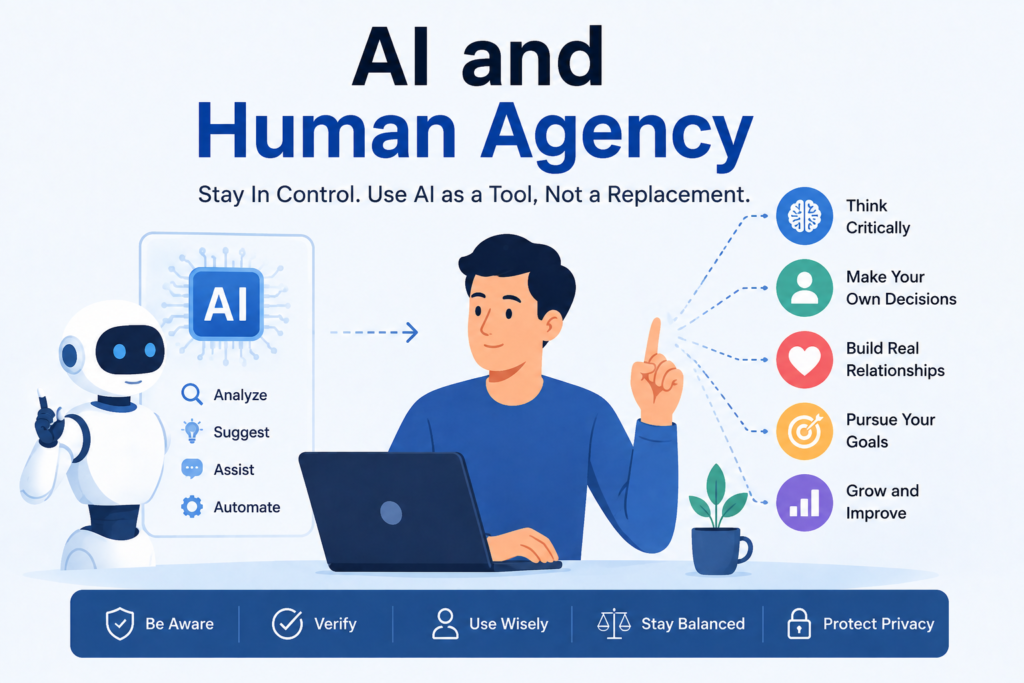
AI and Human Agency: How to Stay in Control in the Age of Artificial Intelligence
Artificial intelligence is becoming deeply integrated into everyday life. From generative AI and intelligent assistants to AI-powered education, business automation, healthcare systems, and personalized digital services, technology is increasingly influencing how people work, learn, communicate, and make decisions.
This rapid transformation creates enormous opportunities. AI can save time, improve access to information, support creativity, and help people solve complex problems.
But another question deserves equal attention:
As AI becomes more capable, how can humans remain capable, independent, and in control?
This is the central challenge of human agency in AI.
Recent research increasingly focuses on whether AI can enhance human reasoning and wellbeing while preserving agency, meaning, and healthy social connections.
What Is Human Agency?
Human agency is the ability to make choices, exercise judgment, take responsibility, and intentionally shape the direction of your life.
AI can provide recommendations, generate ideas, analyze information, and automate tasks. However, people should still have the ability to decide whether those recommendations are appropriate.
For example, an AI system might suggest a career path based on someone’s interests and previous experience. The recommendation may be useful, but it cannot fully understand that person’s dreams, family circumstances, personal values, or definition of success.
AI can provide information. Humans provide meaning.
That distinction is becoming increasingly important as AI systems become more sophisticated.
AI Should Expand Human Capability
The most valuable role for AI may not be replacing human abilities but amplifying them.
A student can use AI to understand a difficult concept.
A writer can use it to brainstorm ideas.
A researcher can use AI to organize large amounts of information.
A business owner can use AI to analyze customer feedback.
A programmer can use AI to explore possible solutions.
In each situation, the technology can act as a powerful assistant.
The key is to remain actively involved.
Instead of asking:
“How can AI do this for me?”
we should sometimes ask:
“How can AI help me become better at doing this myself?”
That small change in mindset can make a significant difference.
The Risk of Outsourcing Critical Thinking
One of the biggest concerns surrounding AI and critical thinking is cognitive over-reliance.
When an AI system produces an answer instantly, users may be tempted to accept it without questioning the reasoning behind it.
Recent research has specifically highlighted the importance of verification, reflection, and judgment when people use generative AI.
This doesn’t mean AI always weakens critical thinking. Its effect depends heavily on how it is used.
Using AI to challenge your assumptions, compare arguments, or explain a difficult concept can encourage deeper thinking.
Using AI simply to avoid thinking can have the opposite effect.
Don’t Let Convenience Replace Learning
Education provides a particularly important example.
AI tutors and educational assistants can provide personalized explanations and immediate feedback. They can help students practice difficult subjects and explore topics at their own pace.
However, learning involves more than receiving correct answers.
Students need to develop:
- Problem-solving skills
- Persistence
- Curiosity
- Independent reasoning
- Creativity
- Communication
- Intellectual confidence
If AI completes every assignment, students may finish their work faster without developing the skills the assignment was designed to teach.
That’s why AI in education should be designed around learning rather than simply task completion.
Recent research similarly emphasizes that structured human-AI collaboration can support writing ability and digital critical thinking when human agency is preserved.
AI and Creativity: Tool or Replacement?
Generative AI has created extraordinary possibilities for creators.
People can generate images, develop story concepts, brainstorm marketing campaigns, produce presentation ideas, and experiment with different creative styles.
But creativity isn’t only about producing a finished product.
The creative process itself helps people develop imagination and discover new ways of thinking.
A writer who uses AI to generate ten ideas and then develops one into something original is using technology differently from someone who simply publishes the first generated answer.
The goal of AI and creativity should therefore be collaboration.
AI can generate possibilities.
Humans decide what is meaningful.
Human Relationships Cannot Be Fully Automated
Another important part of human flourishing is relationships.
AI can communicate naturally, provide conversational assistance, and even simulate emotionally supportive interactions.
However, genuine human relationships involve mutual responsibility, shared experiences, trust, vulnerability, and real-world connection.
This becomes especially important as AI companions become more sophisticated.
Research into AI and mental wellbeing is examining both potential benefits and risks, including accessibility and emotional support on one side and dependency, over-trust, and reduced human connection on the other.
The important question is not simply whether AI can imitate conversation.
It is whether our use of AI encourages us to build stronger lives and relationships.
AI Can Support Human Wellbeing
AI also has significant potential to improve AI and wellbeing.
It can help people organize schedules, discover educational resources, automate repetitive tasks, and access information more efficiently.
In workplaces, human-AI collaboration may also create opportunities for learning and professional growth. Emerging research is examining how AI-supported work can contribute to employee thriving through learning and reflection.
However, wellbeing should remain the goal—not simply productivity.
A system that makes someone work faster isn’t necessarily improving their life if it simultaneously increases stress, dependence, or isolation.
The Importance of AI Literacy
As AI becomes part of everyday life, AI literacy will become increasingly important.
AI literacy isn’t simply knowing how to write prompts.
A genuinely AI-literate person should understand:
- How AI systems generally work
- Why AI can make mistakes
- How to verify AI-generated information
- How AI can reflect bias
- How personal data may be used
- When human judgment is necessary
- When AI should not be used
This broader approach puts human agency at the center of technology use.
AI Ethics Is About More Than Safety
Discussions about AI ethics often focus on privacy, bias, security, transparency, and accountability.
These issues are essential.
But ethical AI should also consider a bigger question:
What kind of people and society does this technology encourage us to become?
If an AI system saves people time but makes them less independent, that’s worth considering.
If an educational system improves test scores but reduces curiosity, that’s worth considering.
If a recommendation system increases engagement but damages attention, that’s worth considering.
Technology should therefore be evaluated not only by what it can accomplish, but also by its broader impact on human life.
Building Human-Centered AI
The concept of human-centered AI provides a useful direction for the future.
Instead of designing systems purely around automation and efficiency, developers can focus on technologies that preserve human choice and strengthen human capabilities.
A human-centered AI system should ideally:
- Keep people informed.
- Give users meaningful choices.
- Make important limitations clear.
- Protect personal information.
- Encourage appropriate human oversight.
- Support learning rather than dependence.
- Consider long-term wellbeing.
The goal is not to slow technological progress.
It is to make technological progress more meaningful.
Five Rules for Responsible AI Use
Individuals can also adopt simple habits.
1. Think Before You Ask AI
Try to understand the problem yourself before immediately outsourcing it.
2. Use AI for Assistance
Let AI provide explanations, ideas, examples, and feedback.
3. Verify Important Information
Never assume that a confident AI answer is automatically correct.
4. Keep Your Own Voice
When using AI for writing or creativity, make sure the final result reflects your own ideas and judgment.
5. Know When to Step Away
Not every human experience needs an AI solution.
Sometimes thinking, creating, talking, learning, or solving something yourself is the more valuable experience.
The Future of Human-AI Collaboration
The future doesn’t have to be humans versus artificial intelligence.
A better possibility is human-AI collaboration.
Machines can handle enormous amounts of information and repetitive processes.
Humans can contribute judgment, empathy, creativity, responsibility, and purpose.
Together, these strengths can produce better results than either humans or machines working alone.
But collaboration only works when humans remain active participants.
The objective shouldn’t be to create a society where people depend on AI for every decision.
It should be to create a society where people have better tools for making their own decisions.
Conclusion
Artificial intelligence has the potential to transform the way we learn, work, create, and communicate.
But the success of AI should not be measured only by how powerful the technology becomes.
We should also ask whether people remain capable of thinking independently, developing meaningful relationships, creating original ideas, making responsible choices, and pursuing purposeful lives.
The future of AI and human flourishing depends on maintaining that balance.
AI should make humans more capable—not less.
It should support curiosity rather than eliminate it.
It should strengthen creativity rather than replace it.
It should improve decision-making without taking away human agency.
And above all, technology should remain a tool in service of human goals.
The future of AI should not be about giving machines control over our lives. It should be about giving people better tools to shape those lives themselves.