History of the Internet: How the World Became Connected
The internet is one of the most important inventions in modern history. Today, billions of people use it to communicate, work, study, shop, watch videos, share information and connect with people around the world.
However, the internet did not appear suddenly. It developed over several decades through the work of scientists, engineers, universities and technology organizations.
The History of the Internet is a fascinating journey from early computer networks to the global digital system people use every day.
How Did the Internet Begin?
The origins of the internet can be traced back to research into computer networking during the twentieth century.
In the early days of computing, computers were mostly independent machines. Researchers began exploring ways for computers to communicate with each other and share information.
One important goal was creating networks that could continue operating even if part of the network experienced a failure.
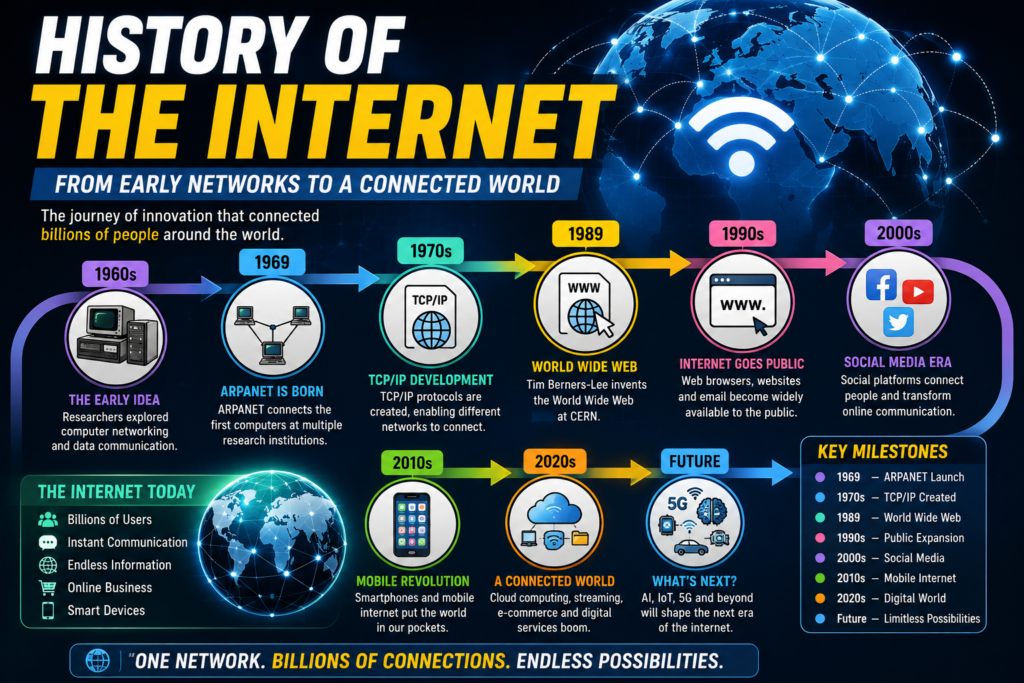
These ideas eventually contributed to the development of ARPANET, one of the most important milestones in internet history.
What Was ARPANET?
ARPANET was an early computer network developed with support from the U.S. Advanced Research Projects Agency.
In 1969, ARPANET connected its first computers at several research institutions.
The network demonstrated that computers located in different places could communicate and exchange information.
ARPANET was not the modern internet, but it became an important foundation for the networking technologies that followed.
The Development of TCP/IP
As computer networks developed, researchers needed common communication standards that would allow different networks to communicate with one another.
TCP/IP became a fundamental set of networking protocols.
TCP helps manage the reliable transmission of information, while IP is responsible for addressing and routing data between networks.
The adoption of TCP/IP was an important step toward creating a network of interconnected networks.
The Birth of the World Wide Web
The internet and the World Wide Web are not exactly the same thing.
The internet is the underlying global network infrastructure, while the Web is a system that allows people to access interconnected websites and information through the internet.
In 1989, British computer scientist Tim Berners-Lee proposed the World Wide Web while working at CERN.
He developed important technologies including HTML, HTTP and URLs that helped make the Web practical.
The Internet Becomes Public
During the 1990s, internet access expanded rapidly.
Web browsers made it easier for ordinary users to visit websites and navigate online information.
Search engines, email services, online communities and early commercial websites began appearing.
For many people, this was the beginning of a major change in how they accessed information and communicated with others.
The History of the Internet entered a new phase as the technology moved beyond research institutions and became increasingly accessible to the general public.
The Rise of Search Engines
As the number of websites increased, finding information online became more difficult.
Search engines developed to help users discover websites and information.
Search technology eventually became one of the most important parts of the online experience.
People could enter a query and quickly find information from websites around the world.
This transformed the internet from a collection of websites into a much more useful information resource.
Social Media Changes the Internet
The 2000s brought another major transformation.
Social media platforms allowed people to create profiles, publish content and communicate with friends and communities online.
Instead of simply reading information created by websites, users increasingly became content creators themselves.
Photos, videos, opinions and personal updates could be shared with audiences around the world.
This created a more interactive internet and changed online communication.
The Smartphone Revolution
The development of smartphones transformed internet access once again.
People no longer needed to sit in front of a desktop computer to go online.
Mobile internet allowed users to browse websites, communicate, watch videos, use maps, shop and access applications from almost anywhere.
The internet became integrated into everyday life.
How the Internet Changed Business
The internet also completely changed the business world.
Companies could create websites, sell products online, advertise to global audiences and communicate with customers digitally.
E-commerce became a major industry.
Small businesses gained opportunities to reach customers outside their local areas, while large companies developed global online operations.
Today, online shopping, digital payments, remote work and online marketing are all major parts of the global economy.
The Modern Internet
Today’s internet is far more advanced than the networks of the 1960s and 1970s.
High-speed broadband, mobile networks, cloud computing, streaming platforms, online banking, social media and digital services have created a deeply connected world.
People can communicate across continents almost instantly and access enormous amounts of information from a smartphone.
Cloud computing has also changed how software and data are stored and accessed, allowing users and businesses to rely on powerful online infrastructure.
The Future of the Internet
The internet continues to evolve.
Faster networks, connected devices, artificial intelligence, cloud computing and emerging technologies are changing how people interact with digital services.
The Internet of Things is connecting more physical devices to networks, while new technologies are creating different ways to communicate and share information.
The next stage of internet development may make digital connectivity even more integrated into homes, businesses and everyday life.
Why Internet History Matters
Understanding the History of the Internet helps us appreciate how much technology has changed in a relatively short period.
A network originally developed for research and communication eventually became a global platform used for education, business, entertainment, communication and countless other activities.
The internet’s development also demonstrates how major technologies often evolve gradually through contributions from many researchers and organizations.
Final Thoughts
The History of the Internet began with early experiments in computer networking and eventually developed into the global communication system we know today.
From ARPANET and TCP/IP to the World Wide Web, search engines, social media and smartphones, each stage changed how people interacted with information and with one another.
The internet is still evolving, and its future may bring changes that are just as significant as those of the past.
What started as a small network connecting computers has become one of the most influential technologies in human history.