History of Artificial Intelligence: From Early Ideas to Modern AI
Artificial Intelligence may seem like a modern technology, but the idea of creating machines capable of intelligent behavior has existed for decades. Researchers, mathematicians and computer scientists have spent generations exploring whether machines could learn, reason and solve problems in ways similar to humans.
Today, AI can generate text and images, recognize speech, analyze information and assist with complex tasks. However, reaching this point required decades of research, experiments and technological development.
Understanding the History of Artificial Intelligence helps explain how today’s powerful AI systems emerged from much simpler ideas.
The Early Idea of Machine Intelligence
Long before modern AI systems existed, scientists and philosophers discussed whether machines could imitate human reasoning.
The development of modern computers in the twentieth century made these ideas more practical. Researchers began asking whether computers could be programmed to solve problems that normally required human intelligence.
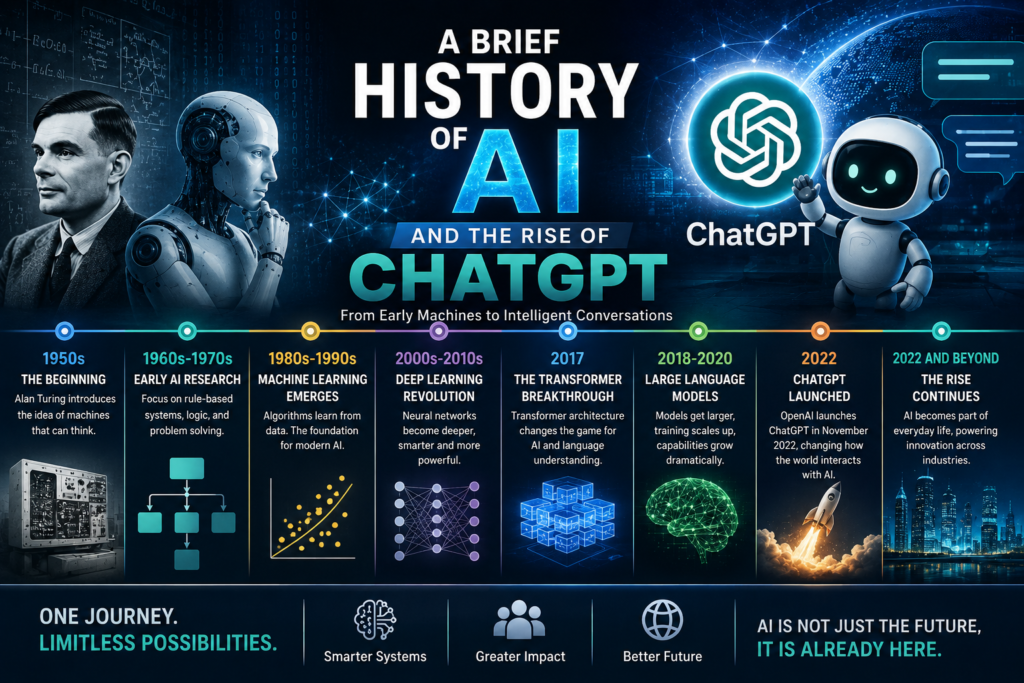
One of the most influential figures in this area was Alan Turing. His work on computation helped establish important ideas about whether machines could demonstrate intelligent behavior.
The Birth of Artificial Intelligence
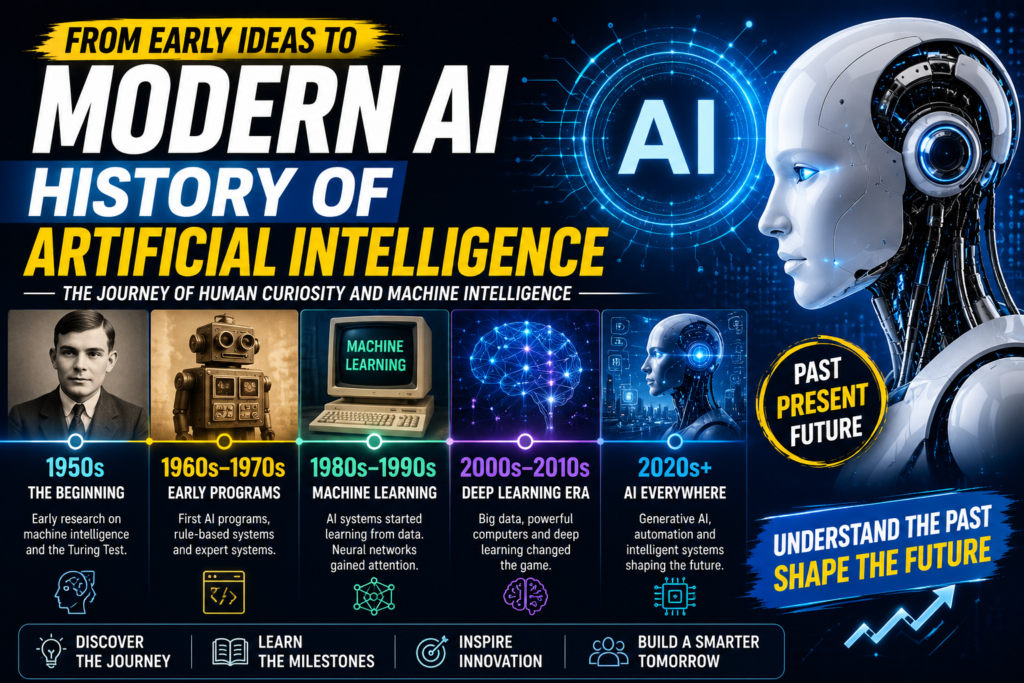
The field of Artificial Intelligence became formally recognized as an area of research during the 1950s.
A group of researchers gathered at the Dartmouth workshop in 1956 and explored the possibility of creating machines capable of simulating aspects of human intelligence.
This period is often considered an important milestone in the History of Artificial Intelligence.
Early researchers were optimistic about the potential of computers. They believed machines could eventually perform tasks involving reasoning, problem-solving and language.
Early AI Programs
During the early decades of AI research, scientists developed computer programs designed to solve specific problems.
Some systems could play games, solve mathematical problems or use logical rules to reach conclusions.
These early programs were very different from today’s AI models. They generally relied on predefined rules rather than learning from enormous datasets.
Nevertheless, they demonstrated that computers could perform tasks that appeared to require a degree of intelligence.
The Rise of Machine Learning
One of the biggest changes in AI occurred when researchers increasingly focused on machine learning.
Instead of programming every rule manually, machine learning systems could learn patterns from data.
This approach opened new possibilities for applications such as image recognition, speech processing and prediction.
As computers became more powerful and digital data became more abundant, machine learning became increasingly practical.
Neural Networks and Deep Learning
Neural networks were inspired in part by the way biological brains process information.
Researchers developed computational models containing interconnected units that could process information and learn patterns.
Although neural networks had existed for many years, improvements in computing power, algorithms and access to large datasets eventually helped make deep learning highly effective.
Deep learning uses neural networks with multiple layers and has become an important technology behind modern AI applications.
AI Enters Everyday Life
As AI technology improved, it gradually became part of everyday digital services.
People began interacting with AI through search engines, recommendation systems, voice assistants, translation tools, spam filters and image recognition systems.
Many users may not even realize how much artificial intelligence is already involved in the technology they use every day.
These applications helped move AI from research laboratories into mainstream products and services.
The Growth of Generative AI
Generative AI represents another major stage in the development of artificial intelligence.
Modern generative AI systems can create text, images, audio, video and computer code based on user instructions.
Large language models have also transformed the way people interact with computers. Instead of using traditional menus or commands, users can communicate with AI using natural language.
This has made advanced AI technology accessible to a much larger audience.
History of Artificial Intelligence and Modern Business
The development of AI has also changed how businesses use technology.
Companies now use AI for customer service, marketing, data analysis, software development, content creation and automation.
Small businesses can use AI tools to assist with everyday tasks, while larger organizations can integrate AI into complex business workflows.
The technology continues to expand into new industries as organizations discover practical applications.
Challenges Along the Way
The development of AI has not been completely smooth.
AI research has experienced periods of high expectations followed by reduced investment and interest. These periods are sometimes described as AI winters.
Researchers have also faced challenges involving limited computing power, insufficient data and difficulties in developing systems that can handle complex real-world situations.
The progress of recent years has been helped by improvements in hardware, algorithms, datasets and computing infrastructure.
Where AI Is Going Next
The next stage of AI development could involve systems that are more capable of reasoning, using tools, understanding different types of information and completing multi-step tasks.
AI agents and multimodal systems are already expanding what AI can do.
At the same time, researchers and organizations are focusing on issues such as reliability, privacy, safety and responsible AI development.
The future will likely involve both technological progress and greater attention to how AI should be used.
Final Thoughts
The History of Artificial Intelligence is a story of decades of research, experimentation and technological progress.
From early theories about machine intelligence to machine learning, neural networks, deep learning and generative AI, each stage has contributed to the technology available today.
Artificial Intelligence did not appear overnight. It developed gradually through the work of researchers and engineers who explored how machines could learn, reason and process information.
Understanding the History of Artificial Intelligence gives us a better perspective on where modern AI came from—and why its future could be even more significant.