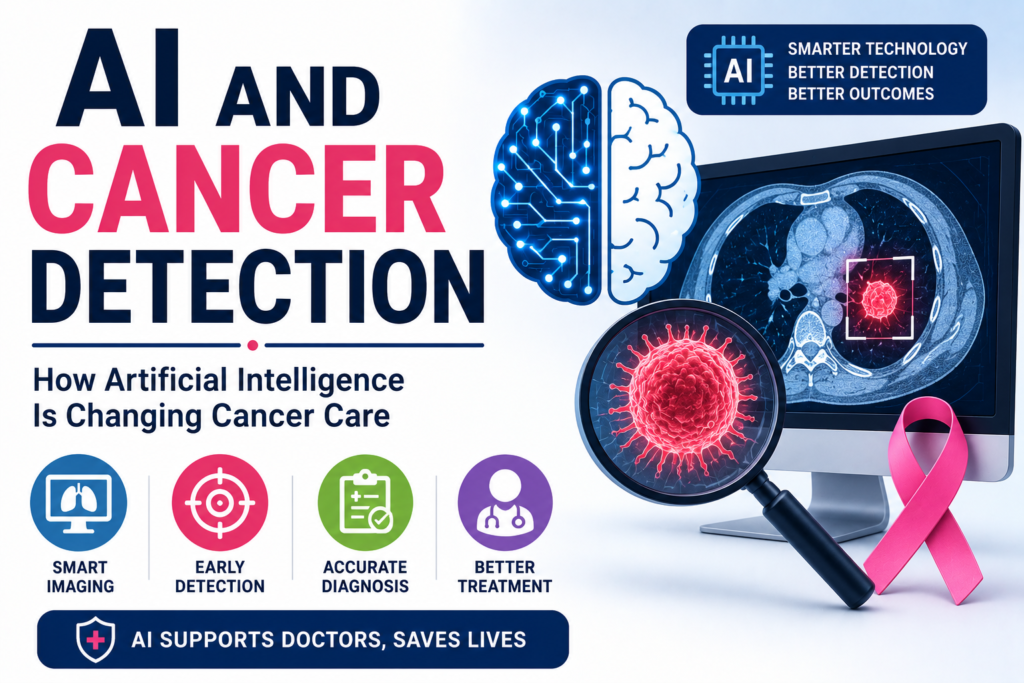
AI and Cancer Detection: How Artificial Intelligence Is Changing Cancer Care
Cancer remains one of the biggest challenges in modern healthcare. Detecting cancer at an earlier stage can be extremely important because earlier diagnosis may provide more opportunities for appropriate treatment.
At the same time, medical imaging, pathology reports, genetic information and electronic health records are generating enormous amounts of data.
Artificial intelligence is increasingly being researched as a way to analyze this information and identify patterns that may be difficult to detect manually.
The combination of AI and Cancer Detection is therefore becoming an important area of modern medical research.
What Is AI Cancer Detection?
AI cancer detection refers to the use of artificial intelligence and machine-learning technologies to analyze medical information and help identify possible signs of cancer.
AI systems can be trained using large datasets containing medical images, pathology slides, clinical information and other forms of health data.
Researchers are exploring AI applications across different parts of the cancer-care process, including screening, diagnosis, prognosis and treatment planning.
How AI Can Analyze Medical Images
One of the most developed areas of AI Cancer Detection is medical imaging.
Doctors use technologies such as X-rays, CT scans, MRI scans, ultrasound and mammography to look for abnormalities.
AI models can analyze these images and identify patterns that may require closer examination.
Recent research has examined AI applications across multiple imaging technologies, including X-ray, CT, MRI, ultrasound and endoscopy.
The goal is not necessarily to replace radiologists. Instead, AI can potentially act as an additional tool that helps healthcare professionals review large numbers of images more efficiently.
AI and Early Cancer Detection
Early detection is one of the most important areas of interest.
Researchers are developing AI systems that may help identify suspicious patterns before they become obvious to the human eye.
AI can analyze multiple factors simultaneously and potentially help identify people who may benefit from additional screening or testing.
However, an AI prediction is not the same as a cancer diagnosis. A healthcare professional must interpret the result and determine what further investigation is appropriate.
AI in Cancer Diagnosis
Another major application is AI in Cancer Diagnosis.
Pathologists examine tissue samples under microscopes to determine whether abnormal cells are present.
Digital pathology allows tissue slides to be converted into digital images. AI systems can then analyze these images and look for patterns associated with different cancers.
Research has shown that AI is being investigated for tumor diagnosis, molecular biomarker detection and prognosis assessment.
This could eventually help pathologists process complex information more efficiently.
AI and Cancer Risk Prediction
AI may also help estimate cancer risk.
Traditional risk assessments often consider individual factors such as age, family history and medical history.
Machine-learning models can potentially analyze many variables simultaneously.
Researchers are exploring AI approaches that combine different sources of information for cancer-risk prediction and screening management.
This could support more personalized screening strategies in the future.
AI for Personalized Cancer Treatment
Cancer is not one single disease.
Different patients can have tumors with different biological characteristics, which means treatments can affect individuals differently.
AI is being studied for personalized oncology, including the analysis of genomic, transcriptomic and proteomic information.
These technologies may help researchers identify patterns that could eventually contribute to more individualized treatment strategies.
AI and Cancer Research
Artificial intelligence is also being used in cancer research.
Researchers can use machine-learning systems to analyze enormous datasets and search for relationships between biological characteristics, cancer types and potential treatments.
AI-driven drug discovery is another developing area of oncology research.
The ability to process large datasets could help researchers investigate potential drug targets and treatment strategies more efficiently.
Benefits of AI in Cancer Care
Potential advantages of AI and Cancer Detection include:
Faster analysis of medical images
Assistance with cancer screening
Identification of suspicious patterns
Support for pathology analysis
Cancer-risk prediction
Personalized treatment research
Analysis of large medical datasets
Support for healthcare professionals
Recent reviews suggest that AI applications are expanding across almost the entire cancer-care process, from screening and diagnosis to treatment and follow-up.
Can AI Replace Doctors?
No.
AI can analyze data extremely quickly, but medical decisions involve much more than analyzing patterns.
Doctors consider symptoms, medical history, physical examinations, test results and the individual circumstances of each patient.
Current research emphasizes the importance of combining AI with clinical expertise rather than treating AI as an independent replacement for healthcare professionals.
Problems and Limitations
Despite its potential, AI Cancer Detection has important limitations.
AI systems require high-quality training data. If the data is incomplete or does not represent different populations properly, the system may perform less reliably in some groups.
Other challenges include:
Algorithmic bias
Patient privacy
Data security
Lack of transparency
Clinical validation
Regulatory requirements
Integration into existing healthcare systems
Researchers have specifically highlighted the need for diverse datasets, explainable algorithms and strong clinical validation before widespread implementation.
The Future of AI in Cancer
The future of AI and Cancer Detection could involve healthcare systems that combine medical imaging, pathology, genetic information and patient records.
AI could help identify patterns across these different sources of information and provide healthcare professionals with additional insights.
Future developments may also involve multimodal AI systems that can analyze several types of medical information together.
However, responsible development will be essential. Technology must be accurate, clinically validated, secure and accessible.
Final Thoughts
AI and Cancer Detection is becoming an important area of modern healthcare research.
Artificial intelligence has the potential to assist with cancer screening, medical imaging, pathology, risk prediction and personalized treatment research.
However, AI should be viewed as a powerful medical-support technology rather than a replacement for doctors.
As research continues, the combination of artificial intelligence and medical expertise could lead to faster analysis, more personalized care and potentially earlier identification of cancer.
For patients, the most important point remains simple: AI tools should support professional medical care, not replace it.