AI and Diabetes: How Artificial Intelligence Is Changing Diabetes Care
Diabetes is a major health challenge affecting millions of people around the world. Managing the condition often requires regular monitoring, healthy lifestyle choices, medication and ongoing medical care.
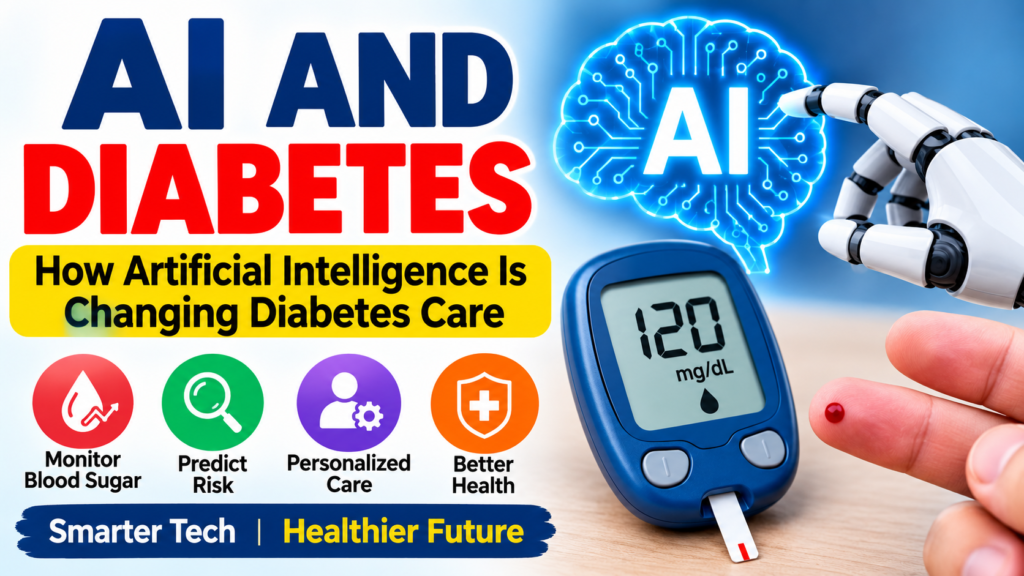
Artificial intelligence is now becoming an important area of research in healthcare. AI systems can analyze large amounts of medical and health data and identify patterns that may be difficult to detect manually.
The combination of AI and Diabetes could create new opportunities for earlier risk detection, smarter monitoring and more personalized diabetes care.
What Is Diabetes?
Diabetes is a chronic condition in which blood glucose levels become too high because the body does not produce enough insulin, does not use insulin effectively, or both.
There are several types of diabetes, including type 1, type 2 and gestational diabetes.
Managing diabetes can involve monitoring blood glucose, taking medication when prescribed, maintaining a balanced diet and staying physically active.
How Can AI Help With Diabetes?
AI can process large amounts of information and identify patterns within that data.
In diabetes care, researchers are exploring AI systems that can analyze glucose measurements, medical records, lifestyle information and other health data.
This could help healthcare professionals understand individual patterns and potentially identify risks earlier.
The development of AI in Diabetes Management is particularly interesting because diabetes generates large amounts of health data that can potentially be analyzed using machine learning.
AI and Blood Sugar Monitoring
Blood glucose monitoring is an important part of diabetes care for many people.
Modern glucose-monitoring devices can collect measurements throughout the day. AI algorithms may analyze these measurements to identify patterns in glucose changes.
For example, an AI system could potentially identify how glucose levels change after meals, exercise or medication.
This does not mean AI should replace medical advice, but it may help organize and interpret information more efficiently.
AI for Predicting Diabetes Risk
Another important application of AI and Diabetes research is risk prediction.
Machine-learning models can analyze multiple factors at the same time, including age, medical history, lifestyle information and laboratory results.
Researchers are investigating whether these systems can help identify people who may have an increased risk of developing type 2 diabetes.
Earlier identification could provide an opportunity for appropriate lifestyle changes and medical follow-up.
Personalized Diabetes Management
Every person with diabetes is different.
Two people can have different responses to the same foods, physical activities or medications.
This is where AI in Diabetes Management could become valuable.
AI systems may eventually help analyze an individual’s historical health data and identify patterns that could support more personalized recommendations.
However, treatment decisions should remain under the supervision of qualified healthcare professionals.
AI and Continuous Glucose Monitoring
Continuous glucose monitoring devices can provide frequent glucose measurements.
AI can potentially analyze these measurements and detect trends rather than simply displaying individual readings.
For example, algorithms may identify whether glucose levels are consistently increasing, decreasing or changing at particular times of the day.
This type of analysis could help patients and healthcare professionals better understand glucose patterns.
AI and Diabetes Complications
Long-term diabetes can increase the risk of complications involving the eyes, kidneys, nerves, heart and blood vessels.
AI is also being researched for detecting some diabetes-related complications.
For example, AI-based systems have been developed to analyze medical images for signs of diabetic eye disease.
These technologies could potentially assist healthcare professionals with screening and early detection.
AI Can Support Doctors
One of the most important points about AI and Diabetes is that artificial intelligence is better viewed as a supporting technology rather than a replacement for doctors.
Doctors can consider symptoms, medical history, physical examinations and individual circumstances.
AI can process data and identify patterns.
Combining these strengths could make healthcare more efficient while keeping human medical judgment at the center of patient care.
Benefits of AI in Diabetes Care
Potential benefits of AI in Diabetes Management include:
- Faster analysis of health data
- Personalized risk assessment
- Improved glucose pattern analysis
- Earlier identification of potential problems
- Support for healthcare professionals
- Remote monitoring possibilities
- Better use of continuous health data
These technologies are developing rapidly, but their effectiveness depends on accurate data and proper clinical validation.
Challenges of AI in Diabetes
AI also has limitations.
A system can produce incorrect results if the underlying data is incomplete, inaccurate or biased.
Privacy is another important issue because healthcare AI systems may process sensitive medical information.
There are also concerns about transparency. Healthcare professionals and patients need to understand how AI systems reach important conclusions.
For these reasons, AI technologies need appropriate testing, regulation and clinical validation before being widely used for medical decisions.
The Future of AI and Diabetes
The future of AI and Diabetes could involve connected healthcare systems that combine glucose monitors, smartphones, wearable devices and medical records.
AI could analyze information from these different sources and help identify patterns in an individual’s health.
Researchers are also exploring predictive models that could potentially warn patients and healthcare professionals about certain risks before they become serious.
However, these technologies should complement established medical care rather than replace it.
Final Thoughts
AI and Diabetes represent an exciting combination of artificial intelligence and modern healthcare.
AI has the potential to improve glucose-data analysis, support risk prediction, assist with screening and contribute to more personalized care.
At the same time, AI in Diabetes Management still faces challenges involving accuracy, privacy, bias, clinical validation and responsible use.
As technology continues to develop, artificial intelligence could become an increasingly useful tool for patients and healthcare professionals.
The goal should not simply be to use more technology. The goal should be to use AI responsibly to provide better, earlier and more personalized diabetes care.