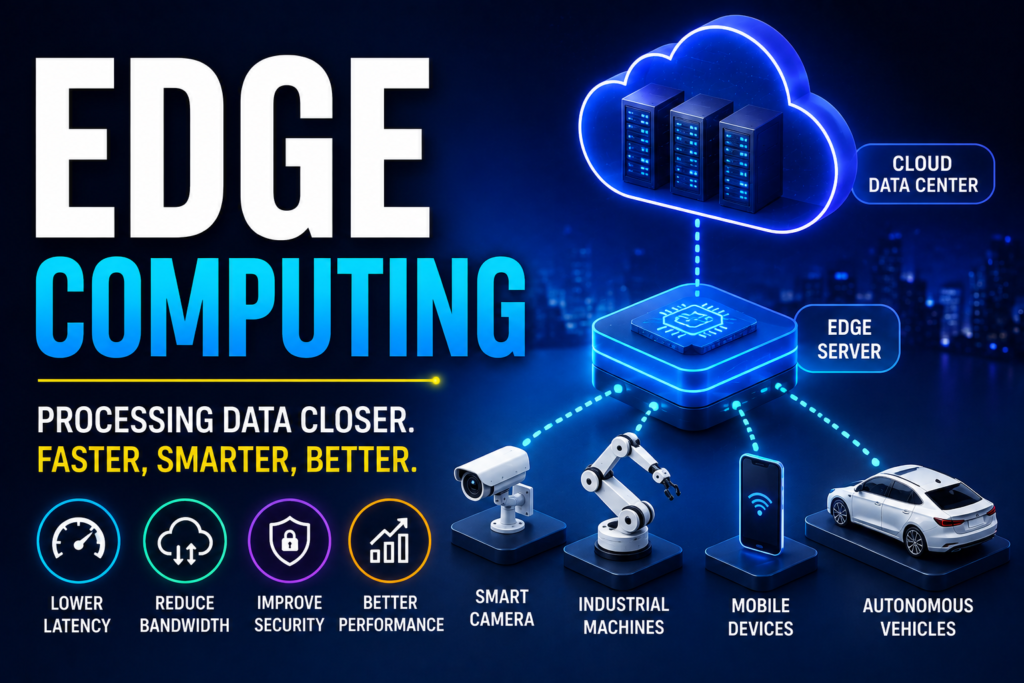
Edge Computing: How Data Processing Is Moving Closer to Users
Modern technology generates enormous amounts of data every second. Smartphones, security cameras, connected vehicles, industrial machines and smart devices continuously collect and transmit information.
Traditionally, much of this data has been sent to centralized cloud data centers for processing.
Edge Computing introduces a different approach: processing more data closer to where it is generated.
What Is Edge Computing?
Edge Computing is a computing architecture in which data processing and storage are moved closer to the devices, users or locations where data is generated.
Instead of sending every piece of information to a distant cloud server, some processing can happen on local devices or nearby edge servers.
For example, a smart security camera could analyze video locally and send only important events to the cloud.
How Does Edge Computing Work?
A traditional cloud workflow may look like:
Device → Internet → Cloud Data Center → Result
An edge workflow can look more like:
Device → Local/Edge Processing → Result
The closer processing happens to the source of the data, the less information may need to travel to a centralized data center.
Cloud computing and edge computing can also work together rather than being competing technologies.
Why Is Edge Computing Important?
One of the biggest reasons businesses are interested in Edge Computing is the need for faster responses.
Applications such as autonomous systems, industrial robots and real-time monitoring cannot always afford to wait for data to travel to a distant server and back.
Processing information closer to the source can reduce communication delays.
1. Lower Latency
Latency refers to the delay between sending information and receiving a response.
When processing occurs closer to the user or device, data may have a shorter journey.
This can be particularly useful for applications that require near-real-time responses.
2. Better Performance
Local processing can reduce the amount of information that needs to travel across a network.
This can improve performance for certain applications, especially when huge amounts of data are generated continuously.
3. Reduced Network Traffic
Millions of connected devices can produce enormous quantities of information.
Sending all of this data to the cloud can place significant demands on networks.
Edge systems can process and filter information locally, sending only relevant data to centralized systems when necessary.
4. Edge Computing and IoT
The Internet of Things, or IoT, is one of the major areas where edge technology can be useful.
Smart factories, connected vehicles, medical devices and smart buildings can generate huge amounts of data.
Instead of transmitting everything to a remote cloud, edge computing allows some data analysis to happen near the devices.
5. Edge AI
Artificial intelligence is increasingly being combined with edge computing.
This is known as Edge AI.
Rather than sending every image, sound recording or sensor reading to a cloud-based AI system, some AI models can run directly on devices or nearby edge infrastructure.
Examples include:
- Smart cameras
- Smartphones
- Industrial machines
- Autonomous vehicles
- Drones
- Smart appliances
6. Edge Computing in Smart Cities
Edge computing can allow some of this information to be processed locally.
For example, traffic systems could analyze local traffic conditions and respond quickly without sending every piece of sensor data to a distant server.
7. Edge Computing in Healthcare
Healthcare devices can generate sensitive and time-critical information.
Edge processing can potentially allow certain data to be analyzed closer to medical devices.
Applications may include:
- Patient monitoring
- Medical imaging
- Wearable devices
- Hospital equipment
- Remote monitoring
However, healthcare applications require strict security, privacy and regulatory controls.
8. Edge Computing in Manufacturing
Modern factories increasingly use sensors, robots and automated systems.
These machines continuously produce information about production lines.
Edge computing can analyze data locally and help identify problems quickly.
For example, an industrial system could detect unusual machine behavior and alert operators before a major failure occurs.
9. Autonomous Vehicles
Self-driving and advanced driver-assistance systems need to process information extremely quickly.
Vehicles can receive data from cameras, radar and other sensors.
Processing some of this information locally can help reduce dependence on remote servers for immediate decisions.
This makes edge computing particularly relevant to autonomous transportation technologies.
10. Edge Computing and Cloud Computing
Edge computing does not mean that cloud computing is disappearing.
In many modern architectures, both technologies work together.
The edge can handle tasks requiring fast local processing, while cloud platforms can provide:
- Large-scale storage
- Advanced analytics
- Model training
- Centralized management
- Long-term data analysis
This creates a hybrid architecture where each technology performs the tasks it is best suited for.
Challenges of Edge Computing
Although Edge Computing has many potential advantages, it also introduces challenges.
Security
More distributed devices create more potential points that need to be protected.
Management
Managing thousands or millions of edge devices can be complicated.
Hardware Limitations
Edge devices may have less computing power and storage than large cloud data centers.
Maintenance
Physical devices deployed in factories, vehicles or remote locations may require maintenance and monitoring.
Data Management
Organizations must determine what data should remain local and what should be transferred to centralized systems.
The Future of Edge Computing
The growth of AI, IoT, autonomous systems and connected devices is likely to increase demand for local data processing.
Future edge systems may become more powerful and increasingly capable of running advanced AI models.
Smartphones, vehicles, factories and other devices could perform more intelligent processing without constantly depending on remote cloud servers.
Edge Computing and the Future of AI
The combination of edge computing and artificial intelligence could be particularly important.
As AI models become more capable, businesses may want to run them closer to users and devices.
This could provide faster responses and reduce the amount of information that needs to be transmitted.
The result could be a more distributed AI ecosystem in which intelligence exists across devices, edge servers and cloud infrastructure.
Final Thoughts
Edge Computing is changing the way organizations think about data processing.
Instead of sending every piece of information to a centralized cloud, businesses can process selected data closer to where it is generated.
This approach can help reduce latency, network traffic and dependence on centralized processing for certain applications.