
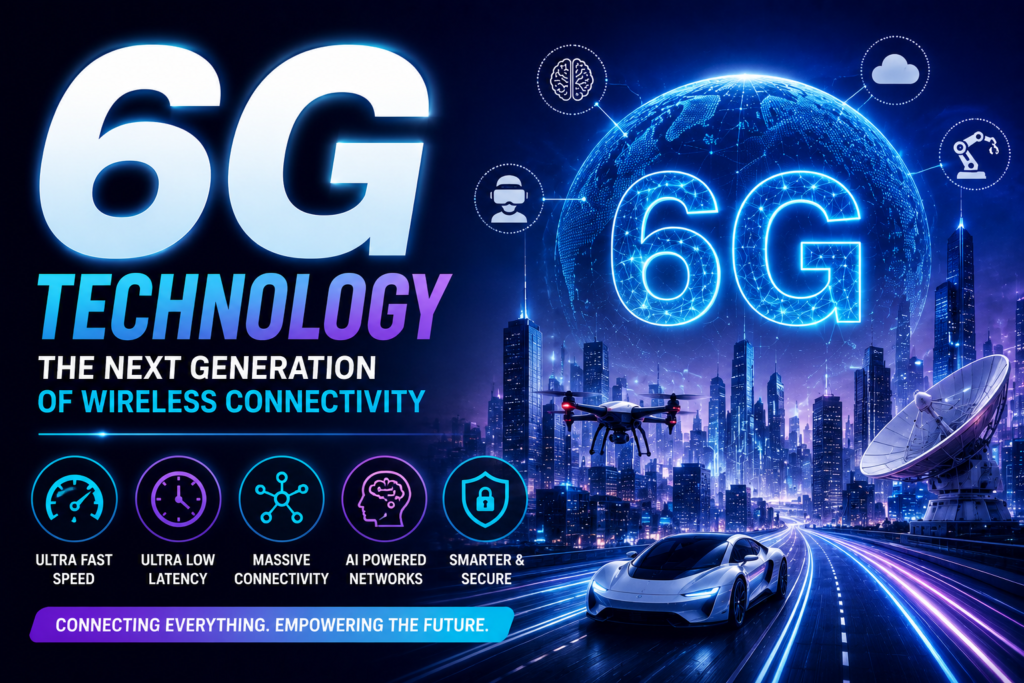
6G Technology: How the Next Generation of Wireless Networks Could Change the World
Wireless communication has transformed the way people connect to the internet. From early mobile networks to 4G and today’s 5G systems, every generation has introduced new capabilities.
The next major step is expected to be 6G Technology.
Although 6G is still being researched and standardized, scientists, telecommunications companies and technology organizations are exploring what future wireless networks could offer.
6G is expected to go beyond simply providing faster internet. It could combine advanced connectivity with artificial intelligence, sensing, automation and new computing technologies.
What Is 6G Technology?
6G Technology refers to the next generation of wireless communication systems expected to follow 5G.
Unlike simply increasing download speeds, researchers are exploring 6G as a broader platform for connecting people, machines, sensors and intelligent systems.
The exact technical specifications of commercial 6G networks are still being developed.
6G vs 5G
5G has already introduced major improvements in mobile connectivity, including lower latency, higher capacity and support for massive numbers of connected devices.
6G research is looking toward even more advanced capabilities.
Potential areas include:
Higher data rates
Extremely low latency
AI-native networks
Advanced sensing
Massive device connectivity
Integrated communications and sensing
More intelligent network management
The exact performance of future 6G systems will depend on standards and technologies that are still under development.
- Artificial Intelligence and 6G
Artificial intelligence is expected to play an important role in future wireless networks.
Instead of treating AI as an application running on top of a network, researchers are exploring networks that are designed to use AI throughout their operation.
AI could help with:
Network optimization
Traffic management
Resource allocation
Security
Energy efficiency
Predictive maintenance
This could make future networks more adaptive and automated.
- Extremely Fast Connectivity
One of the major goals of future wireless research is to provide much higher data rates.
This could support applications involving enormous amounts of information, including advanced immersive experiences, high-resolution content and real-time machine communication.
However, theoretical peak speeds should not be confused with the actual speeds consumers will necessarily experience.
- Ultra-Low Latency
Latency is the delay between sending information and receiving a response.
Lower latency can be important for applications where even small delays matter.
Future wireless systems could support extremely responsive applications such as:
Remote robotics
Autonomous transportation
Industrial automation
Extended reality
Real-time collaboration
- 6G and Smart Cities
Future cities could contain enormous numbers of connected sensors.
These devices could monitor:
Traffic
Energy consumption
Public transportation
Environmental conditions
Infrastructure
Public services
6G could potentially provide the communication infrastructure needed to connect these systems at very large scale.
- 6G and Autonomous Vehicles
Connected and autonomous vehicles require reliable communication and rapid data processing.
Future networks could allow vehicles to exchange information with:
Other vehicles
Traffic infrastructure
Road sensors
Cloud systems
Edge computing platforms
This could contribute to more intelligent transportation systems.
- 6G and Robotics
Robots are becoming increasingly sophisticated.
Factories, warehouses and other environments could use large numbers of connected robots that need to communicate with each other and with centralized systems.
Advanced wireless networks could help coordinate these machines.
The combination of 6G, AI and robotics could therefore become an important area of future technology.
- Integrated Sensing
One particularly interesting concept being researched for future wireless networks is the combination of communication and sensing.
Instead of networks being used only to transmit information, wireless signals could potentially help detect aspects of the surrounding environment.
This could support applications involving:
Object detection
Positioning
Movement tracking
Smart infrastructure
Industrial monitoring
This area is still under active research.
- Extended Reality
Virtual reality and augmented reality require substantial computing and networking resources.
Future wireless systems could support more immersive experiences by providing high-bandwidth and responsive connections.
For example, lightweight AR devices could potentially rely on nearby edge computing infrastructure for some demanding processing tasks.
- 6G and Healthcare
Future connectivity could also influence healthcare.
Potential applications include:
Remote monitoring
Connected medical devices
Robotic assistance
Telemedicine
Real-time medical data
Healthcare applications will require particularly strong security, privacy and reliability.
- 6G and Industrial Automation
Factories are becoming increasingly connected.
Machines, sensors, robots and AI systems can work together to monitor and optimize production.
Future wireless technology could help create highly connected industrial environments where machines communicate with extremely low delays.
- Energy Efficiency
Future networks will need to handle enormous amounts of data while controlling energy consumption.
Researchers are therefore exploring more energy-efficient network architectures, hardware and AI-based optimization techniques.
Energy efficiency will become increasingly important as the number of connected devices continues to grow.
- New Spectrum and Frequencies
6G research is also exploring the use of new portions of the radio spectrum.
Higher-frequency bands can provide access to additional bandwidth, although they also introduce technical challenges related to signal propagation and coverage.
Researchers are studying how different frequency ranges could be combined to create practical future networks.
- 6G and Edge Computing
Edge Computing could work closely with 6G.
Instead of sending all data to distant cloud data centers, some processing can happen closer to users and devices.
Combining advanced connectivity with edge computing could help support applications that require fast responses.
This could be particularly useful for:
Autonomous systems
Industrial robots
Smart cities
AI applications
Extended reality
Challenges of 6G
Despite its potential, developing 6G will not be simple.
Infrastructure Costs
Building new networks will require substantial investment.
Spectrum Challenges
Finding and efficiently using suitable spectrum will be technically and regulatorily complex.
Security
More connected devices and intelligent systems could create new cybersecurity risks.
Energy Consumption
Future networks will need to balance higher performance with energy efficiency.
Global Standards
Telecommunications companies and countries will need to agree on common technical standards for global interoperability.
When Will 6G Arrive?
6G is still in the research and standardization phase.
The telecommunications industry generally expects commercial 6G systems to emerge around the 2030 timeframe, although exact deployment dates will vary by country, operator and technology readiness.
The standards and technical requirements will continue to evolve before commercial networks become widely available.
The Future of 6G
The most interesting aspect of 6G Technology is that it could become more than a faster mobile network.
Future wireless infrastructure could connect:
People + AI + Robots + Vehicles + Sensors + Smart Infrastructure
This could create a highly connected digital environment in which physical and digital systems interact continuously.
Final Thoughts
6G Technology represents the next major stage of wireless communication research.
It could bring faster connectivity, lower latency, AI-driven network management, advanced sensing and massive connectivity for machines and devices.
However, 6G is still being developed, so many proposed capabilities remain research goals rather than commercially available features.
If the technology develops as researchers expect, 6G could become one of the most important connectivity technologies of the 2030s, supporting a future built around AI, robotics, autonomous systems and intelligent infrastructure.