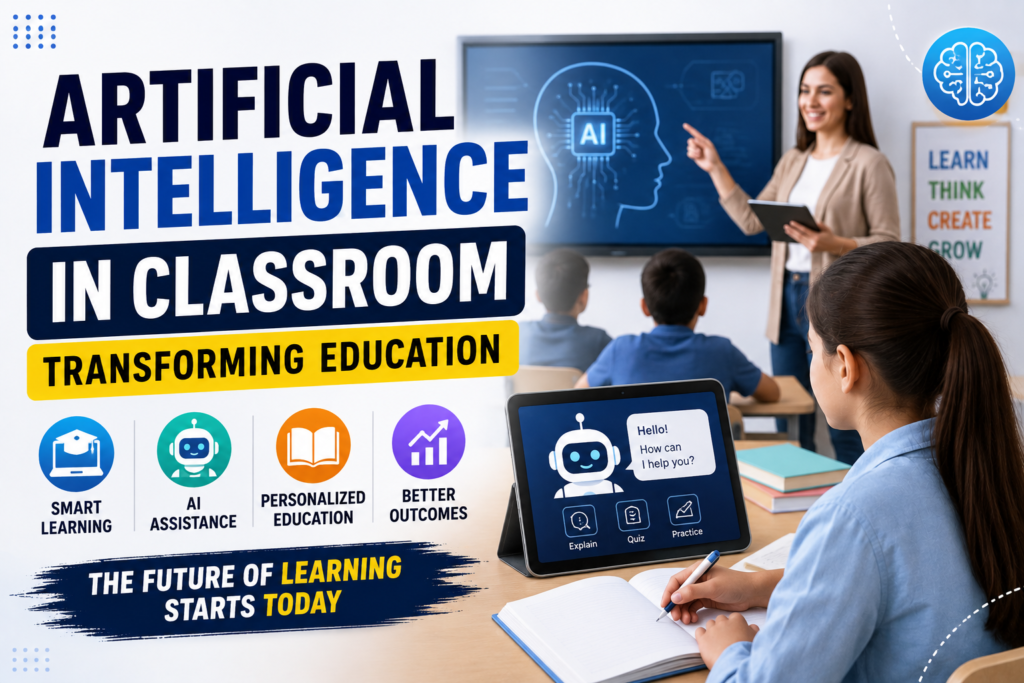
Artificial Intelligence in Classroom: How AI Is Transforming Education in 2026
The traditional classroom is changing.
For decades, students learned from textbooks, teachers wrote lessons on boards, and homework was completed using notebooks and reference materials. Today, artificial intelligence is introducing an entirely new layer of technology into education.
From personalized learning and AI tutoring to lesson planning, feedback, research assistance, and educational content creation, AI can support both teachers and students.
But there is an important question:
Is artificial intelligence making classrooms better, or could excessive dependence on AI create new problems?
The answer isn’t simply “yes” or “no.”
The real opportunity is to use AI as a learning assistant rather than a replacement for teachers or students’ own thinking.
UNESCO says AI has the potential to address major educational challenges and innovate teaching and learning, while also warning that rapid technological development creates risks around equity, inclusion, ethics, and regulation.
What Is Artificial Intelligence in Classroom?
Artificial intelligence in classroom refers to using AI-powered technologies to support teaching and learning.
These technologies can help with tasks such as:
- Explaining difficult concepts
- Creating personalized exercises
- Generating lesson materials
- Providing feedback
- Supporting language learning
- Creating quizzes
- Helping teachers plan lessons
- Assisting students with research
- Creating educational content
The goal isn’t to allow AI to do everything.
Instead, teachers can use AI to handle certain repetitive tasks while spending more time interacting with students.
UNESCO emphasizes that teachers remain essential because AI cannot replace the human understanding, emotional connection, and socialization that teachers provide.
How Artificial Intelligence in Classroom Can Help Students
One of the biggest advantages of AI is personalization.
Every student learns differently.
Some students understand mathematics quickly but struggle with writing. Others may need additional explanations before understanding a scientific concept.
A traditional classroom has limited time for teachers to provide completely individualized instruction to every student.
AI can potentially help fill that gap.
For example, a student struggling with fractions could ask an AI tutor for another explanation.
Instead of repeating the same textbook definition, the AI could explain the concept using a simpler example.
This can give students another opportunity to understand the material.
UNESCO identifies personalized learning and support for diverse student needs among the potential benefits of AI in education.
AI Can Give Students Immediate Learning Support
Imagine a student studying at home at 10 p.m.
They are working on a difficult topic but don’t understand one part of the lesson.
Previously, they might have had to wait until the next school day to ask their teacher.
AI tools can provide immediate explanations.
Students can ask:
“Explain this in simple words.”
“Give me another example.”
“Quiz me on this topic.”
“Explain this step by step.”
This doesn’t mean students should simply copy AI-generated answers.
The better approach is to use AI as a study partner.
Artificial Intelligence in Classroom Can Help Teachers Too
AI isn’t only for students.
Teachers can potentially save significant time using AI for administrative and preparation tasks.
For example, AI can help teachers create:
- Lesson plans
- Quiz questions
- Discussion topics
- Practice exercises
- Reading materials
- Assignment ideas
- Different versions of explanations
A 2026 report on AI in education identified teacher productivity, lesson planning, resource generation, assessment support, and selective personalization as practical areas where educators are using AI.
This is important because teachers already have many responsibilities outside classroom instruction.
If AI reduces some repetitive preparation work, teachers can potentially spend more time focusing on students.
Creating Personalized Learning Experiences
One classroom can contain students with very different abilities.
AI can potentially help teachers create different versions of the same learning activity.
For example:
Beginner: Simple explanation with basic examples.
Intermediate: More detailed exercises.
Advanced: Challenging problems requiring deeper reasoning.
Instead of giving every student exactly the same material, teachers can use technology to support different learning levels.
However, the teacher should remain responsible for deciding what is appropriate.
AI recommendations shouldn’t automatically determine what a child needs.
AI Can Help With Language Learning
Language education is another area where AI can be useful.
Students can use AI-powered systems to practice:
- Vocabulary
- Grammar
- Writing
- Conversation
- Pronunciation
- Translation
A student learning English, for example, could practice conversations with an AI system without worrying about making mistakes in front of classmates.
The AI can then provide suggestions for improvement.
This can give students additional practice outside normal classroom hours.
AI Can Make Lessons More Interactive
Traditional learning can sometimes become repetitive.
AI can help teachers create more interactive classroom activities.
For example, a history teacher could ask students to investigate a historical event through different perspectives.
A science teacher could generate hypothetical scenarios.
A language teacher could create role-playing conversations.
A mathematics teacher could create different practice problems for different skill levels.
The teacher remains in control, while AI becomes another tool for designing learning experiences.
AI Can Support Students With Different Needs
Accessibility is another important area.
AI-powered tools can potentially support students who face barriers in traditional learning environments.
Examples include:
- Text-to-speech
- Speech-to-text
- Language translation
- Simplified explanations
- Personalized practice
- Assistive interfaces
UNESCO stresses that AI in education should be guided by inclusion and equity so that technological progress does not increase existing educational inequalities.
That means schools shouldn’t simply ask:
“Can we use AI?”
They should also ask:
“Who will benefit from it, and who might be left behind?”
The Biggest Problem: Students Can Become Too Dependent on AI
This is where the conversation becomes more complicated.
AI can answer questions quickly.
But education isn’t just about getting answers.
It’s about learning how to think.
If students use AI to write every essay, solve every mathematical problem, complete every assignment, and answer every question, they may miss the learning process itself.
UNESCO has highlighted concerns about over-reliance on AI and the potential effects on deep reading and critical thinking.
That’s why schools need clear rules.
AI should help students learn—not help them avoid learning.
AI and Academic Cheating
Another major concern is academic integrity.
A student can potentially ask AI to write an essay and submit the result as their own work.
This creates a difficult challenge for educators.
Instead of simply trying to ban every AI tool, schools can redesign assignments.
For example, teachers can ask students to:
- Explain their reasoning
- Present their work
- Discuss sources
- Complete parts of assignments in class
- Reflect on how they reached their conclusion
- Critically evaluate AI-generated information
This changes the focus from “Did AI write this?” to “Does the student actually understand it?”
AI Can Make Mistakes
One of the most important lessons students need to understand is:
AI can be wrong.
AI systems can produce incorrect information, outdated information, misleading explanations, or fabricated references.
Therefore, students shouldn’t automatically trust every AI-generated answer.
Teachers can turn this limitation into a learning opportunity.
For example:
“Ask AI to answer this question, then verify its answer using reliable sources.”
Now the student isn’t simply consuming AI output.
They’re learning how to fact-check technology.
That is an increasingly valuable skill.
Privacy Is Another Major Concern
Schools also need to think carefully about student data.
Before adopting AI tools, institutions should understand:
- What information is collected
- Where data is stored
- Who can access it
- How long it is retained
- Whether student information is used for other purposes
The U.S. Department of Education’s guidance on AI adoption highlights privacy and responsible use among important considerations for educational institutions.
Schools should therefore have clear policies before introducing AI into classrooms.
Teachers Should Not Be Replaced by AI
This is perhaps the biggest misconception surrounding educational AI.
AI can explain a mathematics problem.
But a teacher can notice that a student is frustrated.
AI can generate a lesson plan.
But a teacher understands the classroom environment.
AI can provide an answer.
But a teacher can challenge the student to think deeper.
UNESCO’s recent discussions on AI in classrooms emphasize that teachers remain irreplaceable and that AI should support—not replace—the human role in education.
The future classroom is therefore unlikely to be:
Teacher vs AI
It is more likely to be:
Teacher + AI + Student
How Schools Can Introduce AI Responsibly
Schools shouldn’t introduce AI simply because it’s trendy.
A better approach is to create a clear framework.
1. Establish AI Rules
Students should know when AI is allowed and when independent work is required.
2. Teach AI Literacy
Students should understand how AI works, what it can do, and where it can fail.
UNESCO’s student AI competency framework includes areas such as human-centered thinking, AI ethics, AI techniques and applications, and AI system design.
3. Train Teachers
Teachers need practical training rather than simply being told to “use AI.”
4. Protect Student Privacy
Schools should carefully evaluate how AI platforms handle student information.
5. Encourage Critical Thinking
Students should learn to question AI outputs rather than automatically accept them.
6. Keep Humans in Control
Important educational decisions should remain under appropriate human oversight.
The Future of Artificial Intelligence in Classroom
The next few years could bring significant changes to education.
We may see more:
- AI tutors
- Personalized learning systems
- Intelligent educational assistants
- AI-powered assessments
- Automated administrative support
- Interactive learning environments
- AI literacy courses
- Adaptive educational content
Some education systems are already moving quickly. For example, UNESCO reported that the UAE made AI a mandatory subject in public schools from kindergarten through graduation in 2025.
The important question isn’t whether AI will enter education.
It already has.
The important question is how schools will use it.
Artificial Intelligence in Classroom: Opportunity or Threat?
The answer depends on implementation.
Used badly, AI can encourage:
- Cheating
- Over-dependence
- Misinformation
- Privacy risks
- Unequal access
- Reduced independent thinking
Used responsibly, it can help provide:
- Personalized learning
- Faster teacher preparation
- Additional student support
- Accessibility
- More interactive lessons
- AI literacy
- New educational possibilities
UNESCO’s position is essentially that AI should be developed and used in education through a human-centered approach that prioritizes inclusion and equity.
Final Verdict
Artificial intelligence in classroom is not simply another technology trend.
It represents a major change in how students can learn and how teachers can prepare and deliver instruction.
But the best classroom of the future won’t be the one with the most AI.
It will be the one that uses AI most intelligently.
Students still need teachers.
They still need books.
They still need conversations.
They still need to make mistakes.
They still need to solve problems themselves.
AI should provide additional support—not remove the fundamental process of learning.
Conclusion
The arrival of AI in education creates both an enormous opportunity and a serious responsibility.
When used correctly, artificial intelligence can help teachers save time, give students additional learning support, personalize educational experiences, and prepare young people for a world where AI will increasingly influence work and society.
But schools must avoid turning AI into a shortcut.
The goal should not be:
“Let AI do the student’s work.”
The goal should be:
“Let AI help the student learn how to do better work.”
That’s the difference between using AI as a shortcut and using it as a powerful educational tool.
The classroom of the future won’t be defined by whether it has artificial intelligence.
It will be defined by how wisely teachers and students use it.