AI Automation for Business: How Companies Can Work Smarter in 2026
Businesses around the world are adopting artificial intelligence to improve productivity, reduce repetitive work and deliver better customer experiences. What was once considered an advanced technology is now becoming an important part of everyday business operations.
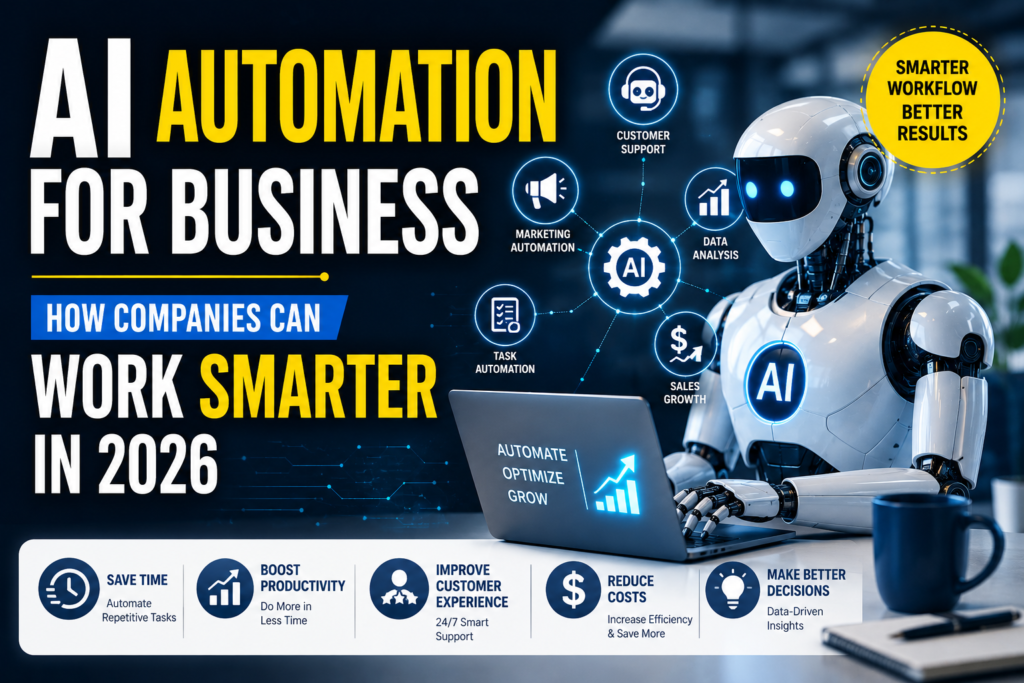
AI Automation for Business combines artificial intelligence with automation technology to perform tasks that previously required significant human effort. From customer support and marketing to data analysis and administrative work, AI can help companies complete many processes faster and more efficiently.
What Is AI Automation?
AI automation means using artificial intelligence to automate tasks that normally require human decision-making, data processing or communication.
Traditional automation generally follows fixed rules. AI-powered automation can analyze information, recognize patterns and respond to changing situations.
For example, a traditional system may automatically send an email after a customer places an order. An AI-powered system can analyze the customer’s previous interactions and create a more personalized response.
This makes AI automation useful for businesses of different sizes, from small online stores to large organizations.
How AI Is Changing Business Operations
Modern companies handle huge amounts of information every day. Employees may spend hours responding to emails, organizing data, preparing reports, answering common customer questions and performing repetitive administrative tasks.
AI can help automate many of these processes.
Businesses can use AI-powered software to organize information, summarize documents, generate reports, analyze customer behavior and assist employees with everyday tasks.
The result can be faster workflows and more time for employees to focus on creative and strategic work.
AI Automation for Business Customer Support
Customer service is one of the areas where AI automation can have a significant impact.
AI chatbots and virtual assistants can answer common questions, provide basic product information and help customers find information at any time of the day.
For example, an online business can use an AI assistant to answer questions about delivery times, return policies and product availability.
More complicated requests can then be transferred to a human customer service representative.
This approach can reduce repetitive workloads while allowing businesses to maintain human support for situations that require personal attention.
AI for Marketing and Content Creation
Marketing teams are also using AI to speed up content production and campaign management.
AI tools can assist with:
- Blog content
- Social media posts
- Email campaigns
- Product descriptions
- Keyword research
- Customer segmentation
- Marketing ideas
- Campaign analysis
Instead of replacing marketers, AI can act as an assistant that helps them complete repetitive tasks more quickly.
Businesses can then spend more time developing strategies, understanding customers and improving their products.
AI Automation for Business Data Analysis
Data is extremely valuable, but analyzing large amounts of information manually can take considerable time.
AI systems can process large datasets and identify patterns that may be difficult to notice manually.
Businesses can use AI to analyze sales information, customer behavior, website activity and marketing performance.
For example, an online store can analyze previous orders to identify popular products, purchasing trends and potential opportunities.
This can help business owners make decisions based on data rather than relying only on assumptions.
AI and Small Businesses
AI automation is not only for large corporations.
Small businesses can also benefit from affordable AI tools that help with customer service, marketing, scheduling, writing, data analysis and administrative tasks.
A small business owner may use AI to generate social media content, answer frequently asked questions and organize information while focusing on sales and customer relationships.
As AI tools become easier to use, small businesses are gaining access to technologies that were previously available mainly to larger companies.
Benefits of AI Automation
There are several potential advantages to introducing AI into business workflows.
Increased Productivity
AI can handle repetitive tasks quickly, allowing employees to spend more time on important responsibilities.
Lower Operational Workload
Automating routine processes can reduce the amount of manual work required for certain business operations.
Faster Customer Responses
AI-powered assistants can respond to common customer questions quickly, including outside normal business hours.
Better Data Insights
AI can analyze large amounts of information and identify useful patterns for decision-making.
Improved Scalability
Automation can help businesses manage increasing workloads without increasing every part of their workforce at the same rate.
Challenges Businesses Should Consider
AI automation also comes with challenges.
AI systems can sometimes generate incorrect information or make mistakes. Businesses therefore need appropriate monitoring and human oversight.
Data privacy and security are also important considerations, especially when AI systems process customer or company information.
Businesses should carefully evaluate AI tools before using them for sensitive operations and should establish clear rules for how AI-generated information is reviewed.
The Future of AI in Business
The use of AI in business is likely to continue growing as companies discover new ways to automate workflows.
Future AI systems may become more capable of handling multi-step tasks, connecting different business applications and assisting employees across entire workflows.
The goal should not simply be to automate everything. Businesses should identify repetitive and time-consuming processes where AI can provide genuine value.
Companies that combine AI technology with human creativity, experience and judgment may be better positioned to adapt to the changing digital economy.
Final Thoughts
AI Automation for Business is becoming an important technology for companies looking to improve productivity and simplify repetitive operations.
From customer service and marketing to data analysis and administrative tasks, AI can help businesses work more efficiently.
The most successful approach is likely to be a combination of intelligent automation and human expertise. Businesses that learn how to use AI responsibly can turn automation into a practical advantage rather than simply following a technology trend.
As artificial intelligence continues to develop, AI Automation for Business will likely become an increasingly common part of modern business operations.