
ChatGPT: Applications, Challenges, Ethics, Limitations and Future Scope
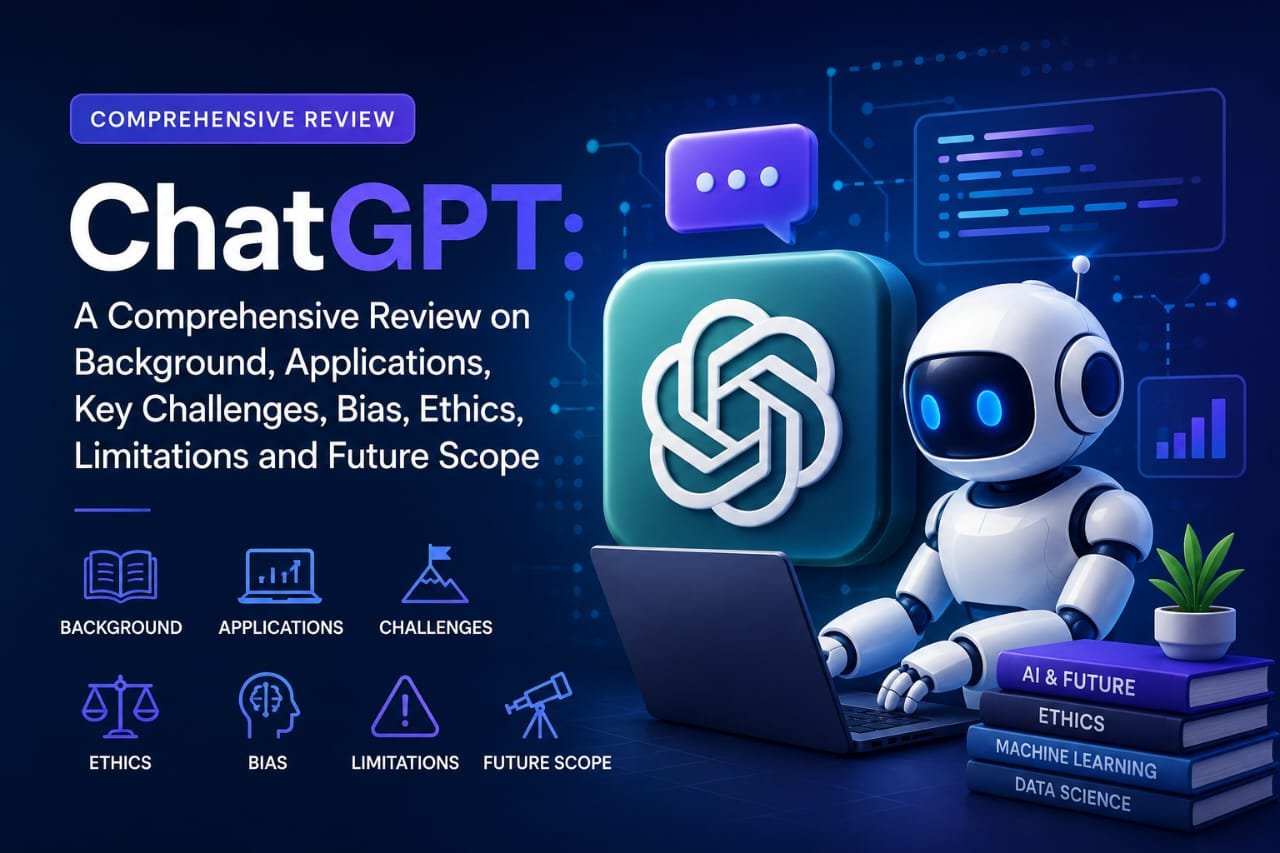
ChatGPT: Applications, Challenges, Ethics, Limitations and Future Scope
Artificial intelligence has rapidly changed the way people interact with technology. One of the most significant developments in recent years has been the rise of conversational AI, particularly ChatGPT. Developed by OpenAI, ChatGPT is an AI-powered language model designed to understand natural-language instructions and generate human-like responses.
From writing and education to software development, research, customer support and content creation, ChatGPT has become a useful tool for individuals and organizations across many fields. However, its growing adoption also raises important questions about accuracy, privacy, bias, ethics, academic integrity and the role of human expertise.
This article explores the background of ChatGPT, its major applications, key challenges, ethical concerns, limitations and possible future developments.
What Is ChatGPT?
ChatGPT is a conversational artificial intelligence system based on large language models. It processes the text provided by a user and generates a response based on patterns learned during training.
Unlike traditional search engines, which primarily return links to existing information, conversational AI can interact with users through a dialogue. Users can ask follow-up questions, request explanations, rewrite content, generate ideas, summarize information and perform many other language-based tasks.
Its ability to understand context and respond conversationally has made ChatGPT one of the most recognizable examples of generative AI.
Background and Development of ChatGPT
ChatGPT is part of the broader development of the GPT family of language models. Earlier generations demonstrated that large neural networks could generate increasingly sophisticated text, while later models significantly improved their ability to follow instructions and maintain conversational context.
The public release of ChatGPT brought conversational AI to a much wider audience. Instead of requiring specialized technical knowledge, users could interact with an AI system simply by typing questions or instructions.
Since then, AI assistants have evolved beyond basic text generation. Modern AI systems can support increasingly complex tasks and, depending on the product and available features, work with different types of information and tools.
Major Applications of ChatGPT
1. Education and Learning
ChatGPT can act as a learning assistant by explaining difficult concepts in simpler language, generating practice questions, helping students brainstorm ideas and providing feedback on writing.
For example, a student learning programming can ask for an explanation of a particular concept and then request examples or exercises.
However, students should use AI as a learning aid rather than simply submitting AI-generated answers as their own work.
2. Content Creation
Writers, bloggers and marketers can use ChatGPT to generate article ideas, outlines, headlines, social media content and first drafts.
AI can make the content creation process faster, but human editing remains important. Content should be checked for factual accuracy, originality, tone and relevance before publication.
3. Software Development
Developers can use AI assistants to explain programming concepts, generate sample code, identify possible bugs and suggest improvements.
This does not eliminate the need for programming knowledge. AI-generated code can contain errors, security weaknesses or inappropriate assumptions, so developers should review and test it before using it in real applications.
4. Customer Service
Businesses can integrate conversational AI into customer-support workflows to answer common questions, explain products and assist customers with routine tasks.
When properly implemented, AI can reduce response times and allow human support teams to focus on more complicated problems.
5. Research and Scientific Work
Researchers can use AI tools for brainstorming research questions, summarizing documents, organizing ideas, explaining technical concepts and assisting with data-processing workflows.
However, AI-generated information should not automatically be treated as authoritative research. Important claims, references and scientific conclusions must be independently verified.
6. Business and Productivity
Professionals can use ChatGPT to draft emails, create meeting summaries, develop business ideas, organize information and automate repetitive language-based tasks.
This can save time and allow people to focus more attention on decision-making and creative work.
ChatGPT and Scientific Research
Generative AI has the potential to influence the research process in several ways. Researchers may use AI to assist with literature exploration, hypothesis brainstorming, technical writing, coding and communication of complex ideas.
AI can also help make scientific information more accessible to a broader audience by translating complex concepts into understandable language.
At the same time, researchers need to maintain clear boundaries between AI assistance and human scientific judgment. AI should support the research process rather than replace critical thinking, experimentation and expert evaluation.
Key Challenges of ChatGPT
Despite its capabilities, ChatGPT has several important challenges.
Accuracy and Hallucinations
AI models can sometimes generate information that sounds convincing but is incorrect. This phenomenon is commonly described as an AI hallucination.
The problem is particularly important when dealing with medical, legal, financial, scientific or other high-stakes information.
Users should verify important information through reliable and authoritative sources.
Bias
AI models learn from large amounts of human-generated information. Because human data can contain stereotypes, incomplete perspectives and social biases, AI systems can sometimes reproduce or amplify those patterns.
Reducing bias requires better training methods, evaluation procedures, diverse data and continuous monitoring.
Privacy
Users should be careful about entering confidential, personal or sensitive information into AI systems.
Organizations using AI should establish clear policies for data handling, access, retention and security.
Misuse
Generative AI can be used for beneficial purposes, but it can also be misused to create misleading content, spam, impersonation attempts and other harmful material.
Responsible deployment therefore requires appropriate safeguards and human oversight.
Ethical Considerations
The increasing use of AI creates several ethical questions.
One major issue is accountability. When AI contributes to an important decision or generates incorrect information, it may be difficult to determine who is responsible.
Another concern is transparency. People should understand when they are interacting with AI and, where appropriate, how AI contributes to decisions or content.
There is also an important question about human dependency. Excessive reliance on AI could reduce opportunities for people to develop their own writing, research, problem-solving and analytical skills.
The goal should not be to eliminate human involvement. Instead, AI should be used as a tool that enhances human capabilities.
Limitations of ChatGPT
ChatGPT has powerful capabilities, but it is not an independent source of truth.
Its limitations can include:
- Generating incorrect or outdated information
- Misunderstanding ambiguous questions
- Producing plausible but unsupported claims
- Requiring human verification
- Reflecting biases present in training data
- Struggling with certain highly specialized or context-dependent problems
- Depending on the capabilities and tools available in the particular AI system
These limitations make human judgment especially important.
ChatGPT and the Future of AI
The future of conversational AI is likely to involve deeper integration with software, search, productivity tools and other digital systems.
AI assistants may become increasingly capable of handling multi-step tasks, understanding different forms of information and interacting naturally with users.
Another important area is improved human-AI collaboration. Instead of treating AI as a replacement for people, future systems may increasingly function as intelligent assistants that help humans research, create, analyze and make decisions.
Accessibility will also remain important. Advanced AI should become useful to people with different levels of technical knowledge and from different regions and languages.
The Importance of Human Expertise
AI can generate text quickly, but speed does not automatically equal accuracy or expertise.
Human professionals remain essential for evaluating evidence, understanding real-world context, making ethical decisions and taking responsibility for outcomes.
The most effective approach is therefore human + AI, where AI handles suitable repetitive or information-heavy tasks while humans provide judgment, creativity and accountability.
Conclusion
ChatGPT represents an important development in conversational artificial intelligence. Its applications extend across education, research, business, software development, customer service and content creation.
At the same time, its limitations and risks should not be ignored. Accuracy problems, bias, privacy concerns, misuse and ethical questions demonstrate why responsible AI adoption is necessary.
The future of ChatGPT and similar technologies will likely depend not only on making AI models more capable, but also on improving safety, reliability, transparency and human-AI collaboration.
Used responsibly, ChatGPT can become a powerful productivity and learning tool. However, it works best when combined with human expertise, critical thinking and independent verification.
Frequently Asked Questions
Is ChatGPT always accurate?
No. ChatGPT can sometimes produce incorrect or misleading information. Important information should always be verified using reliable sources.
Can ChatGPT replace human experts?
ChatGPT can assist experts with many tasks, but it should not automatically replace professional judgment, especially in high-stakes areas.
How can students use ChatGPT responsibly?
Students can use it for explanations, brainstorming, practice and learning. They should follow their institution’s rules regarding AI-generated work and avoid presenting AI-generated material as their own when prohibited.
Is ChatGPT useful for researchers?
Yes. It can assist with brainstorming, writing, coding, summarization and explaining concepts. Researchers should independently verify important claims and references.
What is the biggest limitation of ChatGPT?
One of its major limitations is that it can produce confident-sounding answers that are nevertheless incorrect. Human verification is therefore essential.