Brain-Computer Interface: How Technology Could Connect the Human Brain to Computers
Technology has changed the way humans communicate with machines. We use keyboards, touchscreens, voice commands and gestures to interact with computers.
But what if a computer could receive instructions directly from the brain?
This is the idea behind the Brain-Computer Interface.
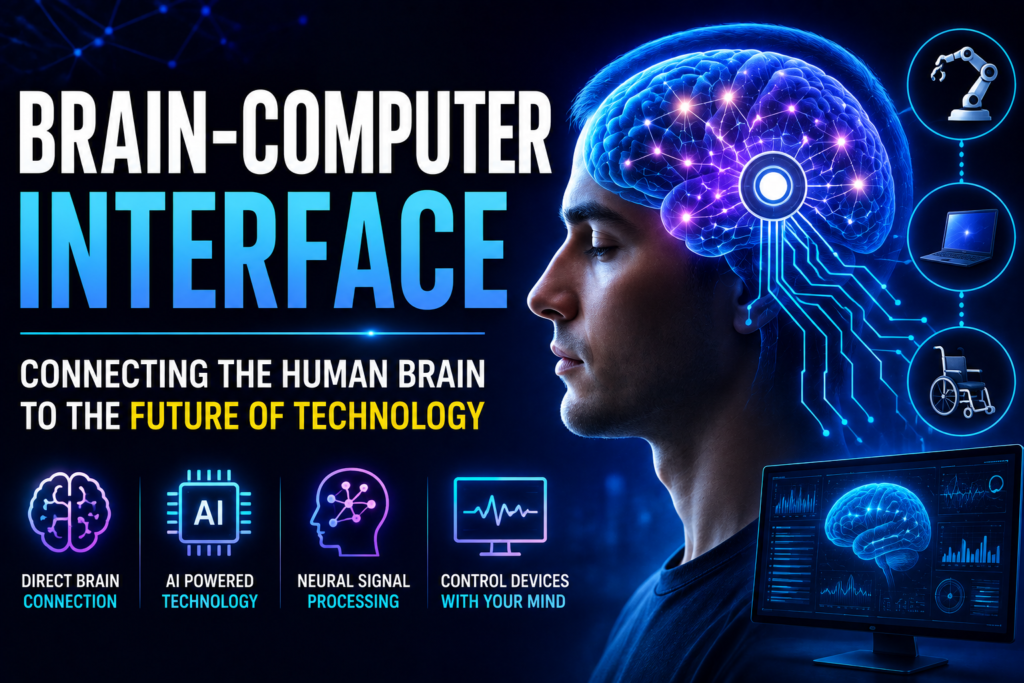
Brain-computer interfaces, commonly called BCIs, are an emerging area of neurotechnology designed to create a communication pathway between brain activity and external devices.
The technology is attracting attention because of its potential applications in healthcare, accessibility, research and human-computer interaction.
What Is a Brain-Computer Interface?
A Brain-Computer Interface is a system that can detect and interpret certain patterns of brain activity and translate them into commands for an external device.
The basic concept can be represented as:
Brain Activity → Sensors → Signal Processing → Computer → Action
For example, researchers can study brain signals associated with an intended movement and use a BCI system to translate those signals into a computer command.
How Does BCI Technology Work?
A BCI generally involves several stages.
- Recording Brain Activity
Sensors detect electrical or other measurable signals produced by brain activity.
Some BCI systems use sensors placed on the scalp, while research systems may use more invasive methods involving implanted electrodes.
- Signal Processing
Raw brain signals can contain noise and other unwanted information.
Computer systems process the signals to identify useful patterns.
- AI and Machine Learning
Machine-learning algorithms can be trained to recognize patterns associated with particular intentions or actions.
This is an important area where artificial intelligence can support BCI research.
- Translating Signals Into Commands
Once the system identifies a pattern, it can translate that information into a command.
Depending on the application, the command might control a computer cursor, robotic device or communication system.
Brain-Computer Interface in Healthcare
Healthcare is one of the most important areas for BCI research.
Researchers are investigating BCIs as assistive technologies that could help people with certain neurological or physical disabilities interact with computers or other devices.
Potential applications include:
Communication assistance
Robotic control
Computer cursor control
Assistive devices
Rehabilitation
Research into neurological conditions
These technologies are still developing, and their suitability depends on the individual and the specific BCI system.
BCI and Communication
One of the most promising applications is helping people who have difficulty communicating through conventional methods.
A BCI could potentially detect patterns associated with intended communication and translate them into computer-generated output.
This could eventually provide new communication options for some people with severe motor impairments.
BCI and Robotic Devices
BCI technology can also be combined with robotics.
Researchers have explored systems in which brain signals are used to control robotic arms or other assistive technologies.
The goal is to create a more direct communication pathway between a person’s intentions and a physical device.
BCI and Artificial Intelligence
Artificial intelligence can play a major role in interpreting complex brain signals.
Brain activity is highly complicated, and signals can vary between individuals and even within the same person.
Machine-learning systems can help identify patterns and improve the interpretation of those signals.
This creates an interesting combination:
Neuroscience + AI + Robotics + Computing
Together, these technologies could lead to new forms of human-computer interaction.
Non-Invasive vs. Invasive BCI
BCI systems can generally be divided into different approaches.
Non-Invasive BCI
Non-invasive systems collect brain signals without surgery.
For example, electroencephalography (EEG) uses sensors placed on the scalp.
Advantages can include easier deployment and lower surgical risk.
However, signals recorded outside the skull can be weaker and more difficult to interpret.
Invasive BCI
Invasive systems use electrodes implanted in or near the brain.
These systems can potentially obtain higher-quality signals from specific brain areas.
However, surgery introduces significant medical risks and technical challenges.
BCI and the Future of Computers
Traditional computers require physical input.
You normally need to:
Type
Click
Touch
Speak
Move
A future BCI could provide another method of interaction.
Instead of physically moving a mouse, a user might eventually control certain digital functions through decoded neural signals.
This does not mean computers will necessarily eliminate keyboards and touchscreens. Instead, BCIs could become another interface for specific applications.
Brain-Computer Interface and Virtual Reality
BCI technology is also being explored alongside virtual and augmented reality.
In the future, researchers may investigate systems that combine:
Brain signals
Eye tracking
Voice
Hand movements
Virtual environments
AI
Such combinations could create more natural ways for humans to interact with digital worlds.
BCI and Accessibility
Accessibility could become one of the strongest reasons to develop BCI technology.
For people who cannot easily use conventional input devices, a neural interface could potentially provide another way to interact with technology.
Possible applications include controlling computers, communicating and interacting with assistive devices.
Major Challenges of BCI Technology
Despite its potential, Brain-Computer Interface technology faces major challenges.
Signal Quality
Brain signals can be difficult to record and interpret accurately.
Individual Differences
Brain activity differs between people, meaning systems may require individual calibration.
Safety
Invasive systems involve medical and surgical considerations.
Privacy
Brain-related data raises important questions about privacy and data protection.
Accuracy
BCI systems need to reliably distinguish intended signals from noise and unrelated brain activity.
Cost
Advanced BCI research and medical systems can require expensive equipment and specialized expertise.
The Privacy Question
As BCI technology develops, privacy will become increasingly important.
Brain-related information is particularly sensitive because it could potentially reveal information about a person’s neurological activity.
Future regulations and technical safeguards may therefore need to address questions such as:
Who owns neural data?
How should it be stored?
Who can access it?
How can users give meaningful consent?
How should companies protect neural information?
These questions will become more important as the technology advances.
Is BCI Ready for Everyday Use?
BCI technology is still an emerging field.
There are research systems and clinical investigations, but widespread consumer brain-computer interfaces capable of controlling computers through complex thoughts remain far from routine.
Many demonstrations reported in the media represent research milestones rather than technology that is ready for everyone.
The Future of Brain-Computer Interfaces
The future of BCI could involve increasingly sophisticated combinations of neural sensing, artificial intelligence and robotics.
Researchers may continue working toward systems that are:
More accurate
Easier to use
More reliable
Less invasive
More affordable
More personalized
If these challenges can be addressed, BCIs could become an important technology for accessibility and specialized human-computer interaction.
Final Thoughts
The Brain-Computer Interface represents one of the most fascinating areas of emerging technology.
Instead of communicating with computers only through keyboards, screens and voice, BCI research explores a more direct connection between neural activity and digital systems.
The technology still faces significant scientific, medical, ethical and privacy challenges.
However, the combination of BCI, artificial intelligence, robotics and advanced computing could eventually create entirely new ways for humans to interact with machines.
The future of computing may not only be about making computers more powerful—it may also be about making the connection between humans and computers more natural.