Artificial General Intelligence (AGI): The Future of Human-Level AI
Artificial intelligence has developed rapidly over the last few years. Modern AI systems can generate text and images, analyze information, write code, answer questions and assist with many professional tasks.
However, most current AI systems are still designed around specific capabilities and tasks.
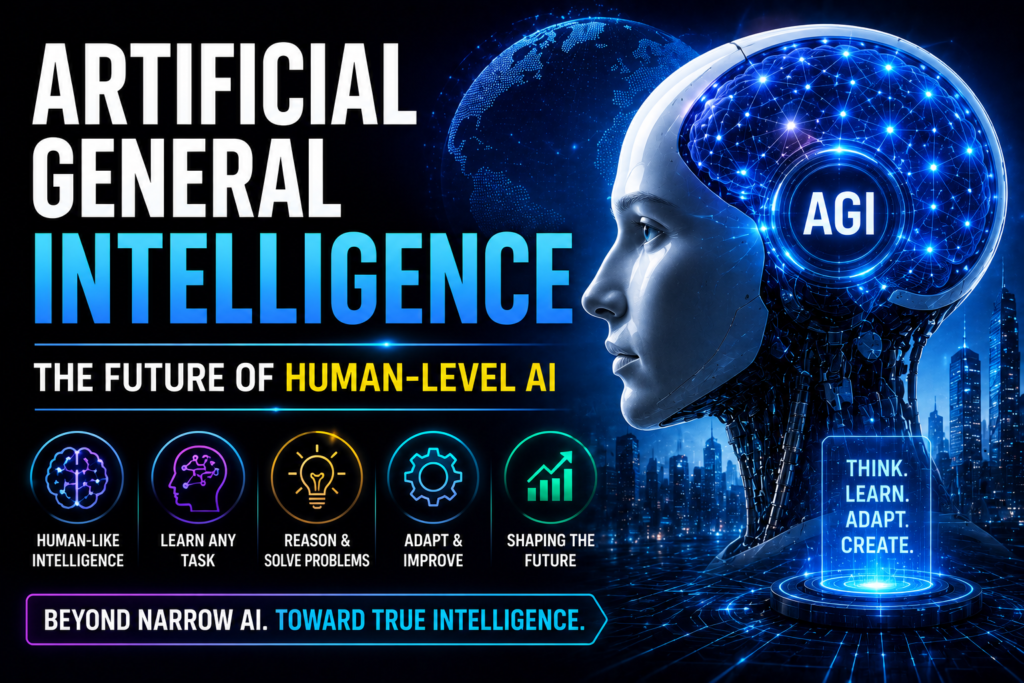
Artificial General Intelligence (AGI) represents a much broader idea: an AI system capable of learning, reasoning and adapting across a wide range of tasks at a level comparable to humans.
AGI remains a research goal rather than an established technology.
What Is Artificial General Intelligence?
Artificial General Intelligence refers to a hypothetical form of AI with broad, flexible intelligence.
Instead of being built primarily for one specific task, an AGI system would ideally be capable of learning and solving many different types of problems.
For example, a hypothetical AGI could potentially:
Learn new subjects
Understand complex instructions
Solve unfamiliar problems
Write software
Analyze data
Plan projects
Learn from experience
Adapt to new environments
The exact definition of AGI varies among researchers and organizations.
AGI vs Today’s AI
Today’s AI systems can be extremely capable, but their abilities are generally limited by their architecture, training and deployment context.
An AI model may be excellent at writing, coding or image generation without possessing the broad adaptability associated with the concept of AGI.
A simple comparison is:
Narrow AI: Designed for particular capabilities or tasks.
AGI: Theoretical AI with broad, general-purpose intelligence.
This distinction is important because AGI is not simply “a better chatbot.”
How Could AGI Work?
There is no single confirmed architecture for AGI.
Researchers are exploring different approaches involving:
Large AI models
Machine learning
Reinforcement learning
Multimodal systems
Memory
Planning
Tool use
Robotics
Reasoning systems
A future AGI system could potentially combine several of these capabilities.
AGI and Machine Learning
Machine learning is one of the major technologies behind modern AI.
Systems learn patterns from data instead of receiving every rule manually.
For AGI, researchers may need systems capable of learning efficiently across many different environments and tasks.
The challenge is not simply learning more information, but developing flexible capabilities that can transfer to unfamiliar problems.
AGI and Reasoning
Reasoning is an important part of the AGI discussion.
A broadly intelligent system would ideally be able to analyze unfamiliar situations, compare possible solutions and make decisions based on available information.
Researchers are actively studying how AI systems can improve their reasoning, planning and problem-solving abilities.
AGI and Memory
Long-term memory could also be important.
A hypothetical AGI system might need to remember previous experiences, understand context and use information learned earlier when solving new problems.
This could allow AI systems to become more personalized and capable over time.
AGI and Robotics
AGI does not necessarily require a physical body.
However, combining general intelligence with robotics could create highly capable autonomous machines.
A future intelligent robot could potentially:
Understand spoken instructions
Navigate environments
Manipulate objects
Learn new tasks
Adapt to changing conditions
Work with humans
This is one reason AGI research is closely connected to robotics and autonomous systems.
AGI in Healthcare
If highly capable general AI becomes possible, healthcare could be one of the areas most affected.
A future system could potentially assist with:
Medical research
Drug discovery
Data analysis
Administrative work
Scientific literature review
Personalized decision support
However, healthcare applications would require extremely high standards for reliability, safety, privacy and human oversight.
AGI in Education
Education could also change significantly.
A highly capable AI tutor could potentially adapt lessons to individual students.
It could explain difficult concepts in different ways, generate practice exercises and adjust its teaching approach based on a student’s progress.
This could make personalized learning more accessible.
AGI and Software Development
Software development is already heavily influenced by AI tools.
Future AI systems with broader reasoning and planning abilities could potentially handle larger parts of the software-development lifecycle.
A highly capable system might be able to:
Understand a project requirement
Plan the architecture
Write code
Test the software
Find bugs
Improve performance
Deploy the application
Human developers could continue to provide oversight, creativity and strategic direction.
AGI and Scientific Research
Scientific research involves reading information, developing hypotheses, analyzing experiments and discovering patterns.
A highly capable AI system could potentially assist researchers across multiple scientific disciplines.
This could accelerate research in areas such as:
Physics
Biology
Chemistry
Materials science
Climate science
Medicine
However, actual progress would depend on whether future AI systems can reliably perform complex scientific reasoning.
Potential Benefits of AGI
If safely developed, AGI could potentially provide significant benefits.
Faster Research
AI could assist researchers with complex scientific problems.
Personalized Education
AI tutors could provide individualized learning support.
Business Productivity
AI systems could automate complex workflows.
Healthcare Support
AI could help analyze large quantities of medical and scientific information.
New Discoveries
More capable AI could help researchers explore problems that are currently difficult to solve.
Challenges of AGI
The development of AGI also raises major challenges.
Safety
Highly capable autonomous systems would need to behave reliably and within intended boundaries.
Alignment
Researchers are studying how to ensure advanced AI systems remain consistent with human goals and instructions.
Security
Powerful AI could potentially be misused if appropriate safeguards are not implemented.
Employment
Highly capable automation could change many types of work and require significant workforce adaptation.
Governance
Governments and organizations may need new frameworks for managing increasingly capable AI systems.
Will AGI Replace Humans?
There is no reliable way to know.
AGI remains hypothetical, and its capabilities, development timeline and economic impact are uncertain.
Even if highly capable general AI is developed, the way society uses it will depend on laws, economics, safety policies, business decisions and human choices.
The future is therefore not simply about whether AI replaces people.
It may instead involve humans and increasingly capable AI systems working together.
When Will AGI Arrive?
There is no universally accepted date for AGI.
Some researchers believe it could emerge relatively soon, while others believe significant scientific breakthroughs are still required.
Because there is no universally agreed definition or reliable test for AGI, predictions about its arrival should be treated cautiously.
The Future of Artificial Intelligence
Artificial General Intelligence represents one of the biggest questions in modern technology.
Today’s AI systems are already transforming software, education, business and creative work.
The development of AGI would represent a much larger step: creating systems capable of adapting across a broad range of intellectual tasks.
Whether and when this becomes possible remains uncertain.
Final Thoughts
Artificial General Intelligence is not simply the next version of a chatbot. It represents the idea of creating AI with broad, flexible intelligence that can learn and adapt across many different types of problems.
If AGI becomes technically possible and is developed safely, it could have enormous effects on science, healthcare, education, business and robotics.
For now, AGI remains a research goal rather than a proven technology.
But as AI systems continue to become more capable, the question of how close we are to truly general artificial intelligence will remain one of the most important conversations in technology.