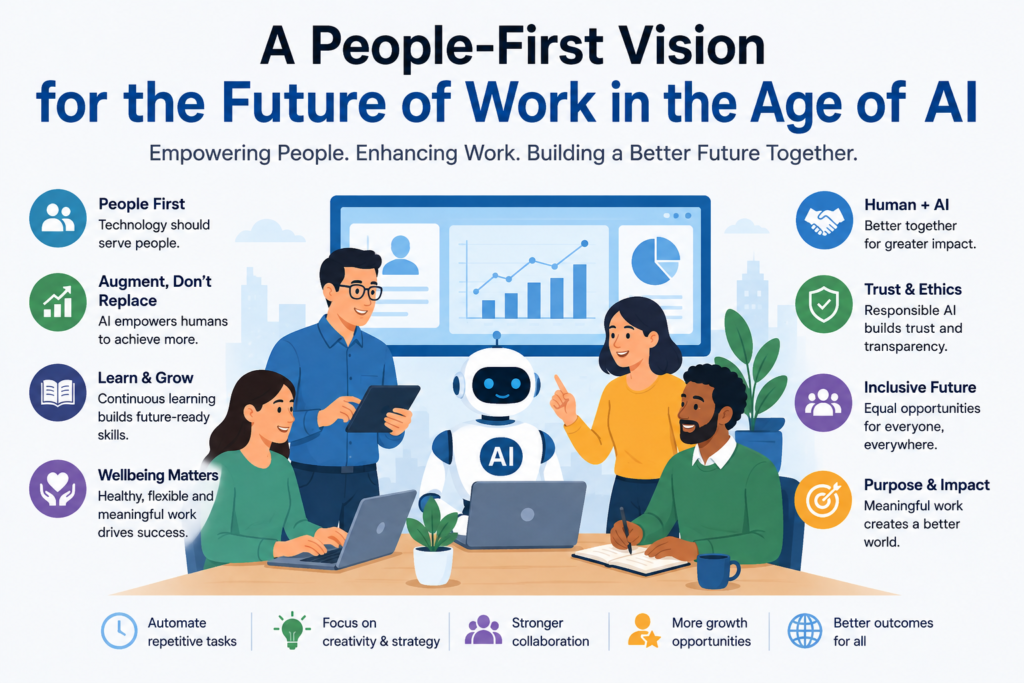
A People-First Vision for the Future of Work in the Age of AI
Artificial intelligence is transforming the workplace at a remarkable pace. Generative AI, automation, AI assistants, intelligent software, and machine learning are changing how organizations operate and how employees complete their daily tasks.
AI can write reports, analyze information, summarize meetings, generate ideas, automate repetitive processes, support customer service, and help employees work more efficiently.
But as AI becomes more powerful, an important question must remain at the center of the conversation:
What should the future of work look like for people?
A successful AI-powered workplace should not be measured only by productivity, efficiency, or cost savings. It should also be measured by whether technology creates better opportunities for people to learn, grow, earn a meaningful living, collaborate, and contribute.
This is the foundation of a people-first future of work.
What Does a People-First Future of Work Mean?
A people-first approach means designing the workplace around human needs while using AI as a powerful supporting technology.
Instead of asking only:
“How many jobs can AI automate?”
organizations should also ask:
“How can AI help people do better work?”
This shift is important because technology should ultimately serve people rather than treating employees simply as inputs in a productivity system.
A people-first workplace can use AI to remove unnecessary administrative tasks, support employees with information, improve accessibility, and create opportunities for people to focus on work requiring creativity, judgment, communication, and problem-solving.
AI Will Change Jobs, Not Just Eliminate Them
One of the biggest concerns surrounding AI and jobs is automation.
Some tasks that previously required human workers can now be completed partially or completely by AI systems.
For example, AI can assist with:
- Data analysis
- Content drafting
- Customer support
- Scheduling
- Document processing
- Software development
- Research
- Marketing
- Administrative work
This transformation will undoubtedly affect some occupations.
However, the future of work is unlikely to be simply a choice between humans and machines.
In many cases, the workplace will involve humans working alongside AI.
Employees who understand how to use AI effectively may be able to accomplish tasks faster while spending more time on activities that require human judgment.
The more useful question is therefore not simply how many jobs AI will replace, but how AI will change the tasks within jobs.
AI Can Remove Repetitive Work
One of the most immediate benefits of artificial intelligence is automation.
Employees often spend hours completing repetitive tasks that require attention but provide relatively little opportunity for creativity.
AI can assist with some of these responsibilities.
Imagine an employee who spends several hours every week organizing documents and creating routine reports.
If AI can safely automate part of that process, the employee may have more time for:
- Strategy
- Customer relationships
- Creative thinking
- Problem-solving
- Collaboration
- Professional development
This is where AI workplace automation can become genuinely valuable.
The objective shouldn’t be to make employees work faster simply so organizations can demand even more work.
Instead, productivity gains should ideally create opportunities for employees to perform more meaningful and valuable activities.
The Future of Work Requires New Skills
As technology changes jobs, the skills required by workers will also change.
Technical skills remain important, but human skills are becoming increasingly valuable.
These include:
Critical Thinking
Employees need to evaluate AI-generated information and recognize errors.
Communication
People must be able to explain ideas, collaborate, negotiate, and build relationships.
Creativity
AI can generate possibilities, but humans still need to determine which ideas are useful and meaningful.
Adaptability
Workers need to learn new tools and adjust as technology evolves.
Emotional Intelligence
Understanding people and responding appropriately remains essential in many workplaces.
Problem-Solving
AI can provide suggestions, but humans need to understand problems and determine which solutions actually work.
The future worker may therefore need both AI literacy and strong human skills.
AI Literacy Will Become a Workplace Essential
Knowing how to use AI effectively is becoming an increasingly important professional skill.
But AI literacy means more than knowing how to write prompts.
Employees should understand:
- What AI can do
- Where AI can fail
- How to verify AI-generated information
- How to protect confidential data
- How bias can affect AI outputs
- When human judgment is necessary
- How to use AI responsibly
Organizations should therefore provide employees with appropriate AI training and upskilling.
Simply giving workers access to an AI tool isn’t enough.
People need to know how to use it effectively and responsibly.
Reskilling Can Help Workers Adapt
A people-first AI strategy must include reskilling and upskilling.
When technology changes the requirements of a job, workers should have opportunities to learn new skills rather than being immediately pushed aside.
Organizations can provide training in areas such as:
- AI tools
- Data literacy
- Digital communication
- Cybersecurity awareness
- Analytical thinking
- Creative problem-solving
- Leadership
- Project management
This approach can help employees remain competitive as the workplace changes.
It also benefits businesses because experienced employees already understand the organization’s customers, processes, culture, and goals.
AI Should Complement Human Intelligence
Artificial intelligence is powerful at processing information and recognizing patterns.
Humans are particularly strong at understanding context, values, relationships, emotions, and complex social situations.
Combining these strengths can create powerful results.
For example, AI might analyze thousands of customer reviews and identify common complaints.
A human manager can then decide what those complaints actually mean for the company’s strategy and how customers should be treated.
This is the essence of human-AI collaboration.
AI provides computational power.
Humans provide context and judgment.
Human Judgment Must Remain Important
A people-first workplace should never assume that AI is automatically correct.
AI systems can produce incorrect information, misunderstand context, or generate recommendations based on incomplete data.
This becomes particularly important when AI is used in high-impact decisions involving employees.
Organizations should maintain appropriate human oversight of AI.
Important decisions should not simply be delegated to an algorithm without accountability.
People need to understand:
- Why a decision was made
- What information influenced it
- What limitations exist
- Who is responsible for the final outcome
This is an essential part of responsible AI in the workplace.
AI and Employee Wellbeing
Workplace technology should also consider employee wellbeing.
If AI increases productivity but simultaneously creates constant pressure to produce more, the benefits may be limited.
A people-first organization should ask whether AI is helping employees work better—or simply increasing the amount of work expected from them.
AI could potentially help reduce unnecessary workload by automating repetitive tasks.
It could also help employees organize information, summarize long documents, and manage routine processes.
But organizations should avoid turning every saved minute into another productivity target.
Sometimes the benefit of automation should simply be less unnecessary work.
The Importance of Meaningful Work
People don’t work only for efficiency.
Many people want their work to provide:
- Purpose
- Recognition
- Growth
- Connection
- Creativity
- Achievement
- Financial security
This is why the future of work and human flourishing should be discussed together.
If AI takes over repetitive responsibilities, organizations have an opportunity to redesign jobs around more meaningful activities.
Employees could spend more time solving problems, helping customers, developing ideas, mentoring colleagues, and improving products and services.
That could make technology more than a productivity tool.
It could become a tool for improving the quality of work itself.
AI Can Support Accessibility and Inclusion
Another important opportunity is AI and workplace accessibility.
AI-powered technologies can assist people with different needs through features such as:
- Speech-to-text
- Text-to-speech
- Automated captions
- Translation
- Communication assistance
- Information summarization
- Personalized interfaces
These tools can potentially help more people participate in the workforce.
A people-first vision should ensure that AI doesn’t create new barriers while solving old ones.
Technology should be designed with accessibility and inclusion in mind from the beginning.
Small Businesses Can Benefit From AI
The AI revolution isn’t limited to large corporations.
Small businesses and individual entrepreneurs can also use AI to compete more effectively.
A small company can use AI to assist with:
- Marketing
- Customer communication
- Research
- Content creation
- Data analysis
- Administrative tasks
- Business planning
This can lower the barrier to accessing certain capabilities that previously required larger teams.
However, responsible implementation remains important.
Businesses should protect customer information, verify AI-generated content, and ensure that automation doesn’t damage the quality of customer relationships.
Leadership Must Change in the AI Era
The rise of AI also requires a new approach to leadership.
Leaders shouldn’t simply ask employees to “use AI.”
They should explain why AI is being introduced and how it is expected to improve the organization.
Effective AI leadership can involve:
- Clearly communicating goals.
- Providing employee training.
- Listening to employee concerns.
- Protecting sensitive information.
- Establishing responsible AI policies.
- Measuring outcomes beyond productivity.
- Keeping people involved in important decisions.
Employees are more likely to embrace technological change when they understand how it benefits both the organization and themselves.
Trust Will Become a Major Workplace Asset
As AI becomes increasingly involved in business decisions, trust in AI will become important.
Employees need confidence that AI systems are being used responsibly.
They should understand how AI affects their work and, where appropriate, have opportunities to provide feedback.
Organizations should also be transparent about the limitations of AI.
Pretending that AI is perfect can create unrealistic expectations.
A healthier approach is to acknowledge that AI is powerful but imperfect.
A Better Vision for AI and Employment
A people-first future doesn’t mean refusing automation.
It means using automation thoughtfully.
Instead of asking:
“How can we reduce the number of people needed to perform this work?”
organizations can ask:
“How can technology help our people create more value?”
That difference can influence everything from hiring and training to workplace culture and employee development.
AI should ideally create opportunities for people to move toward higher-value work rather than simply creating pressure to work faster.
Five Principles for a People-First AI Workplace
1. Put People Before Productivity
Productivity matters, but employee wellbeing, development, and meaningful work matter too.
2. Invest in Skills
Give employees opportunities to learn how to work effectively with AI.
3. Maintain Human Oversight
Keep people responsible for important decisions.
4. Protect Privacy
Employee and customer data should be handled responsibly.
5. Measure Human Outcomes
Evaluate AI not only through efficiency metrics but also through employee satisfaction, learning, accessibility, creativity, and quality of work.
What Will the Best AI-Powered Workplace Look Like?
The workplace of the future may not resemble a completely automated environment filled with machines.
Instead, it may be a workplace where people and AI each contribute their strengths.
AI might handle repetitive information processing.
Employees might focus on relationships, strategy, creativity, leadership, and complex decision-making.
Managers might spend less time collecting reports and more time developing their teams.
Workers might spend less time on administrative tasks and more time solving meaningful problems.
Organizations might become more flexible while employees gain access to better tools for learning and collaboration.
That is a much more optimistic vision of the future of work with AI.
Conclusion
Artificial intelligence is going to change the workplace.
The question is not whether change will happen.
The real question is what kind of workplace we choose to build with this technology.
A purely efficiency-driven approach could focus on automation, cost reduction, and maximum output.
A people-first approach to AI takes a broader view.
It asks whether technology helps people learn, grow, create, collaborate, earn a living, and find meaning in their work.
AI can automate tasks.
It can process information.
It can generate ideas.
It can increase productivity.
But people provide purpose, judgment, empathy, creativity, responsibility, and leadership.
The strongest future of work will not be one where humans compete against machines.
It will be one where AI handles what machines do best while people are empowered to do what people do best.
The goal should not simply be a more automated workplace.
It should be a more human workplace—supported by intelligent technology.