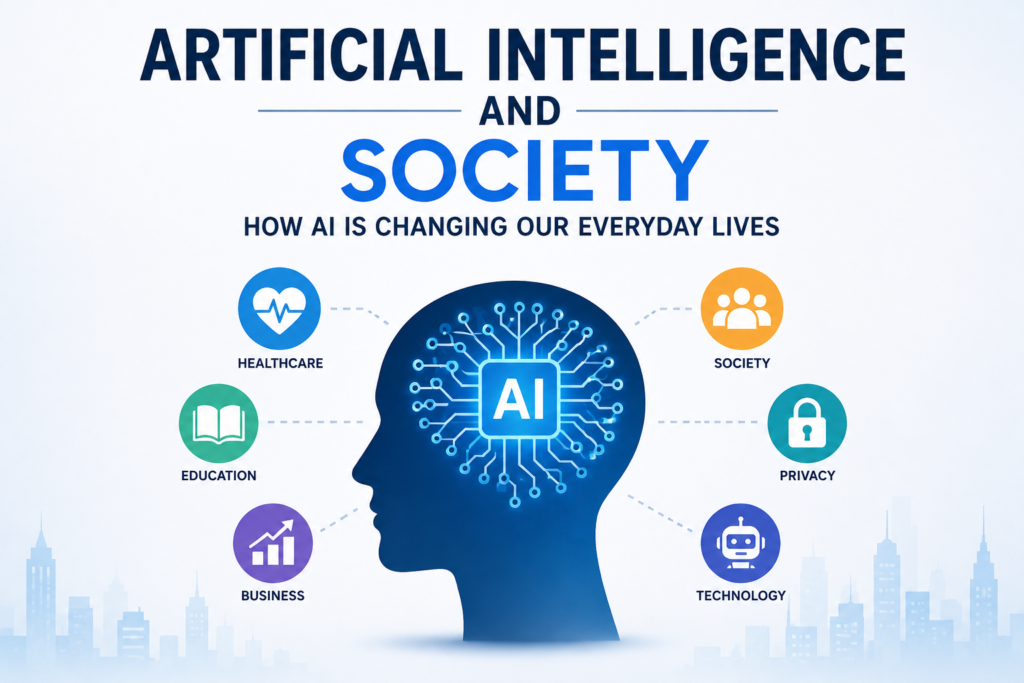
Artificial Intelligence and Society: How AI Is Changing Our Everyday Lives
Artificial intelligence (AI) has moved from being a futuristic concept to becoming a practical part of everyday life. People interact with AI when they use search engines, smartphone assistants, recommendation systems, online shopping platforms, navigation apps, and automated customer service.
The rapid development of artificial intelligence technology is creating new opportunities for businesses, governments, educators, healthcare professionals, and individuals. At the same time, the growing use of AI raises important questions about employment, privacy, security, fairness, and the role of humans in an increasingly automated world.
Understanding the social impact of AI can help society prepare for these changes and make better decisions about how artificial intelligence should be developed and used.
How Artificial Intelligence Is Changing Daily Life
AI applications are becoming increasingly common in everyday activities. Streaming platforms use algorithms to recommend movies and shows, shopping websites suggest products based on customer behaviour, and navigation applications analyse traffic information to recommend efficient routes.
These systems are designed to make everyday tasks faster and more convenient. However, they also demonstrate how much modern life depends on algorithms that analyse information and make predictions.
As AI becomes more advanced, its influence is likely to expand into even more areas of daily life.
AI in Healthcare
Healthcare is one of the areas where artificial intelligence can have a significant positive impact. AI systems can analyse large quantities of medical information and assist professionals in identifying patterns that may otherwise be difficult to detect.
Medical imaging is one example. AI-powered tools can help analyse scans and highlight areas that may require further examination. AI can also assist with patient monitoring, medical research, administrative work, and personalized healthcare.
The objective is not necessarily to replace doctors or other healthcare professionals. Instead, AI can provide additional information that helps professionals make better-informed decisions.
AI and the Future of Education
Artificial intelligence is also changing how students learn. Traditional education often provides similar learning materials to an entire class, while AI-powered systems can adapt learning experiences according to individual performance.
AI can identify areas where a student is struggling and recommend additional exercises or resources. It can also provide automated feedback and help teachers organize educational information.
Generative AI has introduced another dimension by helping students and educators create explanations, examples, summaries, and learning materials.
However, students must learn to use AI responsibly. Critical thinking remains essential because AI-generated information can sometimes be incomplete or incorrect.
Artificial Intelligence in Business
Businesses are among the biggest users of AI technology. Organizations can use AI to automate repetitive processes, analyse customer behaviour, improve marketing campaigns, detect unusual activity, and support decision-making.
Customer service is another important area. AI-powered chatbots can answer common questions at any time, reducing waiting times and allowing human employees to focus on more complicated issues.
AI can also help companies understand large amounts of business data. By identifying patterns and trends, organizations can make more informed decisions about products, customers, operations, and future strategies.
This can increase productivity while allowing employees to spend more time on creative and strategic tasks.
AI and Employment
The effect of AI on employment remains one of the most discussed social issues. Automation can reduce the need for human workers in certain repetitive tasks, potentially changing employment opportunities in industries such as manufacturing, transportation, retail, and customer support.
However, technological development can also create new careers. AI engineers, data specialists, cybersecurity professionals, automation experts, and AI consultants are examples of roles becoming increasingly important.
The key challenge is helping workers adapt. Reskilling and digital education can give people the opportunity to move into new roles as the workplace changes.
Rather than viewing AI only as a job replacement technology, society can focus on developing skills that allow humans and AI to work together.
Privacy in the Age of AI
Artificial intelligence often depends on data. The more information an AI system can access, the more effectively it may be able to identify patterns and make predictions.
However, collecting large amounts of personal information creates privacy concerns. People may not always know what information is being collected or how it is being used.
Companies and governments therefore need strong data protection practices. Individuals should also have greater awareness of privacy settings, data-sharing policies, and the potential risks associated with online services.
Responsible AI development requires a balance between useful data analysis and protection of individual privacy.
AI Bias and Fairness
AI systems are not automatically free from bias. Algorithms learn from data, and if that data contains historical or social biases, AI systems may reproduce them.
This can become particularly important when AI is used for hiring, financial decisions, education, law enforcement, or other areas that directly affect people’s lives.
Developers should test AI systems regularly and evaluate whether they produce unfair outcomes. Transparency, diverse development teams, high-quality datasets, and independent testing can help reduce these risks.
The Challenge of AI-Generated Misinformation
Generative AI can produce realistic text, images, audio, and videos in a matter of seconds. These capabilities provide enormous creative opportunities, but they can also make misinformation easier to produce.
Deepfakes and AI-generated content can potentially be used to manipulate audiences or create false impressions about people and events.
As AI-generated content becomes more realistic, digital literacy will become increasingly important. People need to learn how to question information, verify important claims, and identify potentially manipulated media.
The Growing Importance of AI Ethics
The rapid development of AI has increased the importance of artificial intelligence ethics. Organizations should consider the potential consequences of their AI systems before deploying them.
Responsible AI should focus on principles such as:
- Transparency in AI decision-making
- Protection of personal data
- Fair treatment of users
- Human oversight
- Accountability for AI-related decisions
- Security against misuse
- Regular testing and monitoring
These principles can help organizations build AI systems that are useful while reducing unnecessary risks.
Agentic AI and Autonomous Decision-Making
The development of agentic AI represents another important stage in artificial intelligence. Agentic AI systems are designed to work toward specific goals and may be capable of planning tasks, using digital tools, and taking actions with less direct human intervention.
This technology could have applications in business operations, research, software development, robotics, and other complex environments.
However, increased autonomy also creates additional challenges. When AI systems can take actions independently, developers must ensure that they operate within clearly defined limits and that humans can intervene when necessary.
Preparing for the Future of Artificial Intelligence
The future impact of AI will depend not only on technological progress but also on how society responds to it.
Schools can prepare students by teaching digital literacy, critical thinking, creativity, and problem-solving. Businesses can provide employees with opportunities to learn new skills. Governments can develop policies that encourage innovation while protecting citizens.
Public discussion is equally important. AI affects almost everyone, so decisions about its development should not be limited to technology companies and researchers.
A collaborative approach involving businesses, governments, educators, researchers, and communities can help create a more balanced AI ecosystem.
Conclusion
Artificial intelligence is changing society by influencing healthcare, education, business, communication, employment, and everyday life. Its benefits include greater efficiency, personalized services, improved data analysis, and new opportunities for innovation.
At the same time, the social impact of artificial intelligence includes challenges such as job displacement, privacy concerns, algorithmic bias, misinformation, and excessive dependence on technology.
The future of AI should therefore focus on cooperation between humans and intelligent systems rather than replacing human judgment completely. With responsible development, strong ethical standards, education, and appropriate oversight, artificial intelligence can become a powerful technology for creating a more productive and connected society.