The Social Impact of Artificial Intelligence: Opportunities, Challenges, and the Future
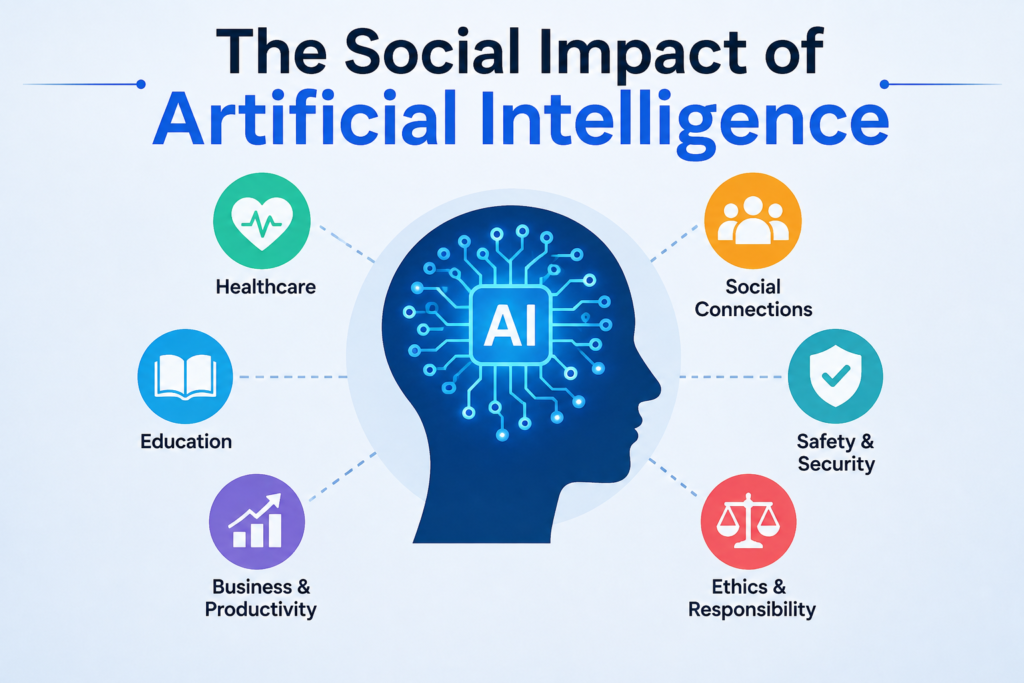
Artificial intelligence (AI) technology has evolved rapidly, becoming an important part of modern society. From healthcare and education to finance, business, communication, and entertainment, AI applications are changing how people work, learn, make decisions, and interact with technology.
AI includes technologies such as machine learning, natural language processing, computer vision, and autonomous systems. While these technologies offer major opportunities for improving efficiency and quality of life, they also create important social challenges involving employment, privacy, fairness, security, and human dependence on technology.
Understanding the social impacts of artificial intelligence is therefore essential for creating a future where AI is developed and used responsibly.
Positive Social Impacts of Artificial Intelligence
1. Improving Healthcare
One of the most promising applications of AI is healthcare. AI-powered systems can analyse medical images, identify patterns in patient data, and assist healthcare professionals in detecting diseases at an early stage.
AI can also support personalized treatment by analysing information about individual patients. Healthcare chatbots and virtual assistants can answer common questions, provide basic information, and help patients navigate healthcare services.
Although AI does not replace medical professionals, it can help them make faster and more informed decisions.
2. Personalized Education
Artificial intelligence is also changing education by making learning more personalized. AI-powered educational platforms can analyse a student’s learning behaviour and identify areas where additional support may be required.
Students can receive customized exercises, learning materials, and feedback according to their individual needs. At the same time, automation can reduce teachers’ administrative workload, allowing them to spend more time teaching and interacting with students.
This combination of AI and education has the potential to make learning more flexible, accessible, and engaging.
3. Increased Business Productivity
Businesses are increasingly adopting AI to automate repetitive tasks and improve decision-making. AI-powered data analytics can process large amounts of information much faster than traditional methods.
Companies can use AI for customer support, inventory management, marketing, forecasting, fraud detection, and supply-chain optimization.
For example, AI chatbots can provide customer assistance around the clock, while recommendation systems can analyse customer behaviour and suggest products that may be relevant to individual users.
As businesses become more efficient, AI can contribute to productivity and economic growth.
4. Better Communication and Social Connections
AI can help people communicate across language and geographical barriers. Automated translation tools make it easier for individuals from different linguistic backgrounds to exchange information.
AI also plays an important role in social media by helping platforms organize content, identify relevant information, and connect users with communities based on shared interests.
These technologies can make communication faster and help people build connections beyond their local communities.
5. Public Safety and Security
AI applications can also support public safety. Data analysis, automated monitoring systems, and intelligent incident-response technologies can help authorities identify potential risks and respond more efficiently.
However, these applications need appropriate safeguards because the use of AI for surveillance and security can also create serious privacy and civil-liberty concerns.
Negative Social Impacts of Artificial Intelligence
1. Job Displacement and Employment Changes
One of the biggest concerns surrounding AI is its effect on employment. Automation can perform many repetitive or predictable tasks that were previously completed by humans.
Industries such as manufacturing, retail, transportation, and customer service may experience significant changes as AI-powered systems become more capable.
At the same time, AI is creating new roles in areas such as AI development, data analysis, cybersecurity, automation, and AI management. The major challenge is ensuring that workers have access to the education and training required to transition into these new opportunities.
Therefore, the future of work will likely depend not only on AI technology but also on reskilling and lifelong learning.
2. AI Bias and Discrimination
AI systems learn from data, and that data can contain existing human biases. If biased information is used to train an algorithm, the resulting AI system may reproduce or even amplify those biases.
This can create problems in areas such as recruitment, lending, insurance, law enforcement, and facial recognition.
For this reason, developers need to test AI systems carefully and evaluate whether their decisions are fair across different groups of people.
3. Privacy and Data Protection
AI applications often depend on large amounts of data. This creates important questions about how personal information is collected, stored, analysed, and shared.
People may not always understand how much information is being collected about their activities online. Data breaches and cyberattacks can make these concerns even more serious.
Strong privacy protections, transparent data policies, and informed consent are therefore important components of responsible AI development.
4. Deepfakes and Misinformation
Generative AI has made it easier to create realistic images, videos, audio, and written content. While these technologies have legitimate uses in entertainment, education, and creative industries, they can also be used to create misleading or deceptive content.
Deepfakes can potentially damage reputations, spread misinformation, and make it harder for people to distinguish authentic information from manipulated media.
Improving digital literacy and developing effective methods for identifying synthetic content will become increasingly important.
5. Overdependence on AI
Another social concern is excessive reliance on artificial intelligence. When people regularly depend on AI systems for writing, research, recommendations, or decision-making, they may become less likely to critically evaluate information themselves.
Human judgment remains important, particularly when decisions involve ethics, emotions, relationships, or significant consequences.
AI should therefore support human capabilities rather than completely replace independent thinking.
Ethical Considerations in Artificial Intelligence
The growing influence of AI makes ethical development increasingly important. Organizations should consider not only whether an AI system works effectively but also how it affects people and society.
Important principles include:
- Transparency — people should understand when AI is being used and, where appropriate, how important decisions are made.
- Fairness — AI systems should be tested for discriminatory outcomes.
- Accountability — organizations should remain responsible for the systems they deploy.
- Privacy — personal information should be protected and handled responsibly.
- Human oversight — humans should retain meaningful control over high-impact decisions.
Regular audits and independent evaluations can help identify problems before they cause widespread harm.
Public education is also important. People who understand how AI works are better positioned to recognize its benefits, limitations, and potential risks.
The Rise of Agentic AI
A newer development in artificial intelligence is agentic AI. Unlike traditional AI tools that generally respond to individual instructions, agentic AI systems are designed to pursue goals, plan tasks, use tools, and take actions with greater levels of autonomy.
Agentic AI could be useful in areas such as business automation, software development, robotics, research, and autonomous systems.
However, greater autonomy also creates new risks. An AI system that can independently make decisions or take actions may produce unintended results if its objectives, information, or safeguards are inadequate.
As agentic AI develops, strong human oversight, security controls, testing, and accountability will become increasingly important.
Preparing Society for an AI-Driven Future
The growth of artificial intelligence means that society must adapt alongside the technology.
Education systems should place greater emphasis on digital literacy, critical thinking, creativity, problem-solving, and AI awareness. Students and workers need skills that complement AI rather than simply compete with automated systems.
Governments can also support workers affected by automation through retraining programs, employment initiatives, and policies that encourage responsible technological development.
Businesses have a role as well. Companies should consider the social consequences of AI before deploying it and should provide employees with opportunities to develop new skills.
Collaboration between governments, businesses, researchers, educators, and communities can help create balanced AI policies that encourage innovation while protecting people.
Conclusion
Artificial intelligence is transforming society in ways that were difficult to imagine only a few years ago. AI applications can improve healthcare, personalize education, increase business productivity, strengthen communication, and support public safety.
At the same time, the social impacts of AI include serious challenges such as job displacement, algorithmic bias, privacy risks, misinformation, and overdependence on technology.
The goal should not be to stop artificial intelligence from developing. Instead, society needs to ensure that AI develops in a responsible, transparent, inclusive, and human-centered direction.
By combining technological innovation with ethical standards, education, regulation, and human oversight, AI can become a powerful tool for improving society while reducing the risks associated with its rapid development.