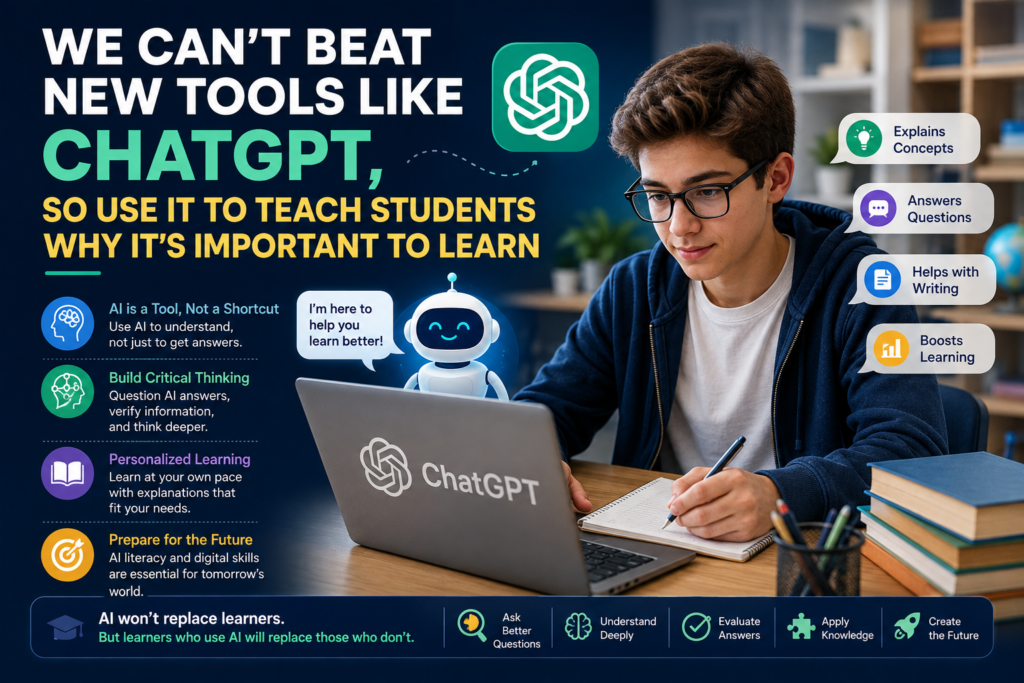
ChatGPT in Education: Why Students Still Need to Learn in the AI Era
Artificial intelligence is changing education faster than many schools and universities expected.
Tools like ChatGPT can explain difficult concepts, summarize information, generate ideas, help with writing, assist with coding, and provide personalized support within seconds. For educators, this creates an obvious challenge: if students can ask AI to do their work, why would they spend time learning it themselves?
The answer should not be to simply fight against AI.
Instead, education needs to teach students why learning still matters—and how AI can become a tool that makes learning more powerful rather than replacing it.
The goal should not be to prevent students from using AI. The goal should be to help them develop the knowledge, judgment, creativity, and AI literacy needed to use these technologies intelligently.
AI Is Changing What It Means to Learn
For generations, students have been taught to memorize information, complete assignments, write essays, solve problems, and prepare for examinations.
But today’s students have access to technology that can provide information almost instantly.
That means simply knowing how to find an answer is becoming less valuable.
What matters increasingly is knowing:
- Which questions should be asked
- Whether an answer is actually correct
- How to evaluate information
- How to identify mistakes
- How to apply knowledge to real situations
- How to think independently
- How to use technology responsibly
This is why AI education for students should not focus exclusively on teaching students how to operate a chatbot.
It should teach them how to think with AI without allowing AI to do all of the thinking for them.
We Can’t Stop Students From Using AI
Schools can attempt to ban AI tools.
They can restrict websites, discourage ChatGPT, or create increasingly complicated rules around AI-generated assignments.
But technology continues to evolve.
The more useful question is not:
“How do we stop students from using ChatGPT?”
A better question is:
“How do we teach students to use ChatGPT in a way that actually improves learning?”
This shift in thinking is important.
OpenAI’s current education resources emphasize learning, teaching, guided practice, and developing stronger study habits rather than treating AI simply as an answer machine. Its education research has also explored approaches designed to encourage students to work through concepts rather than simply receive solutions.
ChatGPT Should Be a Learning Partner, Not a Homework Machine
One of the biggest mistakes students can make with AI is asking it to complete an assignment from beginning to end.
For example, a student could ask:
“Write my 1,500-word essay.”
The student may receive a polished essay, but they may learn very little from the process.
A better approach is to use ChatGPT for learning.
Students could ask AI to:
- Explain a difficult concept in simple language
- Give examples
- Ask them questions about the subject
- Challenge their understanding
- Identify weaknesses in their argument
- Provide practice problems
- Review their explanation
- Help them understand why an answer is wrong
This turns AI from a shortcut into a learning assistant.
OpenAI’s educator guidance similarly describes AI-assisted approaches in which students explain their thinking, evaluate AI responses, correct mistakes, and work through concepts rather than simply receiving immediate answers.
The Importance of AI Literacy
As AI becomes part of everyday life, AI literacy is becoming an important digital skill.
AI literacy means more than knowing how to type a prompt.
Students should understand that AI systems can produce useful information but can also make mistakes. They need to know how to verify information, recognize limitations, protect personal information, and use AI responsibly.
This is particularly important because students may otherwise assume that a confident-sounding AI response is automatically correct.
Even OpenAI’s own educator guidance warns that AI-generated information may not always be correct and recommends that educators review outputs rather than treating them as unquestionable authority.
AI Can Make Learning More Personalized
Every student learns differently.
Some students understand a topic immediately. Others need additional explanations, examples, analogies, or practice.
A traditional classroom can make personalization difficult when one teacher is responsible for a large number of students.
AI tools can provide another layer of support.
A student who doesn’t understand a mathematics concept could ask for a simpler explanation.
Another student could request a more advanced problem.
A language learner could practice conversations.
A student preparing for an examination could ask for a quiz and receive questions based on their level.
This potential for personalized learning with AI is one of the reasons AI is attracting so much attention in education.
AI Should Strengthen Critical Thinking
There is a common fear that AI will make students think less.
That can happen if students use AI simply to obtain answers.
But the opposite can also happen if teachers design activities that require students to question AI.
Imagine giving students an AI-generated answer containing several mistakes.
Instead of asking students to memorize the correct answer, the teacher could ask:
“Find the mistakes. Explain why they are wrong. Then improve the answer.”
Now AI becomes the object of analysis.
Students have to research, compare evidence, reason, and defend their conclusions.
This can turn critical thinking with AI into an important classroom skill.
Students Need to Learn What AI Cannot Replace
AI can generate text.
It can summarize information.
It can provide suggestions.
It can help analyze data.
It can assist with coding and research.
But education should still develop human abilities that cannot simply be outsourced to a chatbot.
Students need to develop:
Curiosity — the desire to understand something deeply.
Judgment — the ability to determine whether information is trustworthy.
Creativity — the ability to generate original ideas and approaches.
Communication — the ability to explain ideas clearly to other people.
Problem-solving — the ability to deal with unfamiliar situations.
Collaboration — the ability to work effectively with other people.
Adaptability — the ability to keep learning when technology changes.
These skills become even more important when powerful AI tools are available.
The Future Job Market Will Reward AI Skills
Students are not only preparing for exams.
They are preparing for a workplace that is increasingly influenced by AI.
Businesses are already using AI for writing, research, customer support, software development, data analysis, marketing, design, and many other tasks.
Therefore, AI skills for students should be considered part of broader career preparation.
A student who understands how to use AI responsibly can potentially enter the workforce with an advantage over someone who has never learned how these tools work.
The objective isn’t to make every student an AI engineer.
The objective is to help students become AI-capable professionals who can use modern tools while maintaining independent judgment.
OpenAI has similarly argued that education has an important role in closing the gap between what AI can do and what students actually know how to do with it.
Teachers Are More Important Than Ever
Some people worry that AI could eventually replace teachers.
But the introduction of powerful AI tools may actually make good teachers even more important.
AI can provide explanations and generate materials.
A teacher provides context, judgment, mentorship, encouragement, classroom understanding, and human connection.
Teachers can also help students understand when AI should—and should not—be used.
OpenAI’s current education resources emphasize the role of educators in guiding AI adoption and helping students develop responsible AI capabilities.
The future classroom doesn’t necessarily have to be teacher versus AI.
It can be:
Teacher + Student + AI.
How Teachers Can Use ChatGPT as a Teaching Tool
Instead of banning AI completely, teachers can create structured activities around it.
For example, students can be asked to:
1. Critique an AI Answer
Give students an AI-generated explanation and ask them to identify factual or logical problems.
2. Improve an AI Response
Ask students to rewrite an AI answer using better evidence and clearer reasoning.
3. Debate With AI
Students can use AI to generate an opposing argument and then respond to it.
4. Explain Their Reasoning
Students can ask AI questions but must explain the reasoning behind their final answer themselves.
5. Compare Multiple Sources
Students can compare AI-generated information with textbooks, academic sources, or trusted websites.
6. Use AI as a Tutor
Students can ask AI to quiz them instead of simply providing answers.
These activities teach students how to learn with AI, not simply how to get work completed by AI.
Learning Still Matters in an AI-Powered World
Perhaps the biggest misunderstanding about AI in education is the idea that because AI can provide information, humans no longer need to learn.
The opposite may be true.
The more powerful AI becomes, the more important it becomes for people to have enough knowledge to evaluate what AI produces.
You cannot effectively challenge an incorrect AI answer if you don’t understand the subject.
You cannot identify a misleading argument if you don’t know how to reason.
You cannot create something valuable with AI if you don’t understand the problem you’re trying to solve.
AI doesn’t eliminate the need for knowledge. It changes how knowledge can be used.
Students Should Learn the Fundamentals First
There is also a danger in introducing AI as a replacement for foundational education.
Students still need to learn mathematics, science, languages, history, communication, research, and other core subjects.
AI should enhance those foundations—not eliminate them.
A student who understands mathematics can use AI to explore advanced problems.
A student who understands writing can use AI to improve structure and clarity.
A student who understands programming can use AI to accelerate development while reviewing and debugging the generated code.
The stronger the foundation, the more effectively the student can use AI.
The New Definition of Academic Success
In an AI-powered education system, success shouldn’t simply mean:
“Can the student produce the correct answer?”
We should also ask:
“Does the student understand why the answer is correct?”
“Can the student explain it without AI?”
“Can the student identify when AI is wrong?”
“Can the student apply the knowledge to a new problem?”
“Can the student use AI responsibly to go further?”
These questions move education toward deeper learning.
AI Is a Tool—Students Still Need to Be the Drivers
The arrival of ChatGPT and other generative AI tools doesn’t mean that learning has become pointless.
It means the purpose of learning needs to become clearer.
Students shouldn’t compete with AI at producing information.
They should learn how to question information, evaluate it, apply it, create with it, and make decisions using it.
That is a much more valuable skill.
The students who thrive in an AI-powered world may not be those who avoid AI.
They may be the ones who understand its strengths and weaknesses, know when to use it, and have enough knowledge to remain in control of the process.
Final Thoughts
We probably cannot stop new AI tools from entering education.
And perhaps we shouldn’t try to.
Instead, schools, universities, teachers, and parents should help students understand why learning remains essential in an age when information is available at unprecedented speed.
ChatGPT can provide an answer. Learning teaches you whether that answer makes sense.
AI can generate an idea. Education teaches you how to evaluate it.
AI can help write something. Knowledge gives you something meaningful to say.
And AI can accelerate your work—but only a capable human can decide what is worth doing.
The future of education should therefore not be about beating AI.
It should be about teaching students how to become smarter, more independent, more creative, and more capable with AI.
That is why learning still matters.