
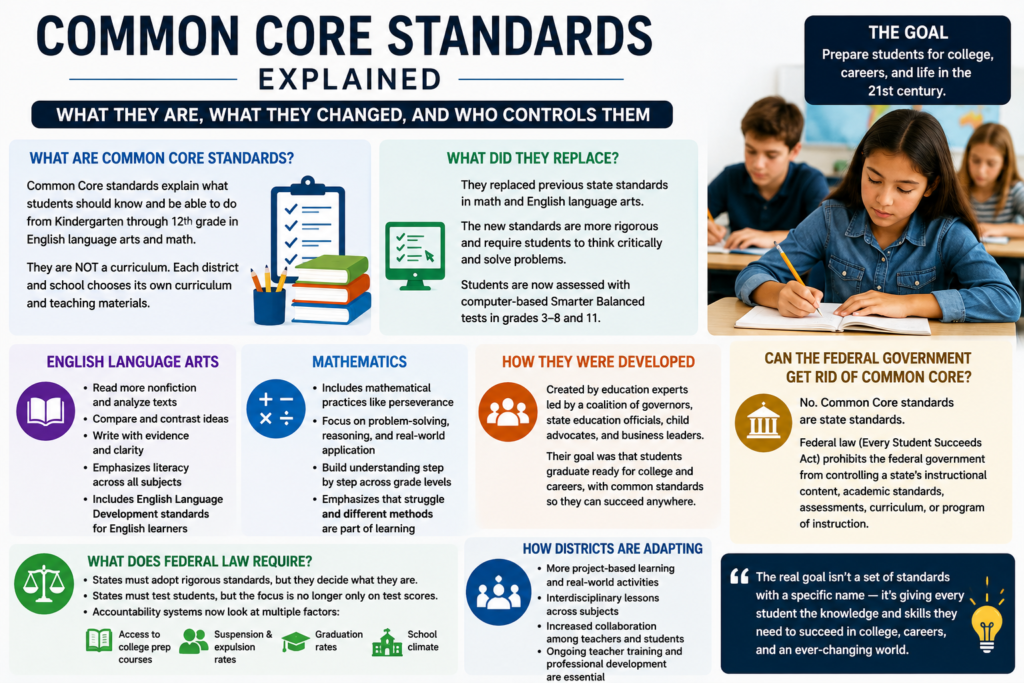
Common Core Standards Explained: What They Are, What They Changed, and Who Controls Them
The Common Core State Standards have been one of the most debated topics in American education. Supporters have argued that common academic expectations can help students develop stronger reading, writing, mathematics, critical-thinking, and problem-solving skills. Critics, meanwhile, have raised concerns about how the standards are implemented and the role of government in education.
Political debates have also made the term “Common Core” widely known. Former President Donald Trump campaigned on ending Common Core and returning greater control over education to states and local communities. However, understanding what Common Core actually is—and who has legal authority over it—is essential before discussing whether a president can simply abolish it.
The answer begins with a basic distinction:
Common Core is a set of academic standards, not a national curriculum.
What Are the Common Core Standards?
The Common Core State Standards are learning expectations for students in English language arts/literacy and mathematics from kindergarten through 12th grade.
In simple terms, standards describe what students should know and be able to do by a particular grade level.
For example, standards can establish expectations for reading comprehension, writing, speaking and listening, mathematical reasoning, algebraic concepts, and problem-solving.
They do not tell a teacher exactly how to teach a lesson.
This distinction between education standards and curriculum is extremely important.
A standard establishes the learning goal.
A curriculum provides the instructional plan, materials, lessons, and activities used to reach that goal.
The Common Core initiative itself states that teachers and local education systems determine how standards are taught and which instructional materials are used.
Common Core Is Not a National Curriculum
One of the most common misunderstandings about Common Core is that it created a single curriculum for schools throughout the United States.
It did not.
A school district can choose textbooks, lesson plans, teaching methods, and other educational resources while still working toward the standards adopted by its state.
This means two schools in different states could use completely different curricula while having similar academic expectations in particular subjects.
The distinction can be summarized simply:
Standards = What students should learn.
Curriculum = How educators teach it.
That difference is central to understanding the Common Core debate.
What Did Common Core Replace?
Before Common Core, states generally had their own academic standards for mathematics and English language arts.
This meant that expectations could vary from one state to another.
Common Core was developed as a state-led initiative to establish clearer and more consistent expectations across participating states.
State leaders, including governors and state education commissioners, played a central role in developing the standards through organizations such as the National Governors Association and the Council of Chief State School Officers.
The objective was to establish learning expectations that would better prepare students for college, careers, and life after high school.
Why Were Common Standards Created?
One argument behind Common Core was that students should have access to strong academic expectations regardless of where they live.
Consider a student whose family moves from one state to another.
If the two states organize their educational expectations very differently, the student may encounter material they have already studied—or material they have not yet learned.
Common standards were intended to provide greater consistency.
The Common Core initiative describes its goals as including clear expectations, college and career readiness, rigorous content, and the application of knowledge through higher-order thinking.
How Did Common Core Change English Language Arts?
The Common Core English Language Arts standards place significant emphasis on reading, writing, speaking, listening, language, analysis, and evidence.
Students are expected not only to read information but also to analyze it and support their conclusions.
This can involve working with both literary and informational texts.
Students may be asked to:
- Analyze what they read
- Compare information from different texts
- Identify evidence supporting an argument
- Write clearly and logically
- Explain their reasoning
- Participate in discussions
- Develop stronger research and communication skills
The standards also extend literacy expectations into subjects such as history, science, and technical fields.
This approach reflects a broader educational goal: students should not simply memorize information; they should learn how to understand, analyze, communicate, and apply it.
What Is Different About Common Core Mathematics?
The Common Core mathematics standards combine mathematical content with mathematical practices.
Students still learn fundamental areas such as:
- Addition
- Subtraction
- Multiplication
- Division
- Fractions
- Decimals
- Algebra
- Geometry
- Mathematical reasoning
But there is also greater emphasis on how students approach mathematical problems.
Students are encouraged to reason, explain their methods, use appropriate tools, persevere through difficult problems, and connect mathematics with real-world situations.
The standards specifically include mathematical practices that apply across grade levels, while the content expectations build progressively from one level to the next.
Why Is Critical Thinking Important?
One of the major themes associated with Common Core is the development of critical thinking and problem-solving skills.
Instead of only asking students to remember a formula or reproduce an answer, instruction aligned with these standards can ask students to explain why a solution works.
That difference matters.
A student who memorizes an answer may succeed on one question.
A student who understands the reasoning behind the answer may be able to solve a completely different problem later.
This focus on understanding and application is one reason the Common Core standards describe themselves as emphasizing rigorous content and higher-order thinking.
Can the President Abolish Common Core?
This is where the political discussion often becomes confusing.
The federal government does not own or administer the Common Core standards.
Common Core is a state-led initiative, and states decide whether to adopt the standards.
The U.S. Department of Education currently states that there are no federal national academic standards and that education standards are primarily determined by states, while curricula are developed by states and local agencies.
Federal law also places restrictions on federal control over state academic standards and curriculum.
The relevant federal provisions state that federal officials may not direct or control a state’s specific instructional content, academic achievement standards and assessments, curriculum, or program of instruction as a condition of receiving federal funds.
Therefore, a president cannot simply sign an order and erase Common Core from every state.
A state that has adopted Common Core—or standards based on similar concepts—has authority over its own education standards.
What Role Does the Federal Government Have?
The federal government still plays an important role in American education through funding, civil-rights enforcement, data, programs, and federal education laws.
But that does not mean Washington determines the curriculum taught in every public school.
The U.S. Department of Education explicitly says it does not determine state education standards or develop and implement state testing systems used to measure whether states meet their own standards.
This is why the phrase “federal education standards” can be misleading when discussing Common Core.
The standards were created through a state-led process and adopted voluntarily by participating states.
What Does Federal Education Law Require?
Federal education law can establish certain requirements related to accountability, testing, funding, and reporting.
However, federal law does not give the Department of Education unlimited authority to decide what every state must teach.
Under the Every Student Succeeds Act (ESSA), states are responsible for selecting their academic standards.
The law specifically limits federal involvement in state academic standards, curriculum, and instruction.
This distinction is important because federal education policy can influence how states operate their education systems without giving the federal government direct authority to impose Common Core.
How Were the Standards Developed?
The development of Common Core was led by state education leaders.
Governors and state education commissioners from numerous states participated in the process through their representative organizations.
Educators, researchers, experts, and other stakeholders also contributed to the development and review process.
The standards were designed using research, existing state standards, international comparisons, and expectations associated with college and career readiness.
The central idea was to create clearer and more consistent academic expectations while leaving curriculum and teaching decisions largely to states, districts, schools, and educators.
How Are Schools Adapting to Standards?
Implementing new academic standards can require substantial changes.
Teachers may need new instructional materials.
Schools may need professional development.
Districts may need to update curriculum resources and assessments.
Students may also encounter different types of questions that require more explanation and reasoning.
Implementation can therefore look different from one district to another.
Some schools may emphasize project-based learning, collaborative activities, interdisciplinary lessons, and real-world applications.
For example, a lesson about climate change could combine science research, mathematics, writing, presentations, and group work.
This type of interdisciplinary learning can help students understand how knowledge from different subjects connects to real-world problems.
Why Teacher Training Matters
Standards alone cannot improve education.
Teachers need the training, resources, time, and support necessary to implement them effectively.
Even when academic standards are clear, the quality of classroom instruction can vary depending on the preparation and support available to educators.
This is why professional development is an important part of education reform.
Teachers need opportunities to understand the standards, develop appropriate lessons, evaluate student progress, and adapt instruction for students with different learning needs.
The Common Core framework itself recognizes that implementation support is primarily a state and local responsibility.
Common Core and the Future of Education
The debate over Common Core is ultimately part of a much larger question:
What should students know and be able to do before they graduate?
Modern education increasingly emphasizes more than memorization.
Students need to read critically, communicate clearly, solve problems, work with information, use mathematics, evaluate evidence, and adapt to changing career requirements.
These goals have become even more significant in an era of artificial intelligence and rapidly changing technology.
Students entering today’s workforce may need to work alongside AI systems, analyze information generated by technology, and make decisions that require judgment and creativity.
That makes skills such as critical thinking, problem-solving, communication, and analytical reasoning increasingly valuable.
Final Thoughts
The Common Core debate is often presented as a simple political argument, but the issue is more complicated.
Common Core is not a federally imposed curriculum. It is a state-led set of academic standards for English language arts and mathematics, designed to establish clear learning expectations. States decide whether to adopt them, while districts and educators have significant responsibility for curriculum and instruction.
The federal government can influence education through laws, funding, and accountability requirements, but current federal law places clear limits on its ability to dictate state academic standards and curriculum.
Whatever position someone takes on Common Core, one principle remains important: students need strong academic foundations, critical-thinking skills, and the ability to apply what they learn.
The real challenge for education is not simply deciding which standards carry a particular name.
It is ensuring that every student receives the knowledge and skills needed to succeed in college, careers, and an increasingly technology-driven world.