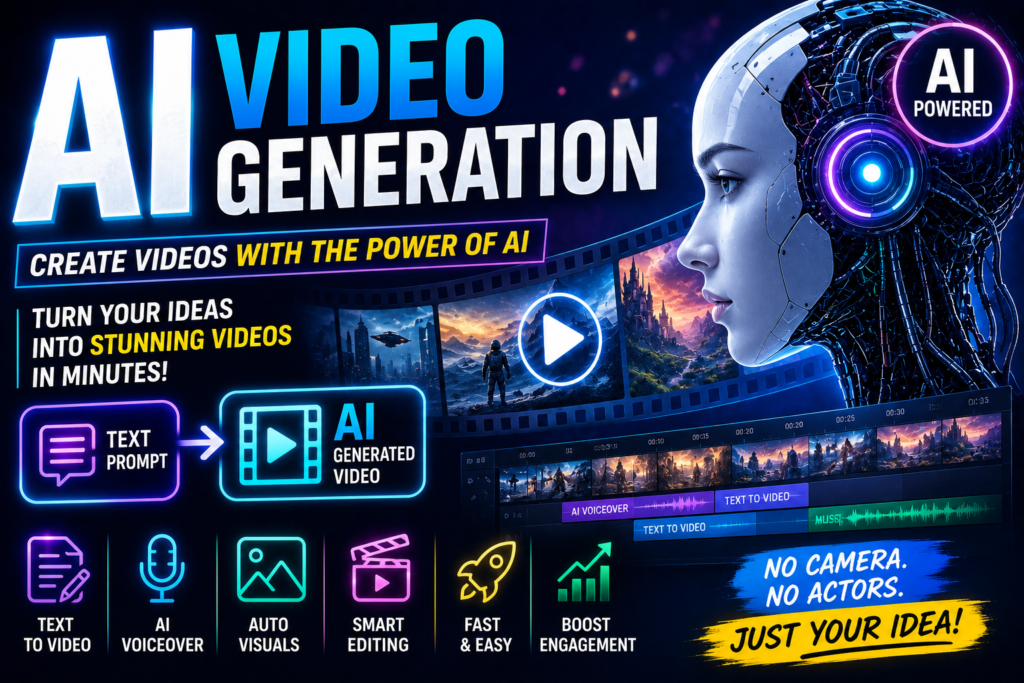
AI Video Generation: How Artificial Intelligence Is Changing Video Creation
Video has become one of the most powerful forms of digital content. Businesses, creators, marketers and educators use videos to explain ideas, promote products and communicate with audiences.
Creating professional videos, however, can require cameras, actors, editing software, animation skills and significant amounts of time.
AI Video Generation is changing this process by allowing users to create video content with the help of artificial intelligence.
Instead of producing every element manually, creators can use AI to generate scripts, scenes, visuals, voiceovers and other parts of the production process.
What Is AI Video Generation?
AI Video Generation is the use of artificial intelligence to create or transform video content.
Depending on the tool, users may be able to start with:
- A text prompt
- A script
- An image
- Existing video
- A product description
- A creative idea
The AI system can then generate or modify video content based on the instructions.
How Does AI Video Generation Work?
Modern AI video systems can use machine-learning models trained on large amounts of visual and language data.
A simplified workflow looks like this:
Prompt → AI Understanding → Scene Generation → Motion → Audio → Final Video
For example, a creator could describe a futuristic city at night. An AI system may interpret the description and generate a short visual sequence based on it.
The exact capabilities vary considerably between AI video tools.
Text-to-Video Technology
One of the most exciting developments is Text to Video.
With text-to-video systems, users can describe a scene using natural language.
For example:
“A futuristic city with autonomous vehicles moving through neon-lit streets at night.”
The system can attempt to generate a video matching the description.
This makes video creation accessible to people who may not have professional filmmaking skills.
AI Video for Social Media
Social media platforms are heavily focused on video content.
Creators can use AI tools to help produce:
- Short videos
- Educational clips
- Product videos
- Promotional content
- Storytelling videos
- Social-media advertisements
AI can potentially reduce the time required to turn an idea into a finished piece of content.
AI Video for Businesses
Businesses can also use AI video technology for marketing and communication.
Companies may create videos for:
- Product demonstrations
- Advertisements
- Tutorials
- Training
- Presentations
- Website content
- Social media
This can make video production more accessible to smaller businesses that may not have large production budgets.
AI Video and Marketing
Marketing teams constantly need fresh content.
AI can help marketers generate multiple creative concepts and variations.
For example, a marketing team could create different versions of a product video for different audiences.
AI can also assist with scripts, captions, voiceovers and editing.
Human marketers can then review the material and select the strongest version.
AI Avatars and Digital Presenters
Another growing area is AI-generated presenters and avatars.
These systems can create digital characters that appear to speak a script.
Potential applications include:
- Online courses
- Corporate training
- Product explanations
- News-style presentations
- Marketing videos
- Educational content
This can reduce the need for traditional filming for certain types of videos.
AI Voice Generation
Video creation often requires narration.
AI voice technology can generate synthetic speech from written text.
This allows creators to produce voiceovers without recording every sentence themselves.
Modern AI voices can sometimes provide different languages, accents and speaking styles, depending on the system.
However, creators should make sure they have appropriate rights when using cloned or highly recognizable voices.
AI Video Editing
AI is not limited to generating new videos.
It can also assist with editing existing footage.
AI-powered editing systems may help with:
- Removing unwanted sections
- Generating captions
- Improving audio
- Detecting scenes
- Creating short clips
- Adding effects
- Organizing footage
This can reduce repetitive editing work.
AI Video for Education
Education is another area where AI video could become useful.
Teachers and content creators can use AI-assisted video production to create:
- Tutorials
- Explainer videos
- Animated lessons
- Language-learning content
- Training materials
Instead of spending hours creating every visual element manually, educators can use AI to accelerate parts of the production process.
AI Video for E-Commerce
Online stores can use video to showcase products.
AI video tools can help create promotional content from product images, descriptions or existing footage.
Potential applications include:
- Product advertisements
- Social-media videos
- Product demonstrations
- Promotional campaigns
- Short-form video content
Benefits of AI Video Generation
Faster Production
AI can automate parts of the video creation process.
Lower Production Requirements
Creators may not need cameras, actors or large production teams for every project.
More Creativity
Creators can experiment with ideas that would be difficult or expensive to film traditionally.
Easy Content Variations
AI can help produce different versions of a video for different audiences.
Accessibility
People without professional video-production skills can experiment with advanced visual content.
Challenges of AI Video Generation
Despite its advantages, AI video generation has important limitations.
Inconsistent Results
AI-generated videos may sometimes contain visual inconsistencies or unexpected movements.
Control
Producing exactly the desired scene can still require multiple attempts and careful prompting.
Copyright Questions
Training data, generated content and the use of copyrighted material raise ongoing legal and ethical questions.
Deepfakes and Misinformation
AI video can also be misused to create realistic but misleading content.
Human Creativity Still Matters
AI can generate content, but human direction, storytelling and editing remain important for producing effective videos.
AI Video and the Future of Content Creation
The future of video production is likely to combine AI tools with human creativity.
A creator could potentially describe an idea, generate initial scenes with AI, edit the result, add original footage and finalize the project manually.
This creates a hybrid workflow:
Human Idea → AI Generation → Human Direction → AI Assistance → Final Video
Rather than replacing every filmmaker or creator, AI may become another powerful production tool.
Will AI Replace Video Creators?
It is unlikely that AI will completely replace human creativity in every type of video production.
Professional filmmaking involves storytelling, emotion, cultural understanding, creative direction and many decisions that go beyond generating individual scenes.
However, AI could change how creators work.
People who learn how to combine AI video tools with traditional creative skills may be able to produce content faster and experiment with more ideas.
The Future of AI Video Generation
As AI models improve, video generation is likely to become more realistic, controllable and accessible.
Future systems may provide creators with greater control over:
- Characters
- Camera movement
- Lighting
- Storylines
- Dialogue
- Environments
- Video length
- Visual styles
This could bring sophisticated video production capabilities to a much larger number of people.
Final Thoughts
AI Video Generation is becoming an important part of the rapidly growing generative AI industry.
From social-media creators and marketers to educators and businesses, people are exploring AI for creating, editing and transforming video content.
The technology still has challenges involving quality, consistency, copyright and misinformation.