AI Agents: How Autonomous AI Is Changing the Future of Technology
Artificial intelligence has moved beyond simple chatbots and content-generation tools.
Today’s AI systems can write text, generate images, analyze information and assist with coding. The next major development is the rise of AI Agents—systems designed to take a goal, plan steps and use available tools to complete tasks with less human intervention.
This emerging approach is often called Agentic AI.
What Are AI Agents?
AI Agents are software systems that can perceive information, reason about a task, make decisions and take actions to achieve a particular goal.
A traditional chatbot might answer:
“How can I improve my website?”
An AI agent could potentially go further by researching the website, analyzing information, creating a plan and using connected tools to perform specific actions.
The exact capabilities depend on the agent and the tools it has access to.
How Do AI Agents Work?
A typical AI agent workflow can involve several stages:
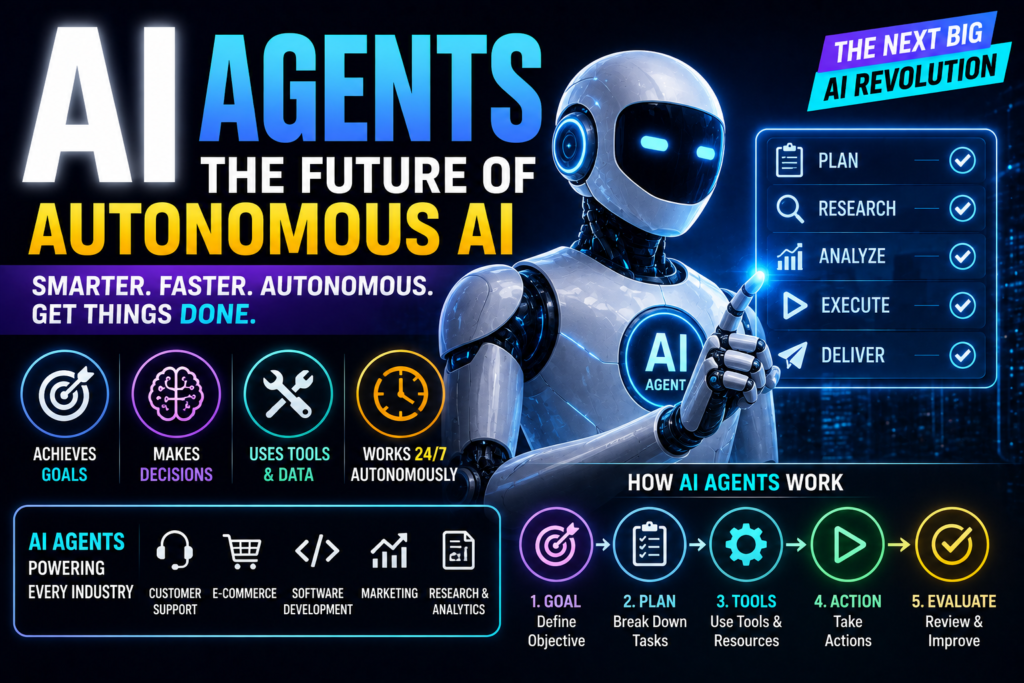
Goal → Planning → Tool Use → Action → Evaluation → Next Step
The agent receives an objective and determines what needs to be done.
It may then:
- Search for information
- Analyze data
- Use software tools
- Generate content
- Call APIs
- Check results
- Adjust its approach
This makes agents different from systems that only generate a single response.
AI Agents vs AI Chatbots
There is an important difference between traditional AI assistants and autonomous agents.
AI Chatbot
A chatbot generally waits for a user’s message and produces a response.
AI Agent
An agent can potentially take a broader goal, break it into tasks and execute multiple steps using available tools.
For example:
Chatbot:
“Here is how you can create a marketing campaign.”
AI Agent:
“Research the market, identify opportunities, prepare campaign content and organize the workflow.”
The second approach focuses more on action rather than conversation.
Why AI Agents Are Trending
The popularity of AI agents is growing because businesses want AI systems that can do more than generate information.
Companies are exploring agents for:
- Customer service
- Sales
- Marketing
- Software development
- Research
- Data analysis
- Administration
- Workflow automation
Instead of using AI only as an assistant, businesses are exploring how it can become part of the actual workflow.
AI Agents in Business
Businesses perform many repetitive digital tasks every day.
AI agents could potentially automate parts of these workflows.
For example, a marketing agent could:
- Research a topic
- Analyze competitors
- Generate content ideas
- Create a draft
- Prepare social posts
- Organize the campaign
Human employees could then review the results and make important decisions.
AI Agents for Customer Support
Customer service is another major application.
An AI agent could potentially:
- Read customer questions
- Search a knowledge base
- Identify the issue
- Provide an answer
- Update a support ticket
- Escalate complicated cases
This can help companies handle large numbers of routine requests.
However, sensitive or complicated situations may still require human involvement.
AI Agents for Software Development
AI coding tools are already changing software development.
Agent-based systems can potentially work through multiple steps of a development task.
For example, an agent could:
- Understand a requirement
- Inspect existing code
- Write new code
- Run tests
- Identify errors
- Make corrections
This can transform AI from a simple coding assistant into a more active development partner.
AI Agents for Research
Research often involves gathering information from many sources.
An AI agent can potentially help automate parts of the process by:
- Searching information
- Comparing sources
- Summarizing findings
- Organizing data
- Identifying patterns
- Creating reports
Human review remains important because AI systems can make mistakes or misunderstand sources.
AI Agents and E-Commerce
Online stores can also benefit from agentic workflows.
Potential applications include:
- Product research
- Customer support
- Inventory analysis
- Marketing
- Competitor monitoring
- Product descriptions
- Sales assistance
An e-commerce agent could potentially connect several business tools and coordinate tasks automatically.
Multi-Agent AI Systems
Another interesting development is multi-agent AI.
Instead of using one AI agent for everything, several specialized agents can work together.
For example:
Research Agent → Writing Agent → SEO Agent → Marketing Agent
Each agent can focus on a specific task.
A coordinator can then organize the workflow.
This approach resembles having a digital team with different areas of expertise.
AI Agents and Automation
Traditional automation generally follows predefined rules.
For example:
If an email arrives → send a predefined response.
AI agents can potentially handle more flexible situations.
They may interpret the content, determine what is required and select an appropriate action.
This can make automation useful for tasks that are difficult to describe with simple rules.
Benefits of AI Agents
Increased Productivity
Agents can automate repetitive digital tasks.
Faster Workflows
Multiple steps can potentially be completed without constant human intervention.
24/7 Operation
Software agents can operate continuously when properly configured.
Scalability
Businesses can deploy agents to handle large volumes of routine work.
Better Tool Integration
Agents can potentially connect AI reasoning with external applications and services.
Challenges of AI Agents
AI agents are powerful, but they also introduce new risks.
Incorrect Decisions
An agent can misunderstand a task or produce an incorrect result.
Security
Agents connected to business systems need strong access controls.
Privacy
Agents may process sensitive company or customer information.
Cost
Complex agent workflows can require significant computing resources.
Human Oversight
Important business decisions should not automatically be delegated to AI without appropriate review.
The Importance of Human Control
The future of AI agents is unlikely to be completely autonomous for every task.
For important workflows, humans may continue to provide:
- Approval
- Supervision
- Strategy
- Quality control
- Ethical judgment
This creates a human + AI model where agents perform routine actions while humans remain responsible for important decisions.
The Future of AI Agents
The development of AI Agents could change how people interact with software.
Instead of opening multiple applications and manually performing every step, users could increasingly describe what they want to accomplish.
The AI agent could then coordinate the required tools and workflows.
For example:
“Prepare a weekly business report and send it to my team.”
A future agent could potentially gather data, analyze it, create the report and prepare the communication.
AI Agents and the Future of Work
AI agents may change many jobs without necessarily eliminating every human role.
Employees could spend less time on repetitive digital work and more time on:
- Strategy
- Creativity
- Communication
- Problem-solving
- Leadership
The biggest change may be that people learn to manage and collaborate with AI agents rather than simply use AI as a search or writing tool.
Final Thoughts
AI Agents represent an important shift in artificial intelligence.
Instead of only answering questions, AI systems are increasingly being designed to plan tasks, use tools and take actions toward a goal.
Agentic AI could influence software development, marketing, customer service, research, e-commerce and many other industries.
The technology is still developing, and reliability, security and human oversight remain important challenges.
But as AI agents become more capable, the future of AI may move from simply generating answers to actually helping people complete entire workflows.