Your Teen Turned to AI Instead of You: What Parents Can Do
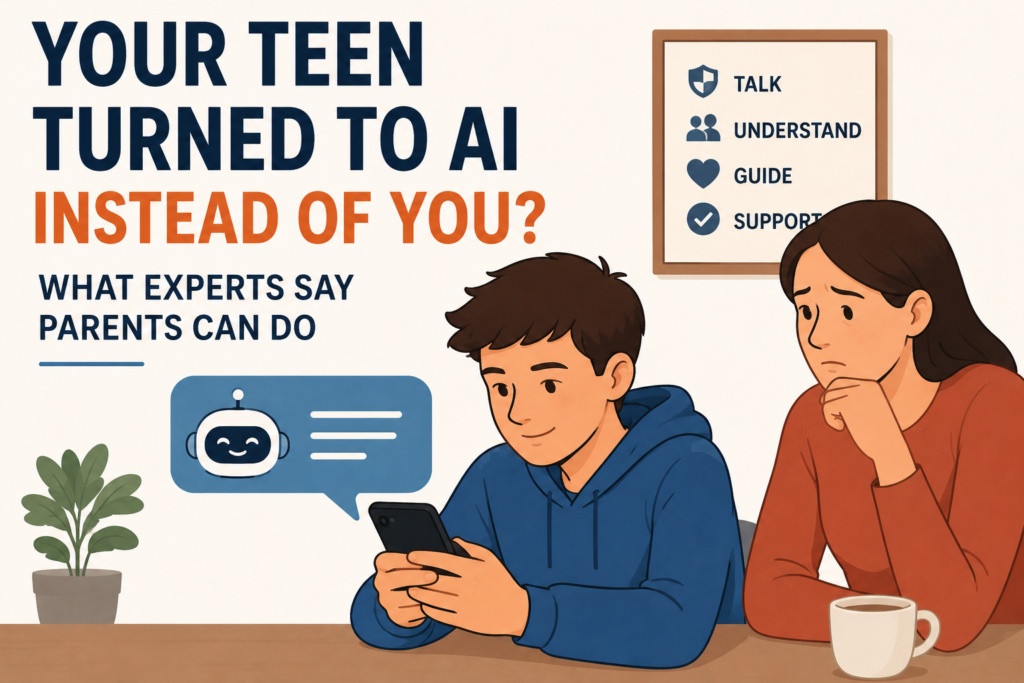
For many parents, one of the strangest parts of the AI era is realizing that their teenager may ask a chatbot a question they once would have asked Mom or Dad.
It might be something simple: help with homework, advice about a friendship, ideas for dealing with stress, or even an embarrassing question they don’t feel comfortable asking out loud.
That can hurt.
A parent may immediately wonder: “Why didn’t my child come to me?”
But experts suggest that parents should look at this development with curiosity rather than immediately treating it as a rejection. AI is becoming a normal part of teenagers’ digital lives, and the better response may be to understand why teens use AI, what they are using it for, and where parents still need to play a central role.
Recent Pew Research Center research found that 64% of U.S. teens ages 13–17 reported using AI chatbots, compared with 51% of parents who said their teen uses them. More than half of teens said they use chatbots to search for information or get help with schoolwork.
The important question, therefore, isn’t simply whether teenagers are using AI.
It’s how they are using it—and whether AI is becoming a supplement to human relationships or a substitute for them.
Why Are Teens Turning to AI?
There are several reasons an AI chatbot can feel easier for a teenager to approach than a parent.
First, it’s available almost instantly.
A teenager doesn’t have to wait until a parent is free, explain why they are asking, or worry about an immediate reaction.
There is also a sense of privacy.
A teen may think:
“I can ask this without someone looking disappointed.”
“I don’t have to explain everything.”
“I can ask the same question five different ways.”
That convenience can make AI attractive, particularly when a teenager is embarrassed, uncertain, or simply curious.
But convenience shouldn’t be confused with genuine understanding.
A chatbot can generate a supportive-sounding response, but it does not have the lived relationship, emotional connection, or knowledge of the family that a parent has.
The American Psychological Association warns that some adolescents can mistake programmed responses for genuine empathy and recommends that parents help teens understand the difference between AI interaction and real human relationships.
Don’t Start With: “Why Are You Talking to AI Instead of Me?”
If you discover that your teenager has been asking AI for personal advice, your first reaction may be frustration.
You might want to say:
“Why didn’t you just ask me?”
But that question can accidentally shut down the conversation.
A better approach is curiosity.
Try:
“What do you usually use AI for?”
Or:
“Can you show me how you use it?”
Or even:
“What do you like about asking AI questions?”
The American Academy of Pediatrics recommends that parents approach teens’ AI use with openness and curiosity, including asking low-pressure questions such as how they use AI, what their friends use it for, and how the interactions make them feel.
The goal isn’t to interrogate your teenager.
It’s to keep the door open.
AI Can Become a Bridge Between Parents and Teens
Instead of treating AI and parenting as competing forces, parents can use AI as an opportunity to start conversations.
For example, if your teen tells you that they asked ChatGPT about a school problem, don’t immediately criticize the use of AI.
Ask:
“What did it tell you?”
Then:
“Do you think that answer was accurate?”
This creates an opportunity to teach AI literacy for teens.
You’re helping your child understand that AI responses should be questioned, checked, and discussed—not automatically accepted.
Over time, these conversations can become part of normal family life.
Teach Your Teen That AI Can Be Wrong
One of the biggest risks of relying on AI is that an answer can sound confident even when it is incomplete or incorrect.
This is particularly important when teenagers use AI for health, relationships, emotional problems, or other sensitive subjects.
Research and guidance from psychologists have highlighted concerns about teens receiving misleading health information from AI because chatbot responses can sound authoritative even when the underlying information isn’t reliable.
Parents can teach a simple habit:
Stop → Question → Verify.
Before acting on important AI-generated information, ask:
- Where did this information come from?
- Could the AI be wrong?
- Is there another reliable source?
- Should an adult or professional be involved?
- Does this advice actually make sense for my situation?
These are valuable digital safety skills for teenagers, regardless of which AI tool they use.
Don’t Try to Compete With AI
Parents can’t—and shouldn’t—try to become faster versions of ChatGPT.
AI can instantly summarize a 20-page document.
It can generate dozens of ideas.
It can answer questions at any hour.
Trying to compete with that isn’t the point.
What AI cannot replace is the relationship between a parent and child.
You know your teenager’s history.
You know their personality.
You recognize changes in their behavior.
You understand family circumstances that an AI system doesn’t know.
Most importantly, your teenager knows that you genuinely care about them.
That human relationship is the foundation that technology cannot reproduce.
Make AI Something You Can Talk About Together
One of the most effective strategies for parents and teens using AI is to make AI a normal conversation topic.
You don’t need to have a formal family meeting.
You can bring it up naturally.
Ask your teen:
“What AI tools are people at school using?”
“What do you think AI is actually good at?”
“Have you ever gotten an answer from AI that turned out to be wrong?”
“What would you never tell an AI?”
These questions can teach your teenager to think critically without making them feel like they are being monitored.
Help Your Teen Understand Privacy
Teenagers may share more information with AI than they realize.
That can include names, school details, relationship problems, personal experiences, images, or other sensitive information.
Parents should teach children to think carefully before entering personal information into AI systems.
A good general rule is:
If you wouldn’t want that information shared outside a private conversation, think carefully before putting it into an AI chatbot.
The American Psychological Association has also highlighted concerns around teens’ personal data and how information collected by AI systems may be used.
Teaching AI privacy and online safety is therefore becoming an important part of modern parenting.
Pay Attention to Emotional Dependence
Using AI for homework or brainstorming is very different from relying on a chatbot for emotional companionship.
This distinction matters.
Pew Research Center found that 12% of U.S. teens surveyed had used chatbots for emotional support or advice, while 16% reported using them for casual conversation.
Parents should pay attention if a teenager begins treating an AI system as their primary source of emotional support.
Warning signs can include:
- Spending increasing amounts of time talking to an AI companion
- Preferring AI conversations to real-world relationships
- Becoming upset when unable to access the chatbot
- Sharing extremely personal information with AI
- Relying on AI for major emotional or personal decisions
- Withdrawing from friends or family
The American Psychological Association specifically recommends encouraging real-world relationships and helping teens understand that AI cannot replace genuine human connection.
AI Should Not Become Your Teen’s Therapist
This is one area where parents should be particularly careful.
A chatbot may respond empathetically, but that doesn’t make it a therapist.
If your teenager is struggling with serious emotional distress, mental-health concerns, self-harm thoughts, abuse, or another significant safety issue, don’t rely on an AI chatbot as the primary source of help.
Real people need to be involved.
That can include parents or other trusted adults, qualified mental-health professionals, doctors, school counselors, or appropriate local support services.
The American Academy of Pediatrics similarly advises families to understand the risks of generative AI, particularly when young people use chatbots for companionship or mental-health-related purposes.
Use AI to Strengthen Your Teen’s Learning
There is also a positive side to AI for teenagers.
AI can be a useful educational tool when students use it to understand concepts rather than simply avoid doing their work.
A teenager might ask AI to:
- Explain a difficult mathematics problem
- Quiz them before an exam
- Provide examples of a concept
- Help brainstorm an essay
- Explain difficult vocabulary
- Create practice questions
- Help organize a study schedule
- Give feedback on a draft
Parents can encourage this type of use while still making sure their teenager understands the material.
The question shouldn’t always be:
“Did AI help you?”
It can also be:
“What did you learn from using it?”
Create Family Rules Instead of Simply Banning AI
A complete ban may sound attractive, but it can make honest conversations more difficult.
Instead, consider creating clear AI rules for teenagers.
For example:
AI can be used for:
- Research
- Brainstorming
- Studying
- Practice
- Organization
- Creative projects
Extra caution is needed for:
- Health information
- Mental-health concerns
- Relationship problems
- Financial decisions
- Personal information
- Sensitive images
Human help is required for:
- Serious safety concerns
- Medical emergencies
- Mental-health crises
- Abuse or exploitation
- Major personal decisions
The exact rules should depend on your child’s age, maturity, school policies, and the AI products being used.
Don’t Forget the Human Skills AI Can’t Teach
The purpose of AI education for teens shouldn’t be to make children dependent on technology.
It should help them become more capable.
Teenagers still need to learn how to:
- Communicate face-to-face
- Handle disagreement
- Solve problems independently
- Develop friendships
- Ask adults for help
- Evaluate information
- Manage emotions
- Make decisions
- Take responsibility for mistakes
These skills become even more important as AI becomes more powerful.
A teenager who can use AI but cannot communicate with people effectively isn’t necessarily prepared for the future.
What If Your Teen Really Does Prefer AI?
This is perhaps the hardest question for parents.
What if your teenager genuinely says:
“I’d rather talk to AI than talk to you.”
Don’t treat that sentence as the end of the relationship.
Try to understand what makes AI feel easier.
Maybe the teenager worries about judgment.
Maybe conversations at home have become tense.
Maybe they’re embarrassed.
Maybe they simply enjoy experimenting with technology.
Or perhaps they’re dealing with something they haven’t figured out how to discuss yet.
Instead of fighting the AI, focus on rebuilding the human connection.
Be available.
Listen without immediately lecturing.
Ask questions.
Give your teenager opportunities to talk without turning every conversation into a lesson.
Sometimes the best response isn’t another rule.
It’s simply making sure your child knows:
“You can still come to me.”
The Goal Isn’t to Remove AI From Your Teen’s Life
Artificial intelligence is already becoming part of teenage life.
Research from Common Sense Media in 2026 found that 86% of surveyed children ages 9–17 reported using AI, while more than four in ten said they had never talked with a parent or guardian about AI safety.
That suggests an important opportunity for parents.
Instead of waiting until something goes wrong, start the conversation now.
UNICEF also recommends that parents begin talking with children about AI early because young people can encounter artificial intelligence at home, at school, through friends, and in everyday digital environments.
Final Thoughts
Your teenager turning to AI doesn’t necessarily mean they’ve stopped needing you.
It may simply mean they have discovered a new tool that is fast, available, and easy to approach.
The challenge for parents is to make sure that convenience doesn’t replace human connection.
Don’t compete with the chatbot. Understand it.
Ask your teenager how they use AI.
Talk about what AI can and cannot do.
Teach them to question information.
Discuss privacy.
Set reasonable boundaries.
Encourage real friendships and family relationships.
And make sure they know that serious health, emotional, and safety concerns belong with trusted humans and qualified professionals—not an AI chatbot.
The future isn’t likely to be parents versus AI.
It will be parents teaching their children how to live wisely in a world where AI is everywhere.
And perhaps the most important lesson you can give your teenager is this:
AI can answer a question. But you will always be there to help them understand what really matters.