How AI Can Help Parents: Smart Ways to Use AI in Everyday Family Life
Artificial intelligence has quickly become part of everyday life. Tools such as ChatGPT can now help people write, research, organize information, generate ideas, plan activities, and solve everyday problems.
For parents, this technology can be surprisingly useful.
Parenting involves countless decisions every day. From organizing family schedules and planning meals to communicating with children and finding useful resources, there is always something that needs attention.
AI cannot replace a parent’s judgment, experience, or emotional connection with their children. But when used responsibly, it can become a practical parenting assistant.
The key is understanding what AI can do well—and knowing where human judgment should always remain in control.
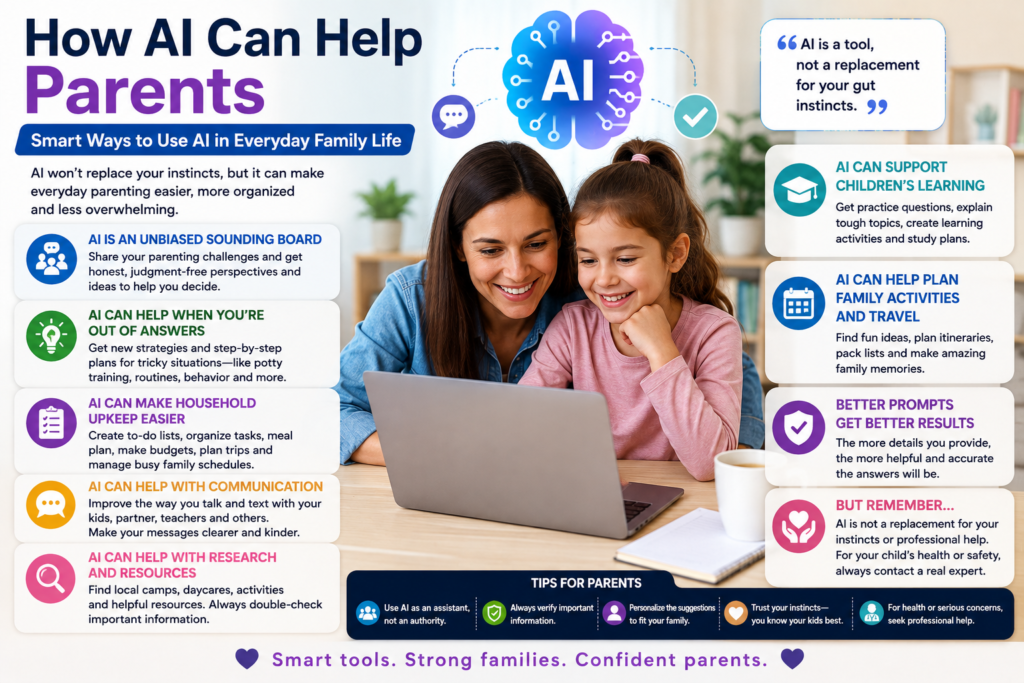
AI Can Be a Useful Parenting Sounding Board
Parents don’t always need someone to make a decision for them. Sometimes they simply need another perspective.
An AI parenting assistant can help you think through a difficult situation by presenting different possibilities, asking questions, and suggesting approaches you may not have considered.
For example, if you’re unsure how to handle a disagreement with your child, you could explain the situation to an AI tool and ask for several constructive approaches.
You can then consider those suggestions alongside your own knowledge of your child.
The advantage is that AI can provide an additional perspective without becoming emotionally involved in the situation.
However, parents should remember that AI doesn’t actually know their family the way they do. Its suggestions should therefore be treated as ideas—not final decisions.
AI Can Give Parents New Ideas When They Feel Stuck
Every parent eventually reaches a point where they think:
“I’ve tried everything. What should I do next?”
Whether it’s dealing with a difficult routine, helping a child develop better habits, planning activities, or finding ways to make learning more interesting, AI can generate new possibilities.
Parents can describe what they’ve already tried and ask an AI tool to suggest alternative approaches.
The important part is not blindly following the first suggestion.
Instead, use AI as a brainstorming tool for parents. Ask follow-up questions, remove ideas that don’t fit your family, and adapt the useful suggestions to your child’s personality and circumstances.
Sometimes a completely different perspective is enough to help you find a better approach.
AI Can Help Organize Busy Family Life
Modern parenting involves much more than taking care of children.
There are school schedules, appointments, extracurricular activities, household responsibilities, shopping, meal preparation, travel plans, birthdays, and countless other tasks.
AI can help turn this information into a more manageable plan.
For example, you can provide your weekly commitments and ask an AI tool to organize them into a practical schedule.
You can also use AI for family organization to:
- Create weekly to-do lists
- Organize household responsibilities
- Build family schedules
- Plan children’s activities
- Prepare packing lists
- Create shopping lists
- Organize vacation plans
- Develop simple household routines
The more relevant information you provide, the more useful the resulting plan can become.
AI Can Make Meal Planning Easier
“What are we having for dinner?” is one of those questions parents seem to answer every day.
AI can make family meal planning considerably easier.
Instead of simply asking for a seven-day meal plan, provide useful details such as:
- Foods your children enjoy
- Foods they refuse to eat
- Dietary requirements
- Available cooking equipment
- Your weekly schedule
- Your preferred budget
- How much time you have for cooking
AI can then help create a more practical meal plan.
Once you’ve selected the meals you actually want, you can ask it to turn the plan into a family grocery shopping list.
That small change can save time and reduce the mental effort involved in planning meals.
AI Can Help Parents Communicate More Effectively
Parent-child communication can become difficult, particularly when emotions are high.
A message that sounds perfectly reasonable to one person can sound harsh or dismissive to another.
AI can help parents review their wording before sending a sensitive message.
For example, if you’ve written an angry response to something your teenager said, you could ask AI to rewrite it in a calmer and more constructive tone.
You don’t have to use the AI-generated version exactly as it is.
Instead, use it as a communication editing tool.
You can ask:
- “Make this less aggressive.”
- “Make this sound supportive.”
- “Keep it firm but respectful.”
- “Make this easier for a teenager to understand.”
- “Make this sound more like a conversation.”
Then make the final changes yourself.
The goal isn’t to let AI communicate with your children for you. It’s to help you communicate more thoughtfully.
AI Can Help With Parenting Research
Parents constantly search for information.
You might want to understand a school-related topic, find activities for children, compare educational approaches, discover ideas for family trips, or learn more about a particular parenting challenge.
AI can be a useful starting point for parenting research.
Instead of opening dozens of websites and trying to figure out where to begin, you can ask AI to explain the topic and suggest areas that deserve further research.
But there’s an important rule:
Don’t Treat Every AI Answer as a Fact
AI systems can make mistakes.
They can provide outdated information, misunderstand a question, or generate information that sounds convincing but isn’t accurate.
Therefore, AI should be used as a research starting point, not the final authority.
For important matters, especially those involving a child’s health, safety, education, or well-being, information should be verified through reliable sources and qualified professionals.
AI Can Help Parents Support Their Children’s Learning
AI isn’t only useful for parents.
It can also help families create better learning experiences at home.
Parents can use AI to generate:
- Practice questions
- Vocabulary exercises
- Reading comprehension activities
- Educational games
- Study schedules
- Explanations of difficult concepts
- Age-appropriate learning activities
For example, if a child is struggling to understand a school topic, a parent can ask AI to explain the concept using simpler language or everyday examples.
This can make AI for children’s education a useful supplement to traditional learning.
The parent still plays the important role of deciding whether the explanation is appropriate and helping the child understand the material.
AI Can Help With Travel and Family Activities
Family planning can also benefit from AI.
Parents can provide information about the destination, children’s ages, available time, interests, budget, and preferred activities and ask AI to create an initial itinerary.
Similarly, AI can suggest:
- Indoor activities for rainy days
- Weekend family activities
- Educational outings
- Creative projects
- Age-appropriate games
- Family-friendly travel ideas
Again, the best results come when parents provide context rather than asking extremely broad questions.
Better Prompts Produce Better Results
One of the most important AI tips for parents is learning how to provide context.
Compare these two requests:
“Make a meal plan.”
and
“Create a seven-day family dinner plan for two adults and two children. We have limited cooking time on weekdays, the children don’t like spicy food, and we’d like affordable meals using ingredients available at a typical supermarket.”
The second request gives AI much more information to work with.
This principle applies to almost everything.
The more clearly you explain your circumstances, preferences, limitations, and desired outcome, the more useful the response is likely to be.
AI Should Support Parenting—Not Replace It
There is a temptation to treat AI as an authority because it can produce detailed answers in seconds.
That’s where parents need to be careful.
AI doesn’t know your child’s personality, your family’s history, your household dynamics, or everything that happens outside the information you provide.
A suggestion that works for one family might be completely unsuitable for another.
That’s why responsible AI use in parenting means keeping the human decision-maker at the center.
AI can suggest.
AI can organize.
AI can explain.
AI can brainstorm.
But the parent makes the final decision.
When Parents Should Turn to a Real Professional
There are situations where asking an AI chatbot isn’t appropriate.
If you’re seriously concerned about a child’s physical or mental health, safety, development, or well-being, professional guidance should take priority.
AI can help you formulate questions or understand general information, but it should not replace a qualified doctor, psychologist, teacher, counselor, or other appropriate professional.
This distinction is especially important because AI can sometimes provide confident answers even when the information is incomplete.
The Best Way to Think About AI as a Parent
Perhaps the simplest way to understand AI in parenting is this:
Don’t treat AI as another parent. Treat it as a tool.
A calculator doesn’t replace mathematical understanding.
A map doesn’t replace the ability to make decisions about a journey.
And an AI assistant shouldn’t replace parental judgment.
Instead, AI can reduce some of the mental workload that comes with modern family life.
It can help you organize information, explore possibilities, improve communication, and save time on repetitive tasks.
The Future of Parenting Will Include AI
Artificial intelligence is unlikely to disappear from everyday life.
Children are growing up in a world where AI will influence education, communication, employment, entertainment, and technology.
Parents therefore have an opportunity to model responsible AI use.
Instead of teaching children that AI is either something to fear or something that can do everything for them, parents can demonstrate a healthier approach:
Use technology. Question technology. Verify information. Think independently.
That lesson may ultimately be more valuable than simply knowing how to use a particular AI application.
Final Thoughts
AI won’t make someone a perfect parent—and no technology can.
But it can make certain parts of parenting easier.
From family organization and meal planning to communication, research, education, scheduling, and brainstorming, AI can act as a useful assistant when used thoughtfully.
The most important thing is to maintain the right balance.
Use AI to save time.
Use it to explore ideas.
Use it to organize information.
Use it to improve communication.
But don’t hand over your judgment.
The best parenting decisions still come from understanding your child, your family, and your own instincts. AI can provide another perspective—but you should remain in the driver’s seat.