
How AI and Its Applications Have Changed Our World
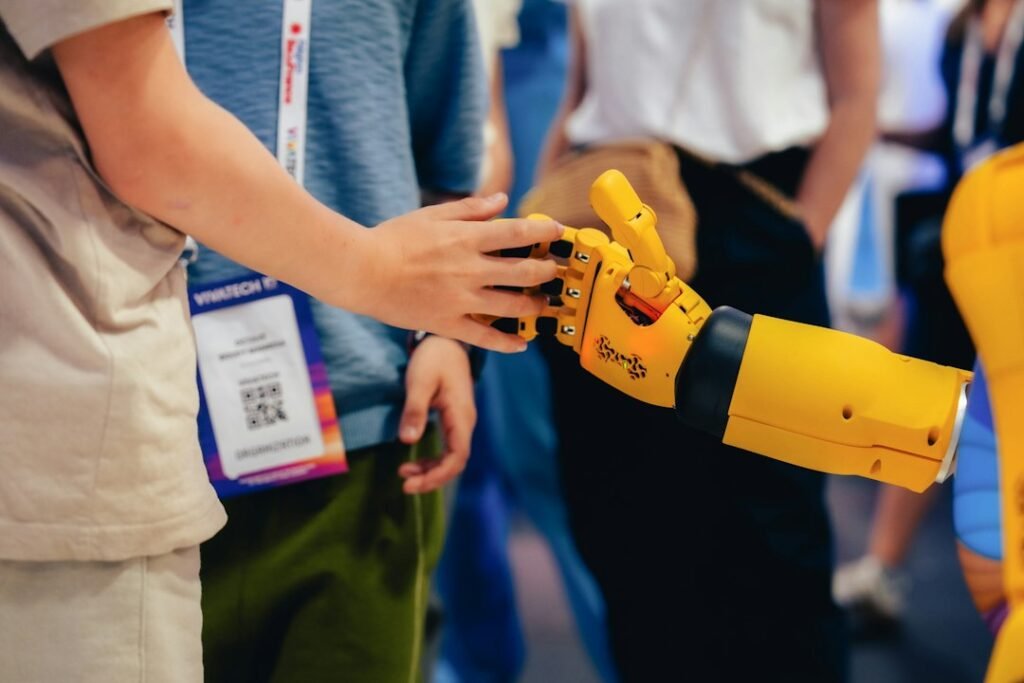
Photo by <a href="https://unsplash.com/@enchantedtools?utm_source=WP+Agent&utm_medium=referral">Enchanted Tools</a> on <a href="https://unsplash.com/?utm_source=WP+Agent&utm_medium=referral">Unsplash</a>
How AI and Its Applications Have Changed Our World
Artificial intelligence is no longer a futuristic concept—it has become one of the most transformative technologies of the 21st century. From the smartphones in our pockets to the hospitals that save lives, AI is reshaping industries, improving productivity, and changing the way humans interact with technology.
Just a decade ago, most AI applications were limited to research laboratories and large technology companies. Today, AI powers search engines, recommendation systems, virtual assistants, autonomous vehicles, medical diagnostics, creative tools, customer service, cybersecurity, and even scientific discoveries.
The impact of artificial intelligence extends far beyond automation. It is changing how people learn, communicate, work, create, and solve complex global challenges. This article explores how AI and its applications have changed our world, the industries benefiting from AI, the challenges it creates, and what the future may hold.
What Is Artificial Intelligence?
Artificial intelligence (AI) refers to computer systems capable of performing tasks that normally require human intelligence. These tasks include learning from data, recognizing patterns, understanding language, solving problems, making predictions, and generating content.
Unlike traditional software that follows fixed instructions, modern AI systems improve their performance by identifying patterns in large amounts of data. This ability has made AI one of the most powerful technologies ever developed.
Today, AI appears in countless forms, including:
- Virtual assistants
- Recommendation engines
- Image recognition
- Speech recognition
- Language translation
- Generative AI
- Predictive analytics
- Robotics
- Autonomous systems
AI is increasingly becoming an invisible layer behind many of the digital services people use every day.
The Evolution of AI
Artificial intelligence has evolved dramatically over the past several decades.
Early AI focused on rule-based systems that followed predefined instructions. Modern AI relies heavily on machine learning, deep learning, neural networks, and large language models capable of understanding complex patterns across enormous datasets.
Several breakthroughs accelerated this transformation:
- Faster computers
- Cloud computing
- Big data
- Neural networks
- Deep learning
- Transformer architecture
- Generative AI
These developments made AI more accurate, more accessible, and more practical for real-world applications.
How AI Has Changed Everyday Life
Many people interact with artificial intelligence dozens of times every day without realizing it.
When your smartphone predicts your next word, your streaming service recommends a movie, your navigation app finds the fastest route, or your email filters spam automatically, AI is already working behind the scenes.
Instead of being limited to one device or application, AI has become deeply integrated into everyday digital experiences.
The result is a world where technology feels increasingly personalized and responsive.
AI in Healthcare: Saving Lives and Improving Medicine
Healthcare is one of the industries experiencing the greatest transformation through artificial intelligence.
AI helps healthcare professionals analyze enormous amounts of medical information more efficiently.
AI applications in healthcare include:
- Medical image analysis
- Disease detection
- Drug discovery
- Patient monitoring
- Administrative automation
- Medical research
- Personalized treatment planning
For example, AI systems can assist doctors by identifying patterns in X-rays, MRIs, and CT scans that may deserve closer attention.
AI also helps researchers analyze biological data much faster than traditional methods.
However, AI is not replacing doctors. Instead, it serves as a decision-support tool that can improve efficiency while human professionals remain responsible for patient care.
AI in Education: Personalized Learning for Everyone
Education has changed dramatically with the introduction of AI-powered learning tools.
Instead of providing identical lessons to every student, AI can adapt learning experiences to individual needs.
AI is helping students by:
- Explaining difficult concepts
- Creating personalized study plans
- Generating practice questions
- Translating educational content
- Supporting language learning
- Providing instant feedback
Students can receive explanations at different difficulty levels, making education more accessible for diverse learning styles.
Teachers also benefit from AI through grading assistance, lesson planning, content creation, and administrative support.
Rather than replacing educators, AI can reduce repetitive tasks and allow teachers to spend more time supporting students.
AI in Business: A New Era of Productivity
Businesses across every industry are adopting AI to improve efficiency and decision-making.
Artificial intelligence can automate repetitive tasks while helping organizations analyze data more effectively.
Common business applications include:
- Customer support
- Marketing automation
- Sales forecasting
- Inventory management
- Document summarization
- Business analytics
- Financial reporting
- Workflow automation
Small businesses now have access to AI tools that were once available only to large corporations.
This has reduced barriers to innovation and increased competitiveness across many industries.
AI in Finance: Smarter Decisions and Better Security
Financial institutions use AI to process enormous amounts of transactional data in real time.
AI helps improve both customer experience and security.
AI applications in finance include:
- Fraud detection
- Credit risk analysis
- Investment research
- Customer service chatbots
- Budgeting assistance
- Market forecasting
- Compliance monitoring
Banks can detect unusual transaction patterns much faster with AI-assisted monitoring, helping reduce financial fraud.
Consumers also benefit from personalized financial insights and automated budgeting tools.
AI in Transportation: Making Travel Smarter
Transportation has become significantly more intelligent through AI.
Navigation applications continuously analyze traffic conditions to recommend faster routes.
AI also supports:
- Traffic management
- Route optimization
- Fleet logistics
- Predictive vehicle maintenance
- Driver assistance systems
- Autonomous vehicle research
Even when fully autonomous vehicles are not involved, AI already helps reduce congestion and improve transportation efficiency.
AI in Manufacturing: Building Smarter Factories
Manufacturing has embraced AI through intelligent automation and predictive maintenance.
Factories increasingly use AI to monitor equipment, detect defects, optimize production, and reduce waste.
Benefits include:
- Higher efficiency
- Better quality control
- Reduced downtime
- Lower operational costs
- Improved workplace safety
Rather than simply replacing workers, AI often assists employees by handling repetitive monitoring tasks while humans oversee complex operations.
AI in Agriculture: Feeding a Growing Population
Agriculture faces enormous challenges, including climate change, population growth, and resource management.
AI helps farmers make better decisions through data-driven insights.
Agricultural AI applications include:
- Crop monitoring
- Soil analysis
- Weather prediction
- Irrigation optimization
- Pest detection
- Yield forecasting
These technologies can improve food production while reducing unnecessary use of water, fertilizers, and pesticides.
AI and Climate and Environmental Challenges
Climate change and environmental protection require analyzing enormous amounts of data.
AI can analyze weather patterns, satellite imagery, energy consumption, and other environmental data to help researchers understand changes and identify opportunities for improvement. It can also support smarter energy management by helping predict demand and optimize systems.
AI itself requires computing resources and energy to run, but its ability to improve efficiency elsewhere can also contribute to solutions for major environmental challenges.
AI in Retail and E-Commerce
Online shopping has become highly personalized because of artificial intelligence.
Retailers use AI to understand customer preferences and improve shopping experiences.
AI powers:
- Product recommendations
- Personalized advertising
- Inventory forecasting
- Dynamic pricing
- Customer support
- Demand prediction
When customers receive recommendations based on previous purchases or browsing behavior, AI is often driving those suggestions.
This creates more relevant shopping experiences while helping businesses increase customer satisfaction.
AI in Entertainment and Media
The entertainment industry has undergone major changes because of AI.
Streaming platforms use recommendation systems to suggest movies, music, and television shows based on viewing habits.
Generative AI has also introduced new creative possibilities.
Creators now use AI to assist with:
- Video editing
- Script writing
- Image generation
- Music composition
- Voice synthesis
- Animation workflows
AI is becoming a creative collaborator rather than simply a production tool.
AI in Communication
Communication has become faster and more accessible through AI-powered technologies.
Examples include:
- Real-time translation
- Speech recognition
- Voice assistants
- Email summarization
- Smart replies
- Accessibility tools
These innovations help reduce language barriers and improve communication across different cultures.
AI-powered translation makes global collaboration easier than ever before. For businesses, this can make it easier to communicate with international customers, and for individuals, it can open access to educational and informational resources created in other parts of the world.
AI and Accessibility
One of the most meaningful benefits of AI is improved accessibility.
AI-powered technologies can help people communicate, read information, understand images, and interact with digital devices. Speech recognition, text-to-speech systems, image descriptions, and other assistive technologies can make digital information easier to access for people with disabilities.
This demonstrates that AI isn’t only about productivity. It can also help make technology more inclusive.
AI and Scientific Research
Scientific research generates enormous amounts of data that humans cannot always analyze efficiently.
AI helps researchers discover patterns, generate hypotheses, and accelerate experimentation.
AI contributes to research in:
- Medicine
- Climate science
- Astronomy
- Chemistry
- Biology
- Engineering
- Materials science
Researchers increasingly combine human expertise with AI-assisted analysis to solve complex global problems more quickly.
Generative AI: Changing Creativity Forever
One of the biggest shifts in recent years has been the rise of generative AI.
Unlike traditional AI systems that classify or predict information, generative AI creates new content.
Modern generative AI can produce:
- Articles
- Images
- Videos
- Music
- Software code
- Presentations
- Marketing content
- Educational materials
This has dramatically expanded the creative possibilities available to businesses, educators, developers, and content creators.
However, it has also introduced new discussions about copyright, originality, authenticity, and responsible use.
AI and the Future of Work
Perhaps no topic generates more debate than AI’s impact on employment.
Some repetitive tasks are becoming increasingly automated.
At the same time, entirely new careers are emerging.
Rather than eliminating all jobs, AI is more likely to transform many existing roles.
Future workplaces will increasingly value skills such as:
- Creativity
- Critical thinking
- Communication
- Leadership
- Emotional intelligence
- Problem-solving
- AI collaboration
Learning how to work effectively alongside AI may become one of the most valuable professional skills of the coming decade.
The Benefits of AI
Artificial intelligence offers numerous advantages across society.
Major benefits include:
- Faster decision-making
- Higher productivity
- Better healthcare
- Personalized education
- Improved accessibility
- Stronger cybersecurity
- Scientific innovation
- Environmental monitoring
- Business efficiency
- Enhanced creativity
These benefits demonstrate why AI is becoming essential across both public and private sectors.
The Challenges AI Brings
Despite its advantages, AI also introduces important challenges.
Key concerns include:
- Privacy
- Bias
- Misinformation
- Job displacement
- Security risks
- Copyright issues
- Transparency
- Ethical decision-making
Responsible AI development requires balancing innovation with fairness, accountability, and human oversight.
Technology alone cannot solve these challenges—they require thoughtful policies and responsible human decisions.
AI Is Changing How Humans Solve Problems
Perhaps the greatest impact of AI is not automation itself.
It is the expansion of human capability.
AI helps people process information faster, discover patterns more efficiently, generate creative ideas, and solve problems that were previously too complex or time-consuming.
Doctors become better informed.
Teachers become better supported.
Scientists become faster researchers.
Businesses become more productive.
Students become more empowered learners.
In many cases, AI acts as an amplifier of human intelligence rather than a replacement for it.
What Does the Future Look Like?
Artificial intelligence is still evolving rapidly.
Future AI systems are likely to become more capable of understanding multiple forms of information, including text, images, audio, video, and real-world environments.
AI assistants may become deeply integrated into everyday software, helping people complete tasks naturally through conversation.
Future developments could include advances in:
- Healthcare
- Scientific discovery
- Climate solutions
- Education
- Robotics
- Accessibility
- Personalized digital assistants
However, the future of AI will depend not only on technological progress but also on ethical leadership and responsible governance.
The choices society makes today will shape how AI affects future generations.
Conclusion
Artificial intelligence has already changed our world in profound ways.
It has transformed healthcare, education, finance, transportation, manufacturing, agriculture, entertainment, communication, and scientific research. AI has become a powerful tool that helps people work smarter, learn faster, and solve increasingly complex challenges.
Yet the true value of AI does not come from replacing humans—it comes from augmenting human potential.
The future belongs not to humans or AI alone, but to the collaboration between human creativity, ethical decision-making, and intelligent technology.
As AI continues to evolve, the greatest opportunity is not simply building smarter machines.
It is building a smarter, more inclusive, and more innovative world for everyone.
For a broader look at AI’s overall impact and the future of work, see our guide to How AI Is Changing the World. For AI’s effect on privacy, bias, and everyday society, see AI and Society.








1 thought on “How AI and Its Applications Have Changed Our World”