
Robot Technology in 2026: How AI Robots Are Changing the Future
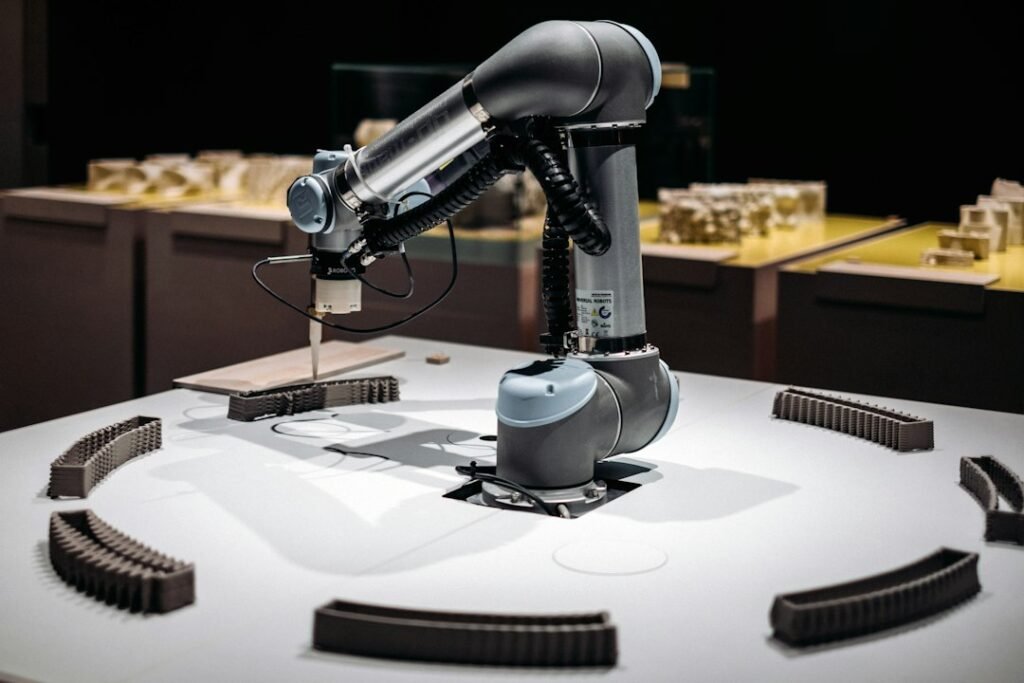
Photo by <a href="https://unsplash.com/@miteneva?utm_source=WP+Agent&utm_medium=referral">Maria Teneva</a> on <a href="https://unsplash.com/?utm_source=WP+Agent&utm_medium=referral">Unsplash</a>
Robot Technology in 2026: Are We Entering the Age of Intelligent Robots?
For decades, robots were mostly associated with factories, science-fiction movies and futuristic laboratories.
That is changing rapidly.
Today, robots are becoming more intelligent, more capable and increasingly connected to artificial intelligence. Machines can now recognize objects, navigate environments, communicate through language and perform physical tasks that once required human workers.
The biggest change, however, isn’t simply that robots are becoming better at moving.
They are becoming better at understanding.
This is why Robot Technology has become one of the most exciting areas of modern technology.
And 2026 may be remembered as one of the years when the robotics industry moved significantly closer to truly intelligent machines.
The Robotics Revolution Is Already Massive
Robots aren’t just futuristic prototypes.
The global industrial robotics industry is already enormous.
According to the International Federation of Robotics, 542,000 industrial robots were installed worldwide in 2024, more than double the number installed a decade earlier. Asia accounted for 74% of new installations.
China alone installed about 295,000 industrial robots in 2024, representing 54% of global deployments.
These numbers show something important:
Robots are already transforming the real economy.
The next step is making them much more flexible.
From Industrial Robots to Humanoid Robots
Traditional industrial robots are extremely useful, but they are generally designed for specific environments.
A robotic arm on a manufacturing line might perform the same task thousands of times.
A humanoid robot is different.
It is designed to operate in environments created for humans.
That means it could potentially:
- Walk through buildings
- Pick up objects
- Use tools
- Move boxes
- Navigate around people
- Follow spoken instructions
- Perform multiple different tasks
This is one reason humanoid robots have become such a major technology story.
Companies around the world are investing heavily in machines that combine robotics with advanced AI.
The Real Breakthrough: AI + Robotics
The most important development isn’t necessarily the robot’s physical appearance.
It’s the brain controlling it.
Traditional robots usually depend heavily on predefined programming.
AI-powered robots can potentially use computer vision, machine learning, language models and other AI systems to interpret their surroundings and decide what to do.
This emerging field is often described as embodied AI.
The idea is simple:
Instead of AI existing only inside a computer, AI gets a physical body.
The machine can see the world.
It can understand instructions.
It can plan an action.
And then it can physically perform that action.
That could represent a major shift in computing.
Why Humanoid Robots Are Suddenly So Popular
Humanoid robots aren’t new.
The difference is that modern AI could make them dramatically more useful.
Our world is already designed around humans.
Doors have handles.
Stairs are built for two legs.
Tools are designed for human hands.
Factories, shops, warehouses and homes are structured around human movement.
A humanoid robot could potentially enter these environments without requiring everything to be redesigned.
That is a powerful concept.
Instead of rebuilding the world for robots, developers are trying to build robots that can operate in our world.
Unitree and the New Generation of Robots
One company attracting enormous attention is Unitree Robotics.
Unitree has become known for its quadruped robot dogs as well as humanoid robots.
Its recent public-market debut in Shanghai demonstrated just how much investor excitement now surrounds robotics. The company raised roughly $904 million, and its shares closed about 460% above the IPO price on the first day.
But the technology still has significant limitations.
Unitree’s CEO has said that a true breakthrough where robots can independently perform most tasks in unfamiliar environments could still be years away.
That distinction is important.
Robots can look incredibly impressive in demonstrations while still struggling with unpredictable real-world situations.
The Biggest Challenge: Understanding the Physical World
AI has made extraordinary progress with text, images and other digital information.
But the physical world is much harder.
Imagine asking a robot:
“Pick up the fragile glass and place it on the table.”
A human immediately understands dozens of details.
Which glass?
How hard should you grip it?
Where exactly should you hold it?
What if another object is blocking the way?
What if the table moves?
What if the glass is wet?
For a robot, these seemingly simple decisions can be extremely difficult.
This is why researchers are increasingly interested in world models and embodied AI systems that can connect perception, reasoning and physical action.
Robots Are Already Changing Factories
While humanoid robots receive most of the attention online, traditional industrial robots are already doing enormous amounts of work.
Factories use robots for:
- Welding
- Assembly
- Painting
- Packaging
- Inspection
- Material handling
- Machine tending
The International Federation of Robotics reports that annual industrial robot installations exceeded 500,000 units for the fourth consecutive year in 2024.
So the robotics revolution isn’t something that will begin in the future.
It has already begun.
Humanoid robots are simply pushing the concept into a much broader range of environments.
Robots Are Moving Into Logistics
Warehouses are another major robotics market.
Modern logistics companies need to move enormous numbers of products quickly.
Robots can help transport goods, sort packages and automate repetitive warehouse operations.
Professional service robotics is also expanding. IFR reported nearly 200,000 professional service robots sold in 2024, with transportation and logistics accounting for more than half of professional service robot sales.
This demonstrates where robots can provide immediate economic value:
Tasks that are repetitive, physically demanding or require continuous operation.
Healthcare Could Become a Major Robotics Market
Robots are also playing a growing role in space exploration and in environments too dangerous for people to enter directly — deep oceans, radiation zones, collapsed buildings, and extreme temperatures. Robotic rovers and spacecraft already collect scientific data on the Moon and Mars, while search-and-rescue robots can inspect disaster sites before human responders go in. These use cases share a common thread with warehouse and manufacturing robots: they take on physically risky or repetitive work so people don’t have to. Healthcare is another area where robotics has enormous potential.
Robotic systems are already being used in areas such as surgery, rehabilitation, logistics and medical assistance.
IFR reported that sales of medical robots increased sharply in 2024, with nearly 16,700 medical robots recorded worldwide.
Future systems could potentially help hospitals with:
- Delivering supplies
- Patient assistance
- Rehabilitation
- Monitoring
- Physical therapy
- Surgical procedures
But healthcare robotics requires extremely high reliability.
A robot working in a hospital cannot simply be “mostly correct.”
Safety has to come first.
Will Robots Take Human Jobs?
This is perhaps the most controversial question surrounding robotics.
Some jobs will certainly change as automation becomes more capable.
Tasks that are repetitive, predictable and physically demanding are particularly suitable for automation.
But the future isn’t necessarily humans versus robots.
A more likely scenario is humans working alongside robots.
A robot might move heavy materials while a human supervises the process.
A warehouse worker might manage a fleet of autonomous machines.
A technician might maintain and troubleshoot robotic systems.
A nurse might use robots for logistics while focusing more attention on patients.
In fact, research highlighted by the IFR has found that robotization can also create opportunities for employment and skill development in adopting firms.
The Future Could Be Human + Robot
The most interesting future may not involve robots replacing everyone.
It may involve humans becoming more productive because robots handle certain physical tasks.
Think about what computers did to office work.
Computers didn’t eliminate the need for humans to think.
They gave humans powerful tools.
Robots could do something similar for physical work.
Humans could provide:
Creativity + judgment + communication + strategy
while robots provide:
Precision + endurance + repetitive physical labor
That combination could fundamentally change productivity.
When Will Humanoid Robots Become Normal?
This is where predictions become difficult.
Some robotics leaders believe major breakthroughs could happen within a few years, while others believe genuinely general-purpose humanoid robots are still much further away. Recent industry comments have placed the possible timeline anywhere from roughly 2–10 years, depending on what counts as a true breakthrough.
The important point is that nobody can confidently predict exactly when robots will become common in homes.
The technology still needs improvements in:
- Battery life
- Dexterity
- Reliability
- AI reasoning
- Safety
- Cost
- Training data
- Real-world navigation
But progress is happening quickly.
The Next Big Step: Robots That Learn
Imagine buying a robot that doesn’t need to be individually programmed for every task.
Instead, you tell it:
“Clean the kitchen.”
The robot looks around.
It identifies objects.
It decides what needs to be moved.
It plans the sequence.
It performs the task.
If successful, it can potentially use what it learned to improve future performance.
That is the long-term vision behind increasingly intelligent robotic systems.
And this is where Robot Technology could merge with AI in a way that changes the meaning of automation itself.
Why 2026 Could Be a Turning Point
The robotics industry is currently experiencing an unusual combination of technologies.
We have:
- Powerful AI models
- Better computer vision
- Faster processors
- Improved sensors
- Better batteries
- More advanced actuators
- Large-scale simulation
- Increasing robotics investment
Put these technologies together and robots become much more capable than the machines of previous generations.
At the same time, the industry is still young enough that major breakthroughs could dramatically change the market.
The Future of Robot Technology
The next decade could bring robots into environments where they were previously impractical.
We could see increasingly capable robots in:
Factories
Performing flexible manufacturing tasks.
Warehouses
Moving and organizing products.
Hospitals
Supporting medical staff and patients.
Agriculture
Monitoring crops and assisting with harvesting.
Construction
Handling dangerous or physically demanding work.
Retail
Helping customers and managing inventory.
Homes
Eventually assisting with household tasks.
The biggest question isn’t whether robots will improve.
They almost certainly will.
The real question is how quickly they become affordable, reliable and intelligent enough for mass adoption.
Final Verdict
The robotics industry is moving far beyond the simple machines people imagined decades ago.
The combination of artificial intelligence, computer vision, advanced sensors and robotics is creating machines capable of interacting with the physical world in increasingly sophisticated ways.
Industrial robots are already widespread, while humanoid robots are pushing toward more general-purpose applications. Global industrial robot installations reached 542,000 in 2024, demonstrating how large the existing robotics ecosystem already is.
The biggest revolution may come when robots can understand unfamiliar environments as naturally as humans do.
That moment hasn’t fully arrived yet.
But the race to reach it is already underway.
Robot Technology could ultimately become one of the defining technologies of the 2020s—not because machines will simply replace humans, but because intelligent machines could fundamentally change what humans are capable of accomplishing.
The age of intelligent robots isn’t science fiction anymore. It’s being built right now.